The Black Pirate Flag — The Symbol That Outlived the Pirates
The black pirate flag was never one uniform historical design. How did a warning at sea become a global cultural icon?
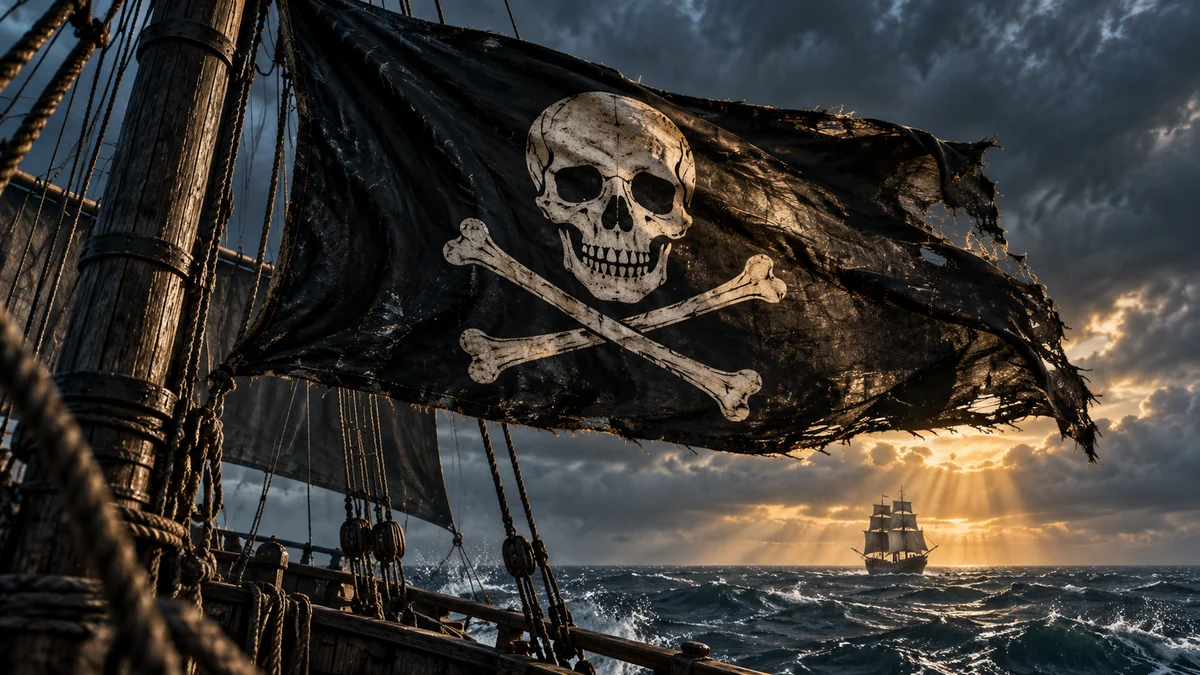
Symbolic editorial artwork of a pirate flag, not a reconstruction of any particular historical pirate’s flag.
A white skull stands out against black cloth billowing in the wind. Beneath it, two bones are crossed. Almost everyone recognises the scene, even without having read a word of maritime history: a single glance is enough to make us think of pirates. Yet a person looking towards the horizon from a ship's deck three centuries ago was not seeing a cinematic emblem of adventure. In a flag appearing above an approaching vessel, they might have seen a threat to their freedom, property and life.
How did a sign of fear become an almost playful symbol of freedom? The answer lies neither with one inventor nor with a single legendary flag. The story takes us through maritime signals, different images of death, uncertain testimony, books that interwove fact and storytelling, and a long journey from sailing ships to museums and popular culture. [1, 2]
The Flag We Still Recognise Today
The familiar white skull and crossbones on a black background has become the most recognisable emblem of piracy. But its present-day familiarity does not mean that every pirate crew sailed under the same design. Historical surveys by maritime museums document a range of flags: black or red, featuring skulls, entire skeletons, hourglasses, weapons and other warning symbols. Others were entirely plain. [1, 2]
The uniformity we see in modern illustrations is partly the result of a later cultural selection. From a wide range of emblems, one easily recognisable image survived, well suited to books, theatre, cinema and children's games. This does not mean skulls and bones were absent from the age of sail. It means we must distinguish historical use from what has become an near-universal emblem of piracy. [1]
That distinction helps explain how a historical object can acquire ever-new meanings. In the past it operated within a dangerous encounter at sea; today we often recognise it before learning anything about the ship, its crew or the period in on which it was said to have flown.
At Sea, a Flag Was More Than Decoration
Ships needed to identify one another at a distance, often long before anyone could speak. A flag might suggest nationality, authority, a demand or an intention. For a merchant vessel under threat, it particularly mattered whether an approaching ship presented itself as a legally authorised adversary or as an armed group intent on plunder. [1]
A pirate flag was above all a means of communication under pressure. It told the targeted crew that their adversary expected surrender. For the targeted crew, surrender might be less dangerous than resistance. For the raiders, taking a ship without a fight meant seizing the vessel and its cargo while avoiding further losses. There was a practical, not merely symbolic, reason for cultivating fear. [1]
For merchant sailors, however, such a decision was not a free choice in the ordinary sense. The threat of violence shaped their options, and there was no guarantee that any promise of mercy would be honoured. Pirate emblems should therefore not be romanticised as clever advertising: their effectiveness rested on a genuine danger to the people who encountered them at sea.
State navies and privateers authorised during wartime to attack enemy shipping also used flags. Yet lawful authorisation, military status and piratical robbery are not the same category. In practice, the boundaries could be disputed and could change over time, but we should not compress every armed seafarer into a single image of a pirate. [1]
Black, Red and the Colours of Deception
In accounts of pirate practice, a black flag is often associated with an opportunity to surrender before decisive violence began. A red flag could express an escalation of the threat and the message that no quarter would be given. Modern museum surveys describe such meanings, but they must not be turned into a universal maritime rulebook: different crews and circumstances did not necessarily use the colours in exactly the same way. [1, 2]
False colours also mattered. A ship might approach under a flag suggesting friendly or neutral affiliation and reveal its true intentions only when close. Distance was critical: people aboard a merchant ship had much less opportunity to escape or prepare if they discovered the truth only at the last moment. [1]
The flag was therefore part of a sequence of actions: spotting a vessel on the horizon, assessing the approaching ship, raising or changing an emblem, and deciding whether to surrender or resist. The black cloth possessed no magical power. It worked because people understood what might follow it.
That is what sets it apart from today's decorative symbol. Once, the same motif helped create an imbalance of power between attackers and their targets; now it frequently appears detached from the danger that gave it meaning in the first place.
Skull, Bones and Hourglass: The Language of Mortality
Why did pirate crews turn to images of death? Part of the answer lies in an established visual language of their time. Skulls, skeletons and hourglasses were not strange inventions of individual ships. In Christian and wider European culture, people knew them as reminders of mortality, passing time and the inevitability of death. On a pirate flag, those motifs became a direct warning to the living. [2]
An hourglass could suggest that time to decide was running out. A skull or skeleton evoked death. A weapon or a heart could make the threat even more explicit. But there is no reliable dictionary that translates each symbol on every pirate flag into precisely the same sentence. Any individual motif must be understood alongside the testimony, period and crew to which it is attributed. [1, 2]
For historical reconstructions, it matters especially how we know what a flag looked like. Very few original pirate flags from the so-called Golden Age have survived. Most descriptions come from testimony, newspapers and narrative books. When we see a neatly rendered image of a particular flag today, we are often looking at a modern visualisation of an old description, not a photograph or a directly preserved artefact. [1]
That limits certainty about every detail, but it does not diminish the value of historical sources. The difference between 'someone described this' and 'this very object has survived' is fundamental to reading material history responsibly.
Emanuel Wynne and the Question of the Earliest Record
Emanuel Wynne, also spelt Wynn, is frequently cited in connection with one of the earliest documented examples of a black pirate flag featuring a skull and crossbones, in 1700. Captain John Cranby, commanding the British ship HMS Poole, reported a flag bearing a death's head, crossed bones and an hourglass. A scholarly publication from 1927 summarises his testimony and provides an Admiralty archive reference; The original Admiralty document has not been examined directly for this article. [1, 7]
Yet the word 'first' is more demanding here than it initially appears. An early mention means we have a trace that historians can identify and date. It does not mean nobody had used a similar emblem before. We need to distinguish Cranby's historical testimony, a later scholarly quotation of that testimony and a direct examination of the archival original. The last of these would allow further verification of its full context.
Wynne's case is therefore not proof of an invention subsequently copied by every crew. Its value is primarily documentary: it helps place the motif in a historical period before the nineteenth century. That challenges the mistaken notion that the skull and crossbones was exclusively a later, Victorian invention. [1]
An emblem need not have an identifiable inventor for its history to be fascinating. Its spread shows how crews drew on images that were already intelligible and adapted them to the violent circumstances of maritime trade.
Jolly Roger: A Name of Uncertain Origin
The name Jolly Roger raises more questions than it settles. Today we often apply it to a black flag with a white skull and crossbones, but in older accounts the name is also associated with other designs. In the early 1720s it was used for different emblems attributed, among others, to the crews of Bartholomew Roberts and Francis Spriggs. We should therefore not equate the name with one standard illustration. [1, 3]
One influential source for these accounts is A General History of the Pyrates, published in 1724 under the name Captain Charles Johnson. It collects stories of several pirate captains and their crews. The book is exceptionally important to history, but it also needs to be read as a narrative of its time: dramatic details cannot be treated as independently verified facts without comparison with other sources. The author's identity remains a matter of bibliographical debate; attribution to Daniel Defoe has not been conclusively established. [3]
Popular explanations include a connection with the French joli rouge ('pretty red') and a link to Old Roger, an expression for the devil. But the popularity of these explanations is not evidence of their origin: the etymology remains uncertain, and the early expression Jolly Roger itself does not prove either proposed route. [1, 3]
The history of the name neatly illustrates how a meaning can become firmly established while its etymology stays open. We need not settle every linguistic uncertainty to understand how the flag became a symbol.
Blackbeard and the Flag Created by Later Memory
In modern images, Edward Teach, better known as Blackbeard, is often associated with a black flag depicting a horned skeleton holding an hourglass in one hand and piercing a bleeding heart with the other. The design is powerful, memorable and almost perfectly suited to a modern story of a notorious pirate. The problem is that its popularity is not the same as a documented connection to Blackbeard. [2, 4]
The research team of the Queen Anne's Revenge project notes that no contemporary connection is known between that particular design and his activities. Historian E. T. Fox has shown that a precursor of the design appeared in a maritime publication in 1912, while its attribution to Blackbeard came later. [4]
That does not mean Blackbeard never used black flags. On the contrary, in 1718 the Boston News-Letter described an attack on the merchant vessel Protestant Caesar in which black flags bearing death's heads and other 'bloody', or red, flags were mentioned. This account is cited in the Queen Anne's Revenge project publication, which identifies issue 739 of the newspaper; the original newspaper page has not been examined directly for this article. Between such an account and the precise modern illustration of a horned figure piercing a heart lies a considerable evidentiary leap. [2, 4]
This case is especially instructive because an error can be repeated even in respected popular accounts. Once an image becomes attached to a famous name, books, websites and flag manufacturers begin reproducing it. Repetition gradually creates an impression of historical certainty, even though the original connection has not been demonstrated.
Blackbeard's fame is no proof of every object attributed to him. His actual life is worth studying without the additional symbols attached to him by later memory.
From Eyewitness Accounts to Books and the Pirate of Cinema
In the early decades of the eighteenth century, stories about pirates were already spreading through newspapers, official records and books. A General History of the Pyrates (1724) was particularly influential because it named, described and wove together the stories of many figures who would recur in historical and imaginative writing. [3]
In the nineteenth century, accounts of piracy acquired new forms. Robert Louis Stevenson's Treasure Island, first published as a book in 1883, significantly influenced later ideas of pirate adventures, treasure and a mysterious world at sea. The Library of Congress holds and digitally presents an 1883 edition. Stevenson did not, however, invent the historical skull-and-crossbones motif; he drew upon an already existing cultural tradition of piracy. [5]

Subsequent theatrical, illustrative and cinematic adaptations increasingly shaped the many historical images into a widely recognisable pirate character. When we now encounter the flag on a toy, a costume or a movie sail, it often carries more centuries of storytelling than the history of any one documented crew.
That cultural journey is not merely a story of distortion. It gave the flag meanings that people in the eighteenth century could hardly have foreseen. A historical essay, however, should enable readers to distinguish creative tradition from accounts of real robbery, captivity and violence at sea.
The Symbol That Outlived the Pirates
Perhaps the most intriguing evidence of the Jolly Roger's long afterlife has nothing to do with cinematic pirates. In 1914, British submarine commander Max Horton flew a pirate flag after a successful action aboard HMS E9. Modern historical accounts interpret the gesture as an ironic response to earlier comparisons of submarine warfare with piracy. In the submarine tradition, the Jolly Roger became a different kind of symbol: a sign of returning from a mission and of crew pride, later often embellished with insignia recording particular operations. [6]
Here the original meaning is almost reversed. A flag that once threatened the targets of attacks becomes an emblem of a group's own identity. What changes is not only who uses it, but also who is meant to read it. A submarine crew does not fly it to frighten a merchant ship into striking its colours. It is understood within an entirely different naval tradition. [6]
The same motif can therefore survive its original setting without retaining the same meaning. It can speak of threat, defiance, playfulness or belonging, depending on who uses it, whom it addresses and the circumstances in which it appears.
When we look at a white skull on black cloth today, we see a simple emblem. Behind it, however, is a history of surprisingly complicated choices: how to intimidate without fighting, how to identify an adversary at sea, how to document an image that may survive only in testimony, and how later generations transform a threat into a legend. The black pirate flag did not survive because it was historically always the same. It survived precisely because people kept giving it new meanings.
Sources and further reading
- [1] Royal Museums Greenwich / National Maritime Museum, 'Pirate flags decoded', museum overview: source Source
- [2] Queen Anne's Revenge Project, Jeremy Borrelli, 'Did You Know Blackbeard's Flag is a Modern Design?', 6 October 2017: source Source
- [3] Captain Charles Johnson (published under this name; real identity uncertain), A General History of the Pyrates (1724), digitised early text and bibliographical record: source ; original scan: source Source 1 Source 2
- [4] Boston News-Letter, no. 739, 16 June 1718, an account mentioning black flags and death's heads, quoted and discussed in source [2]. The original newspaper page was not directly examined in this review. Source
- [5] Robert Louis Stevenson, Treasure Island (1883), bibliographical record and digital copy of the first edition, Library of Congress: source Source
- [6] Portsmouth Historic Dockyard, 'Earliest known example of a Royal Navy submarine Jolly Roger to join new display at Submarine Museum', 19 June 2025: source Source
- [7] The Indian Antiquary (March 1927), historical survey of piracy, paragraph 553, summarising Cranby's account and citing 'Admiralty Records, 1589 No. 25'. An intermediate historical source, not a direct examination of the Admiralty original: source Source