The Black Cube, Saturn’s Hexagon and Symbolic Connections: What Is Documented?
What is actually documented in the links among Saturn, the hexagon, the cube, sevenfold symbolism, the Sabbath, the Kaaba, tefillin and the hexagram — and where does historical evidence become esoteric interpretation or an open hypothesis?
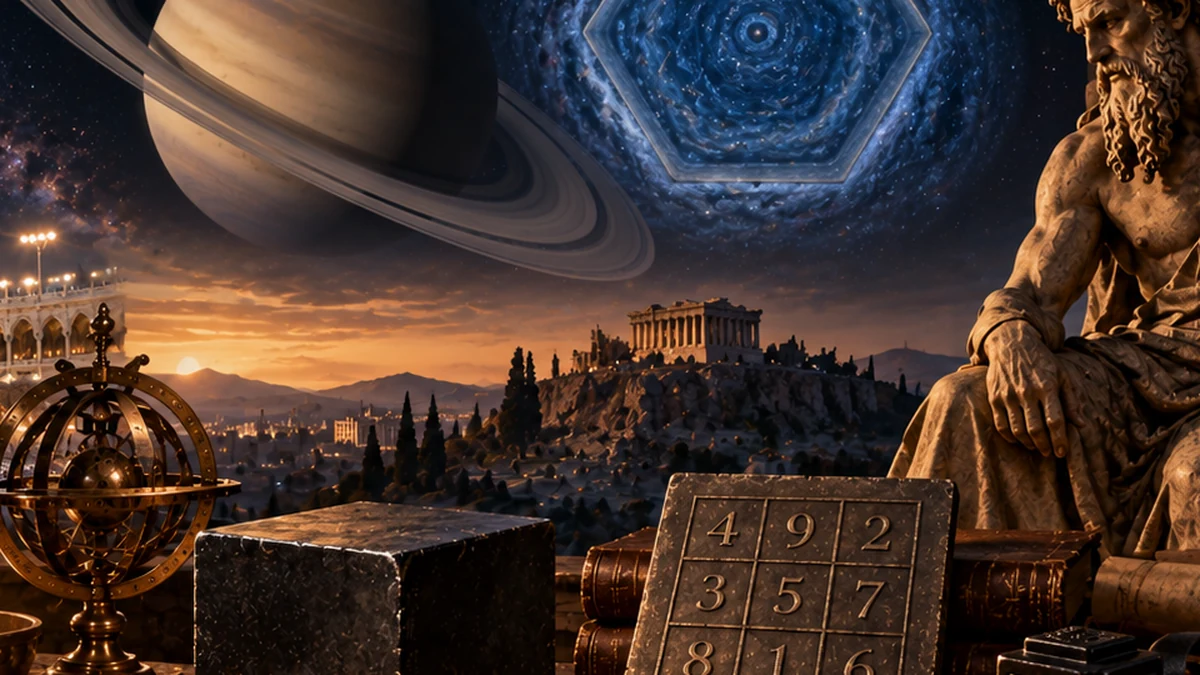
The black cube, Saturn’s north-polar hexagon, the six-pointed star, the Sabbath, the Kaaba, tefillin and modern cubic sculptures are often placed on the same symbolic map. Some links are directly documented, others are geometric, some come from named esoteric writers, and others remain open hypotheses.
The strongest part of the chain is surprisingly concrete: Saturn’s polar hexagon is a real atmospheric phenomenon; a cube has a verifiable geometric relationship to a regular hexagon; and Agrippa explicitly assigns Saturn a 3×3 magic square, lead and dark correspondences.
The harder cases are Kaaba–Saturn, tefillin–Saturn and the broad equation “black cube = Saturn.” No direct transmission chain was found for these. Yet the ancient Sabbath–Saturn association in Tacitus and Cassius Dio, together with Hall’s pre-internet cube–star–seven–Sabbath network, means the similarities cannot fairly be dismissed as a purely modern invention.
The article therefore uses four levels: documented fact, ancient or external association, esoteric interpretation and open hypothesis. The aim is not to manufacture certainty, but to show where the evidence chain is strong and where further provenance research is still required.
How to read symbolic connections: Saturn’s hexagon as a documented phenomenon
The black cube, Saturn’s north-polar hexagon, the six-pointed star, the Sabbath, the Kaaba, tefillin and modern cubic sculptures are often placed on the same symbolic map. Some links on that map are documented, some are geometric, some are esoteric interpretations, and others are open hypotheses. This article therefore does not ask whether “everything is coincidence” or “everything is a cult.” It asks a more precise question: which link in the chain can be shown with a source, and where do we move from document to inference?
A long-lived six-sided atmospheric structure exists around Saturn’s north pole. Voyager observed it in 1980–1981, and Cassini later photographed it in detail in visible and infrared light. NASA describes it as a roughly 30,000-kilometre-wide wavy polar jet stream encircling the north pole.
Laboratory experiments with rotating fluids can generate polygonal jets, including hexagonal ones. The geometry therefore does not require an artificial or occult cause. At the same time, NASA continues to note that every detail of the feature’s extreme longevity and north–south asymmetry is not fully resolved. “Natural” does not mean “explained in every detail.”
Cube, hexagon and the documented geometry of Saturn
When a regular cube is viewed along a body diagonal, its orthographic outline is a regular hexagon. A particular central cross-section of a cube is also a regular hexagon. This is straightforward geometry and can be verified independently of any esoteric tradition.
A regular hexagon is a six-sided polygon. A hexagram is made from two overlapping triangles. A cube can generate a hexagonal outline and an edge network in projection, but the statement “a six-pointed star is simply a two-dimensional cube” is imprecise. Symbolic systems can connect these shapes, but geometrically they are not the same figure.
Renaissance ceremonial magic gives us directly documented Saturnian geometry. Agrippa assigns Saturn a 3×3 magic square of nine numbers; each row, column and diagonal totals 15, while the whole totals 45. The talisman was to be engraved on lead. This is a much firmer historical connection than the modern formula “Saturn = black cube.”
Blackness, lead and the esoteric network of cube, star and seven
Agrippa’s correspondence magic assigns Saturn lead, dark and heavy substances, black bile, melancholy qualities, solitude, old age and gloomy places. Later astrologers continue the association of Saturn with black. Modern black Saturnian symbolism was therefore not created from nothing; what is newer is the specific synthesis “black + cube + Saturn.”
In 1928 Manly P. Hall published a diagram titled “The Cube and the Star.” He derived a cube and six-pointed star from the same tetractys, used seven points in the construction, and identified the central point with the Sabbath or seventh day. This is important pre-internet evidence that a cube–star–seven–Sabbath network already existed in Western esoteric interpretation before modern online theories.
In the Hall material reviewed for this audit, we did not find a direct formula declaring the black cube to be the universal symbol of Saturn or stating that tefillin and the Kaaba mean Saturn. Hall is evidence for a wider symbolic network, not proof of every later equation. That distinction matters.

Sabbath, Saturn and tefillin: from ancient association to open hypothesis
Tacitus reports in the first century that some Roman interpreters associated the Jewish seventh day with Saturn. Cassius Dio repeatedly calls the Jewish day of rest a “day of Saturn” in Greco-Roman terminology. These writers were not neutral insiders to Judaism, and their statements do not prove that the Sabbath originated as Saturn worship. They do prove that Sabbath–Saturn is not merely a modern internet invention.
A symbol audit must distinguish a neighbouring culture’s planetary interpretation of a rite from the way practitioners themselves explain it. The Roman naming of Saturday as Saturn’s day is documented. A Jewish source explicitly declaring the Sabbath to be worship of Saturn has not been found. The status is therefore ANCIENT/EXTERNAL ASSOCIATION, not DOCUMENTED INTERNAL IDENTITY.
Tefillin are small leather boxes containing biblical passages and worn on the head and arm. Archaeological examples reach back to the Second Temple period, and their squared form belongs to Jewish ritual tradition. In the museum and historical sources reviewed here, there is no direct explanation identifying them with Saturn. Their black colour, squared/cubic appearance and Sabbath-related context create convergence, not proof of transmission.
The Kaaba, seven circuits and the hexagram: comparison without premature certainty
The Kaaba is an ancient sanctuary in Mecca and today the centre of Islamic pilgrimage. During tawaf, pilgrims circle it seven times, and the building is covered by the black kiswa. These features are real and therefore legitimate material for comparative symbolic analysis. No verified historical source found in this audit directly identifies the Kaaba as a Saturn shrine. The article therefore preserves OPEN HYPOTHESIS / NO DIRECT TRANSMISSION SOURCE FOUND.
Seven is a powerful religious and cosmological number in many traditions. Hall connected ritual circumambulation and seven planetary principles within his own esoteric framework. But the presence of seven does not by itself show which historical route produced a particular rite. Direct transmission, a shared older numerology and independent convergence remain different possibilities.
The six-pointed star historically appeared in Jewish, Christian and Islamic contexts and also as a decorative or magical sign. Its role as a distinctive communal symbol of Judaism became firmly established much later, especially in the early modern period. The appearance of a hexagram on an older object therefore does not by itself prove either a Jewish or a Saturnian meaning.
Saturnian sign or recurring form? The hexagram and modern black cubes
Older and modern interpretations exist that connect the hexagram with planetary or Saturnian systems. Standard historical treatments of the Magen David, however, describe direct claims that the hexagram was originally a Saturn sign as speculative. The article therefore treats such identifications as ESOTERIC INTERPRETATION or OPEN HYPOTHESIS unless a source exists for the specific object.
Large dark or black cubic sculptures do exist in modern cities. Tony Rosenthal’s Astor Place “Alamo” is a documented example: a black-painted steel cube that rotates on an axis. The artist’s own discussion emphasizes abstraction, human scale and public participation. Without an artist statement, commission archive, plan or other source, it is methodologically unsound to label every black cube a Saturnian cult sign.
Lack of evidence for intent does not make visual similarity irrelevant. A symbol audit can record recurring geometry, colour, placement and ritual use. But moving from “the same visual motif” to “the same cultic meaning” requires an additional evidentiary step. Internet collages often hide precisely that step.
When convergence becomes a serious clue — and what the discovery of the hexagon changes
A hypothesis becomes stronger when several independent markers converge on the same object or tradition: the name Saturn, black colour, lead, the number seven, a 3×3 square, explicit planetary language, ritual instructions or an historical statement by the designer. A single cubic shape is a weak signal; several matching markers with documented provenance are a much stronger argument.
Human beings only learned of the polar hexagon from Voyager imagery. Ancient, medieval and Renaissance symbols therefore cannot be direct copies of the photographed Saturnian hexagon unless an additional hypothesis of lost observation or revelation is introduced. No documentary evidence for such a mechanism has been found here.
Once the hexagon was discovered, it could be added to an already existing network of Saturn–blackness–lead–seven–geometry. This helps explain how the modern “Black Cube of Saturn” synthesis could emerge: older correspondences and older geometric ideas were combined with a new astronomical datum. That modern synthesis is genuine cultural history even if it is not proof of an ancient unified doctrine.
An open hypothesis with safeguards: documenting the pattern without manufacturing certainty
In secret, initiatory or inner systems, the absence of a public declaration is not enough to negate a connection. The article therefore does not use the formula “no direct source, therefore no connection.” It uses the more precise status: not directly confirmed. Where multiple convergent features exist, the hypothesis remains open, but readers must be able to see which elements are documented and which are inferred.
The opposite safeguard matters just as much. If every denial, missing source or alternative explanation is treated as evidence of concealment, a hypothesis becomes unfalsifiable and loses research value. A good open hypothesis states what would strengthen it: an earlier text, a commissioning archive, a ritual manual, an explicit planetary attribution, a chain of transmission or several independent contemporary sources.
The article finds four different things. Saturn’s hexagon is a documented physical phenomenon. Cube–hexagon is a documented geometric relationship. Saturn’s blackness, lead, melancholy and 3×3 square are documented historical correspondences. Linking the Kaaba, tefillin, the hexagram and modern black cubes into one Saturnian cult remains an open hypothesis without a direct transmission chain. That is not a reason for ridicule or certainty; it is a reason to keep auditing the provenance of each individual symbol.
Sources and further reading
- NASA Science — Saturn’s Hexagon in Motion
- NASA Science — Spring Reveals Saturn’s Hexagon Jet Stream
- NASA — Cassini obtains best views of Saturn hexagon
- NASA Science — Spring at the North Pole
- Wolfram MathWorld — Cube
- Wolfram MathWorld — Regular Hexagon
- Agrippa, Three Books of Occult Philosophy, Book II — Saturn magic square
- Agrippa — things ruled by Saturn (transcription)
- Manly P. Hall, The Secret Teachings of All Ages — index
- Manly P. Hall — Pythagorean Mathematics / cube symbolism
- Manly P. Hall — Qabbalah / seven planets and seven days
- Tacitus, Histories V.4 — Perseus
- Cassius Dio, Roman History 37.16
- Marks of Distinctions — chapter 'Planetary Influences; or, the Jews and Saturn'
- Metropolitan Museum of Art — Phylactery (tefillin)
- Smarthistory — The Kaaba
- Smarthistory — Hajj
- Jewish Virtual Library / Encyclopaedia Judaica — Magen David
- My Jewish Learning — What is the Star of David?
- Tony Rosenthal Estate — Alamo, 1967
- Tony Rosenthal Estate — The Alamo
- NYC DOT — Astor Place Alamo restoration
- Smithsonian Art Inventories — Alamo
- Cambridge BJHS Themes — alchemical symbolism and rumūz