Yaksha Prashna: The Yaksha's Questions and Yudhishthira's Test of Dharma
Near the end of the forest exile, Yudhishthira finds his four brothers motionless beside a lake and accepts an unseen Yaksha's condition: questions first, water second. The episode is not merely a collection of wise sayings but a test of judgment, self-command, mortality and impartiality.
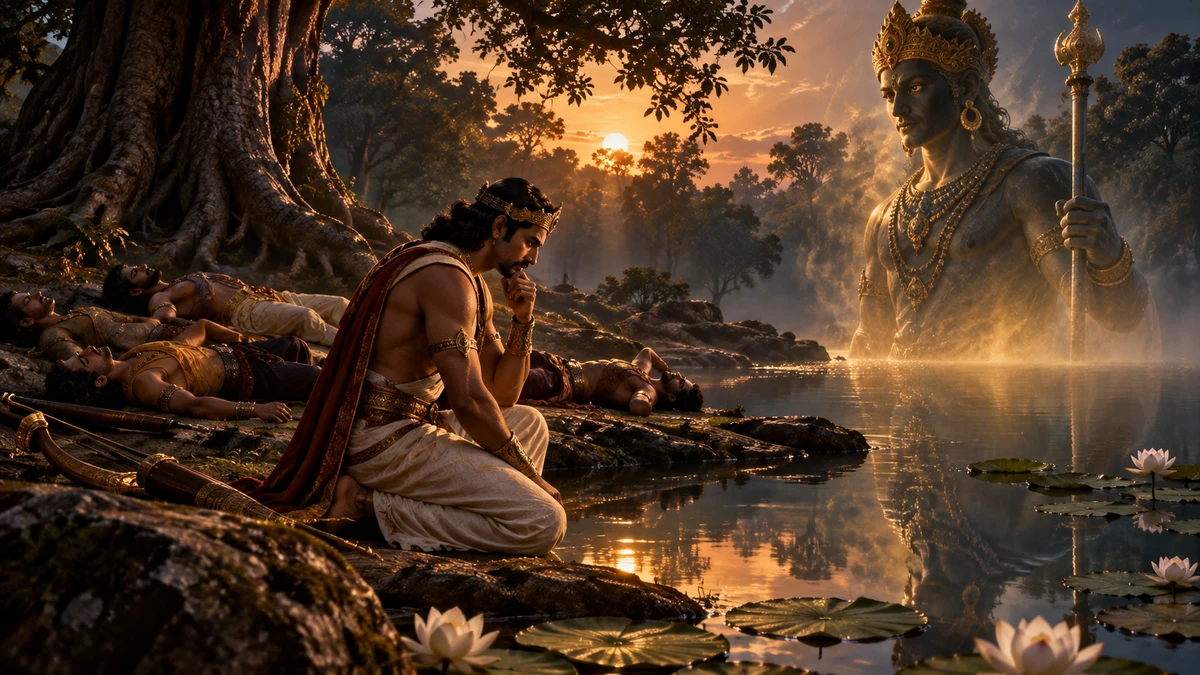
Near the end of the Pandavas' long forest exile, they do not face another great battle but a lake, thirst, and a voice they cannot safely ignore. Nakula, Sahadeva, Arjuna and Bhima each hear a warning to answer the unseen guardian's questions before drinking. Driven by thirst, they ignore it and fall motionless. When Yudhishthira arrives, he responds differently: he observes, reasons and listens first.
The episode known as Yaksha Prashna — 'the Yaksha's questions' — appears near the end of the Vana Parva, the Forest Book of the Mahābhārata. In Ganguli's translation it occupies chiefly Sections CCCX–CCCXII. The questions range across Vedic learning, family obligations, kingship, self-control, happiness, death, character and dharma. Some answers belong unmistakably to an ancient ritual world; others remain strikingly direct.
Yet the story's force does not lie simply in Yudhishthira knowing correct answers. The decisive test comes after the questioning, when he may choose one brother to be restored. Rather than Bhima, his military strength, or Arjuna, the indispensable archer, he chooses Nakula. The choice shows whether he will bear the cost of the principle he has just defended.
This article therefore does not read the Yaksha Prashna as a handbook of timeless slogans. It reads it as a dramaturgy of moral testing: what does a person do when thirsty, frightened, pressed for time, and when the principled choice is not identical with the most useful one?
The lake at the end of exile: the test begins with restraint
The scene begins almost like an investigation. The brothers go for water and fail to return. When Yudhishthira finds their bodies, he notices that they are unwounded and that their colour has not changed, so he does not accept the first available explanation. He considers poisoning, an enemy plot and a supernatural cause before approaching the water.
This is the first difference between him and his brothers. Arjuna tries to defeat the unseen opponent by force, while Bhima and the twins simply disregard the condition because of thirst. Yudhishthira stops. The first answer to the test is not knowledge but the ability to interrupt an impulse.
The scene's first lesson: intelligence appears before the answer — in waiting long enough to discover what kind of situation one is actually in.
Within the narrative, the lake belongs to the Yaksha and he imposes a condition: answer first, water afterwards. Yudhishthira does not try to prove that he is stronger than the rules of the place. He accepts dialogue. A contest of physical power becomes a test of judgment.
Not a quiz on one subject: from ritual to ethics, cosmology to daily life
The range of questions is striking. Some test Vedic ritual knowledge and older cosmological ideas; others ask about friendship, happiness, debt, anger, greed, knowledge, mercy, truth, giving and duty. Modern lists of 'best quotations' can therefore alter the character of the passage if they remove its ritual and social layers.
| Question theme | Yudhishthira's answer, summarized | What it tests |
|---|---|---|
| Best gain | health | what counts as gain |
| Greatest happiness | contentment | the boundary between having more and needing less |
| Highest duty | non-injury / refraining from harm | ethical limits on power |
| What to abandon to avoid regret | anger | self-regulation |
| What to abandon to become happy | greed | the relation to desire and possession |
| True bathing | cleansing the mind | a movement from rite to inner discipline |
| True charity | protecting living beings | relation to others |
| What constitutes human worth | conduct or behaviour | character before status alone |
The table necessarily simplifies Ganguli's translation. Exact terminology varies across Sanskrit editions and translations, so a single English formulation should not be made to bear too much modern doctrine. Yet the sequence clearly returns again and again to conduct, control of desire, and relation to others rather than knowledge alone.
This fits the wider Mahābhārata, which rarely reduces dharma to one abstract rule. Moral dilemmas arise precisely because obligations to family, role, truth, kingship, non-injury and consequences can collide.
Birth, learning or conduct? The danger of modernizing an ancient answer
One of the most quoted exchanges asks what makes a person a brāhmaṇa. In Ganguli's translation, Yudhishthira rejects birth, study and learning as sufficient criteria and stresses conduct. The ethical emphasis is powerful: status without character is not enough.
But it would be anachronistic to turn one answer into a modern manifesto erasing every hierarchy of ancient Indian society. The same episode also contains answers that presuppose Brahmanical rites, sacrifice, śrāddha and Vedic authority. The text is more complex than present-day ideological labels.
Safe interpretation: the passage clearly places right conduct above mere declaration of status; by itself it does not prove that the whole Mahābhārata rejects historical varṇa structures or all their social consequences.
This is why textual criticism matters. BORI's Critical Edition was constructed through comparison of 1,259 manuscripts and includes an apparatus of variants. A popular translation is valuable for reading, but it is not a substitute for critical textual work when a single formulation is made to carry a historical doctrine.
The greatest wonder: we see death everywhere and still live as if exempt
The most famous question asks, in essence: what is the greatest wonder? Yudhishthira answers that beings die every day, yet those who remain behave as if they themselves might escape mortality. The force of the answer lies not in denying death but in exposing the gap between knowledge and the way we live.
This need not be a call to morbid reflection. It can be read as a diagnosis: we know abstractly that time is limited, yet often plan as if the future were unlimited. Death functions less as an answer to 'what comes after?' than as a measure for asking what deserves our time now.
The answer also sits beside another one: contentment is named a supreme form of happiness. Together they create a tension quite unlike simple life-denial — a reduction of blindness to finitude and to insatiability.
A modern rendering of the problem: remembering mortality is not predicting death; it is a constraint that makes priorities real.
What is the path when authorities disagree?
Another famous answer is harder. The Yaksha asks for the path. Yudhishthira says that argument alone yields no certainty, revealed texts differ, and sages disagree; the truth of dharma is therefore hidden or difficult to reach. Ganguli's translation concludes that the path is the one trodden by the great or the good.
This is not a simple recipe to 'obey authority'. The answer begins precisely with disagreement among authorities. The difficulty of dharma is that one cannot always postpone action until perfect proof arrives. One must act amid incomplete rules, examples and consequences.
It is therefore misleading to isolate the final clause and turn it into blind traditionalism. Yudhishthira himself does not merely imitate prior conduct. He studies circumstances, listens, compares duties and then accepts responsibility for a choice.
In modern terms, when there is no algorithm that can calculate the moral answer for us, we may need a combination of principles, exemplars, contextual judgment and willingness to bear consequences. That is an interpretation of the scene, not a literal ancient definition of dharma.
Why Nakula? The moment an answer becomes an action
After the questions, the Yaksha allows Yudhishthira to choose one brother to return to life. Strategically, Bhima or Arjuna would be the safest choice. Bhima is immense physical force; Arjuna is indispensable for the conflict ahead. Yudhishthira chooses Nakula, son of Pandu's other wife Madri.
His explanation is symmetrical: Kunti still has him, her son; therefore Madri should also retain one son. He does not claim Nakula is more useful. On the contrary, he chooses parity between the two mothers even though it is strategically more costly.
Here the episode distinguishes a moral slogan from a moral price. Earlier Yudhishthira spoke of non-injury, fairness and conduct. Now the principle is set against self-interest. The Yaksha responds to this choice by restoring all the brothers.
The test is not: 'Can you say what is just?' It is: 'Will you use the same standard when it costs you?'
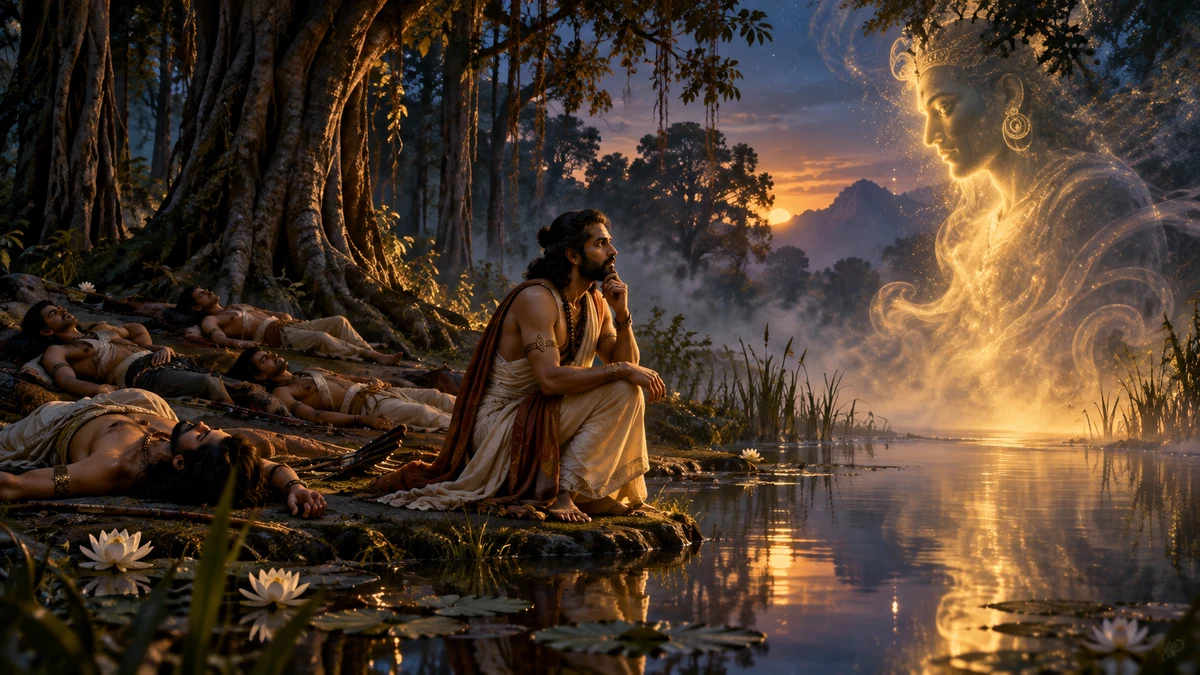
The Yaksha is Dharma: the father is testing more than his son's knowledge
In the next section the guardian reveals himself as Dharma, Yudhishthira's divine father. He says that he came to test his son's virtues. The preceding questions change in retrospect: this was not a neutral philosophical interview but a paternal and cosmic test of the man most closely linked with dharma in the epic.
Dharma names virtues including truth, self-restraint, purity, steadiness, charity, non-injury, impartiality and freedom from malice. He then grants boons, including the ability of the Pandavas to pass their coming year of concealed life without being recognized.
The episode therefore stands at a major transition. Twelve forest years are ending; the thirteenth year in disguise lies immediately ahead, followed by the conflict the reader already anticipates. The Yaksha Prashna functions like a final examination of the forest period: the stronger brothers fail through impulse, while Yudhishthira passes through restraint and judgment.
Hiltebeitel has read the wider Mahābhārata as a long 'education of the Dharma King'. In that frame, the Yaksha Prashna is not an isolated wisdom anthology but one of the scenes in which Yudhishthira becomes what his name and genealogy demand of him.
What the Yaksha Prashna can mean today — without pretending we live in the same world
The passage is not a modern ethical theory. Some answers belong to a ritual, familial and social world that cannot simply be mapped onto the twenty-first century. Accepting them merely because they are ancient would miss the very test of judgment dramatized by the story.
Its more durable value may lie in method. Interrupt impulse. First determine what is happening. Listen to the question. Distinguish status from conduct. Do not confuse desire with need. Remember that time is limited. And when you defend a principle, test whether you apply it against your own interest.
The Mahābhārata is full of situations in which moral rules become entangled. Matilal therefore wrote of its moral dilemmas, while Hiltebeitel emphasized Yudhishthira's education. The Yaksha Prashna does not erase that complexity. It compresses it into a scene by water where a person is allowed to show what he is before receiving what he needs.
The final question of the story is not how many answers you know. It is whether your answer changes when it becomes expensive.
Sources and further reading
- Mahābhārata, Book 3: Vana Parva, Section CCCX, trans. Kisari Mohan Ganguli: the brothers' search for water, the warning at the lake and Yudhishthira's arrival.
- Mahābhārata, Book 3: Vana Parva, Section CCCXI, trans. Kisari Mohan Ganguli: the Yaksha's questions, Yudhishthira's answers and the choice of Nakula.
- Mahābhārata, Book 3: Vana Parva, Section CCCXII, trans. Kisari Mohan Ganguli: revelation of the Yaksha as Dharma and the granting of boons.
- Internet Sacred Text Archive, Mahābhārata Book 3: Vana Parva index and Ganguli translation metadata.
- Bhandarkar Oriental Research Institute, The Mahabharata: history and methodology of the Critical Edition, based on 1,259 manuscripts and completed in 1966.
- Bhandarkar Oriental Research Institute, publication record for the Critical Edition of the Mahābhārata.
- M. A. Mehendale (2007), “The Critical Edition of the Mahābhārata: Its Achievement and Limitations,” Annals of the Bhandarkar Oriental Research Institute 88: 1–16.
- J. A. B. van Buitenen (trans.), The Mahābhārata, Volume 2: Book 2 and Book 3, University of Chicago Press: translation based on the Poona Critical Edition.
- Bimal Krishna Matilal (ed.) (1989), Moral Dilemmas in the Mahābhārata, Indian Institute of Advanced Study: ethics, conflicting obligations and the epic's moral predicaments.
- J. L. Brockington (1992), review of Bimal Krishna Matilal, Moral Dilemmas in the Mahābhārata, Bulletin of the School of Oriental and African Studies 55(1): 147–148.
- Alf Hiltebeitel (2001), Rethinking the Mahābhārata: A Reader's Guide to the Education of the Dharma King, University of Chicago Press.
- Alf Hiltebeitel (2011), “Two Dharma Biographies? Rāma and Yudhiṣṭhira,” in Dharma: Its Early History in Law, Religion, and Narrative, Oxford University Press.
- J. Gonda (1971), “The Vedic Mitra and the Epic Dharma,” Journal of the Royal Asiatic Society 103(2): 120–133: Dharma as a divine figure and Yudhishthira's father in epic tradition.
- Satya P. Agarwal (2002), Selections from the Mahābhārata: Re-affirming Gītā's Call for the Good of All: includes a dedicated 'Dialogue between Yakṣa and Yudhiṣṭhira' section.
- Nicholas Sutton (2000), Religious Doctrines in the Mahābhārata, Motilal Banarsidass: broader doctrinal context for dharma, ethics and religious teaching in the epic.
- Vishwa Adluri & Joydeep Bagchee (2018), Philology and Criticism: A Guide to Mahābhārata Textual Criticism, Anthem Press: methodological context for reading the Critical Edition and manuscript variation.
- Bhandarkar Oriental Research Institute (1971), The Mahābhārata: Text as Constituted in Its Critical Edition, vol. 3: bibliographic record of the critical text.
- Dharma, Yoga, and Animals in the Mahābhārata (Springer, 2025), section on Yudhiṣṭhira's virtue ethics and the epic's presentation of dharma as complex and tested in narrative.