Weather-modification patents: what a patent proves and what it does not
Patents show that a technical idea was concretely described and legally claimed. By themselves they do not prove that a device was built, deployed, or effective at operational scale.

Weather-modification patents are often cited as supposed proof that a technology has already been built, deployed, or even secretly made operational. That conclusion moves too fast. A patent is an important technical and legal document, but it proves something narrower: that by a certain date someone publicly described and sought legal protection for a technical solution — and, if granted, that the claim passed the patent process under the rules of its time.
That does not make patents unimportant. Quite the opposite: they reveal technical concepts, inventors and organizations, timelines, prior art, and specific mechanisms. In weather modification, the patent record clearly shows that cloud seeding, ice-nuclei generation, and aerosol-dispersal methods were subjects of serious research and legal protection by the middle of the twentieth century. Some of these methods were also tested and used in practice — but we know that from additional evidence, not from the patent title alone.
The patent system also does not ordinarily require an applicant to deliver a working prototype to the patent office. The USPTO explicitly states that a working model is normally unnecessary if the description is sufficiently clear and complete; patent law can also treat the filing of an application as a constructive, rather than actual, reduction to practice. A major evidentiary gap therefore remains between 'a patent exists' and 'the system was physically built and worked at the claimed scale.'
This article therefore uses patents neither as proof of a secret program nor as a reason to ridicule an unusual technical idea. It treats them as one layer of evidence. For each patent the useful questions are: what exactly is claimed, who filed it, what mechanism is described, are there laboratory or field tests, and can we find budgets, contracts, procurement, operational records, measurements, or other independent evidence — and where does the chain of evidence actually stop?
A patent is not proof of deployment — but it is more than a rumor
A patent is a legal instrument. In the United States it primarily gives the owner a right to exclude others from making, using, or selling the claimed invention; it does not itself give the owner an affirmative right to practice it. The legal nature of a patent therefore already shows that the patent register is not a list of devices that were built, approved for use, or incorporated into government programs.
At the same time, a patent is far more substantial than an anonymous online claim. Patent documents normally identify the inventor, applicant or owner, dates, the technical problem, disclosure, claims, and prior art. A patent can therefore be strong evidence that a particular technical idea existed by a certain date and had been formulated concretely enough to enter the patent process.
The correct formulation is two-sided: a patent is evidence of a documented technical concept and legal claim; it is not automatic proof of a built system, large-scale deployment, or real-world success.
What a granted patent has to pass
A U.S. utility patent must satisfy several statutory requirements, including patent eligibility, novelty, non-obviousness, and utility. The USPTO describes utility as specific, substantial, and credible. The specification must also disclose the invention clearly enough for a person skilled in the field to understand how to make and use it.
But 'credible utility' is not the same thing as independent field validation of every claimed effect. A patent examiner does not conduct a multi-year meteorological campaign to prove performance in every atmospheric setting. The USPTO explicitly notes that a working model is ordinarily not required, though exceptional claims such as alleged perpetual-motion devices may trigger additional requirements.
Reduction to practice also needs careful reading. Patent law distinguishes actual reduction to practice from constructive reduction to practice, which can arise from filing a sufficiently enabling patent application. 'Patented' is therefore not synonymous with 'physically demonstrated.'
Early patents: where the archive meets real technology
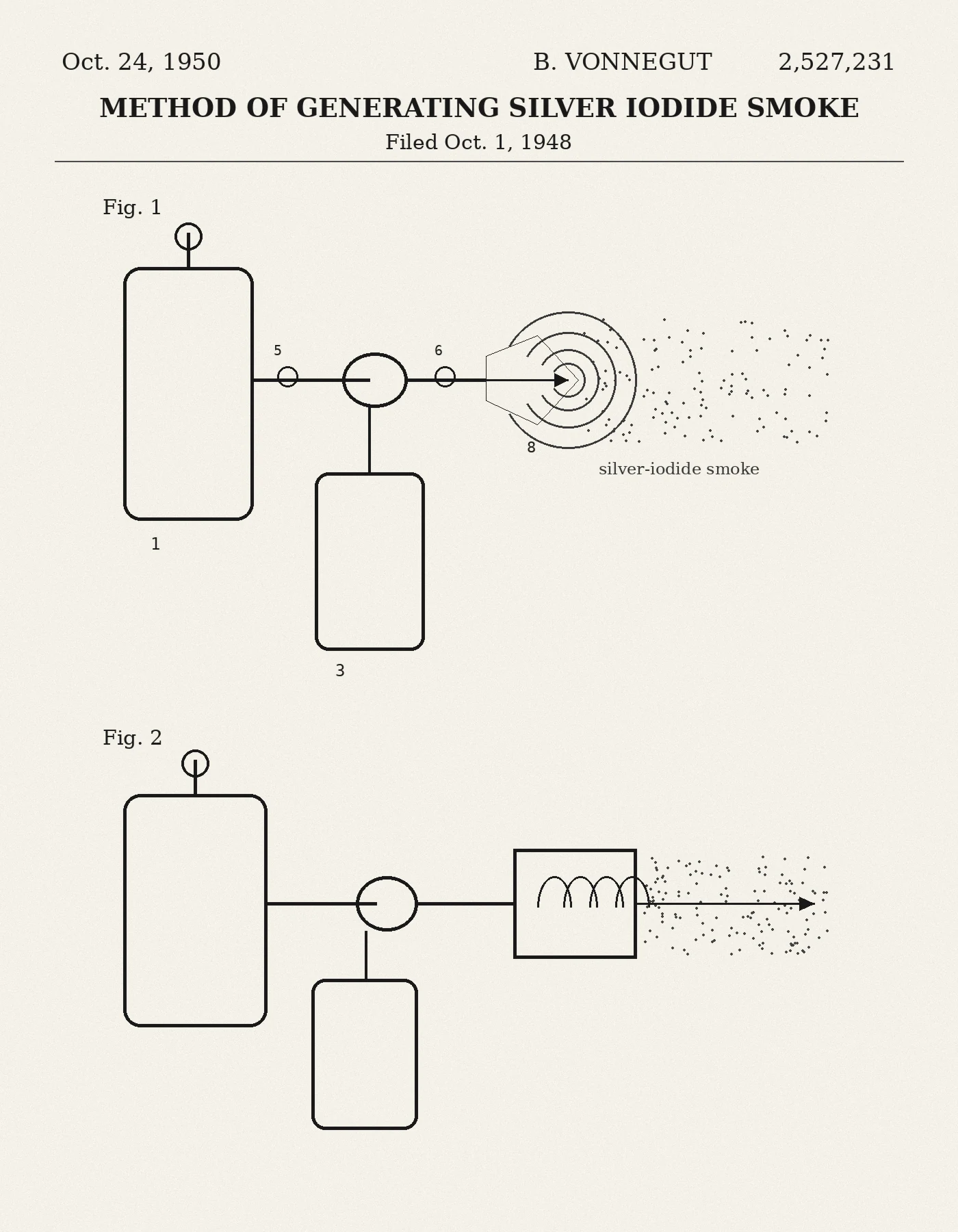
For classical cloud seeding, the patent record aligns closely with independently documented technological history. Vincent Schaefer and Bernard Vonnegut filed a method of crystal formation and precipitation in 1948 that was patented in 1950. Vonnegut's separate 1950 patent described generating very fine silver-iodide particles. These were not merely futuristic titles; they were central to the development of operational cloud-seeding techniques.
Later patents show technical evolution: cloud-seeding apparatus, aqueous silver-iodide aerosols, pyrotechnic generators, and alternative nucleating agents. US3613992, granted in 1971 and associated with the U.S. National Science Foundation, described urea and other soluble substances for producing rain or snow and referred to laboratory and field experiments.
This gives us a useful methodological example. The patent establishes the technical claim; test descriptions inside the document strengthen the evidentiary case; the broader history of cloud seeding, Operation Popeye, and present public programs independently shows that the underlying technology became operational.
Who owns the patent? A signal, not final proof
When a patent is assigned to a major corporation, military service, government agency, or research institution, that is relevant information. General Electric appears in early Schaefer and Vonnegut patents; the U.S. government and National Science Foundation appear in later weather-modification patents; the U.S. Navy appears in particle-generation technology for cloud seeding.
Institutional ownership still does not by itself prove operational deployment of that specific patent. Organizations patent research results for intellectual-property protection, future options, licensing, defensive portfolio strategy, or before they know whether a technology will succeed commercially. A single patent cannot legitimately jump from 'the organization had a legal interest' to 'the organization deployed this at scale.'
The chain becomes stronger when the patent connects to contracts, budgets, technical reports, equipment photographs, field trials, material procurement, testimony, operational orders, or measurements of results.
Eastlund, the ionosphere, and the leap to HAARP
US4686605, granted to Bernard Eastlund in 1987, describes a method and apparatus for altering a region of the Earth's atmosphere, ionosphere, or magnetosphere using electromagnetic radiation and cyclotron resonance. The title alone is dramatic enough that it is frequently cited as proof of much broader claims about weather control or as a direct technical blueprint for HAARP.
The patent certainly proves that Eastlund developed and patented such a concept. It does not, by itself, prove that the described system was built at full scale, achieved every stated effect, or was later implemented by a particular program. Each of those claims requires a separate evidentiary bridge.
That does not make the patent irrelevant. It simply places it correctly: it is a technical document showing what was conceived and legally claimed. To establish a link to a specific infrastructure or operation, further documents are needed.
Welsbach stratospheric seeding: proposal versus program
US5003186, issued in 1991, describes 'stratospheric Welsbach seeding for reduction of global warming': a proposal to place particles with particular radiative properties into the stratosphere. The patent matters to the history of atmospheric-engineering ideas because it shows that proposals to alter atmospheric radiative properties long predate today's geoengineering debate.
The patent itself, however, does not demonstrate that the method was operationally introduced into the atmosphere at scale. Its existence therefore cannot by itself establish that a specific visible phenomenon in the sky, a global program, or a particular present-day operation is an implementation of the patent.
The defensible conclusion is narrower but still significant: the technical idea was publicly formulated, described concretely enough for patenting, and entered the patent literature. Deployment remains a separate question.
An evidence ladder for reading an unusual patent
A useful THY-REALITY evidence ladder begins with the patent or patent application: proof that the concept is documented. The second level is a laboratory prototype or measurement. Third are field trials. Fourth are contracts, procurement, budgets, and infrastructure. Fifth are operational documents, testimony, and independently measurable effects. Each additional layer reduces the space for speculation.
Some weather-modification methods rise very high on that ladder. Cloud seeding has patents, scientific experiments, public operational programs, and historically documented military use. More ambitious patents may remain at level one or two. Both situations are legitimate as long as we do not substitute one evidentiary level for another.
The reverse warning matters too: the absence of an obvious patent does not prove an operational technology does not exist. Some techniques may be trade secrets, classified, patented under less obvious descriptions, or simply not patented. Patent databases are sources, not complete inventories of every capability.
Conclusion: a patent begins an investigation; it does not end one
Weather-modification patents prove something important: technical ideas that can sound futuristic today have a long documented history. In cloud seeding, the patent trail begins early and overlaps with real experiments, civilian programs, and military use. It is therefore unreasonable to dismiss the very idea of intentional weather modification as fantasy.
It is equally unreasonable to treat every patent as a photograph of an operational system. A granted patent means that a defined legal and technical claim was accepted; it does not mean the invention was built, deployed at scale, or successful under every claimed condition.
The most interesting question therefore remains open: when a patent shows that a capability was technically contemplated decades ago, what additional evidence exists for what happened after the patent — and how much modern research may remain outside public view because of commercial, military, or other secrecy? A patent is a strong place to begin an investigation. It is not where the investigation should end.
Sources and further reading
- USPTO — Patent essentials: what a patent is and the right to exclude
- USPTO — Applying for patents: models, exhibits and specimens; working models ordinarily not required
- USPTO MPEP §2107 — Utility requirement: specific, substantial and credible utility
- USPTO MPEP §2138.05 — Reduction to practice; constructive versus actual
- USPTO — Managing a patent: nature of patent rights and right to exclude
- WIPO — Frequently Asked Questions: Patents
- US2527230A — Method of crystal formation and precipitation, Schaefer & Vonnegut / General Electric
- US2527231A — Method of generating silver iodide smoke, Bernard Vonnegut / General Electric
- US2570867A — Method of crystal formation and precipitation, Vincent J. Schaefer / General Electric
- US2550324A — Process for controlling weather, Harvey M. Brandau
- US3127107A — Generation of ice-nucleating crystals
- US3357926A — Cloud seeding apparatus
- US3441214A — Method and apparatus for seeding clouds
- US3545677A — Method of cloud seeding
- US3613992A — Weather modification method, U.S. National Science Foundation
- US3788543A — Uniform size particle generator, U.S. Navy
- US3915379A — Method of controlling weather
- US4686605A — Method and apparatus for altering a region in the earth's atmosphere, ionosphere, and/or magnetosphere, Bernard J. Eastlund
- US5003186A — Stratospheric Welsbach seeding for reduction of global warming
- WMO — Statement on Weather Modification
- U.S. Department of State, FRUS — Weather Modification in North Vietnam and Laos (Project Popeye), 13 Jan 1967
- U.S. Senate / GovInfo — Weather Modification, 1974 hearings
- USPTO — How to apply for a patent
- USPTO MPEP §2104 — Requirements of 35 U.S.C. 101 and utility
- USPTO — Maintain your patent: maintenance fees and expiration