Operation Popeye: when weather became a weapon
Operation Popeye proves that military weather modification through cloud seeding was already an operational technology in the 1960s. The article then separates today’s publicly acknowledged use from the open question of possible non-public capabilities.
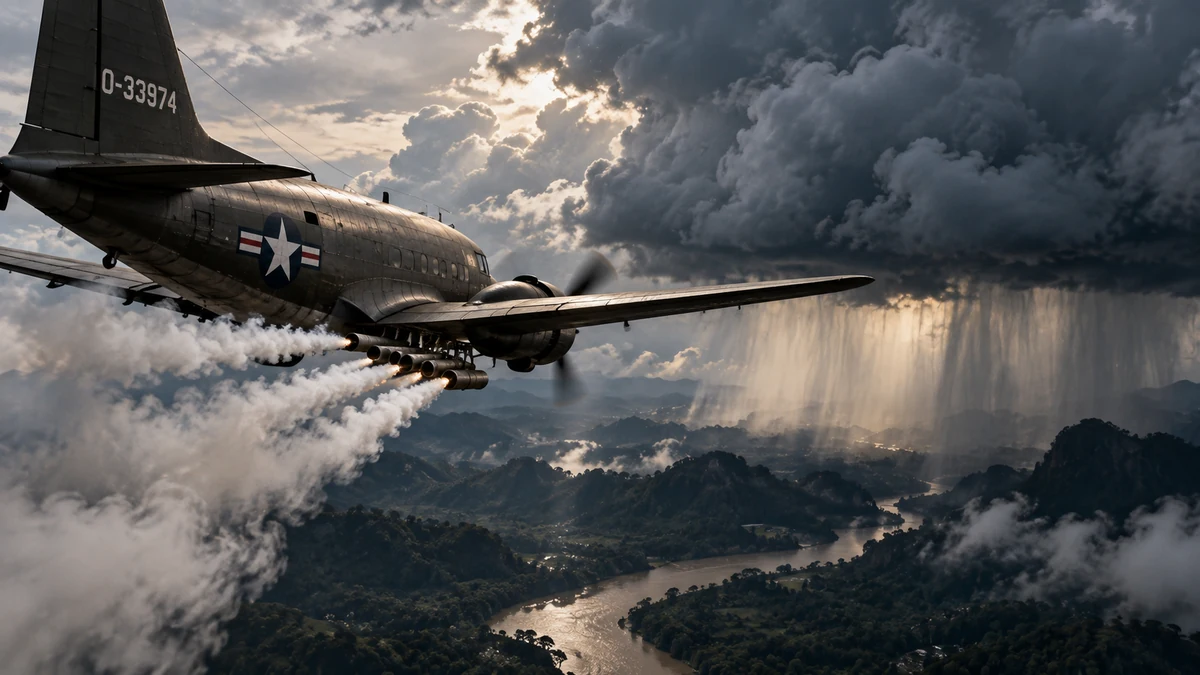
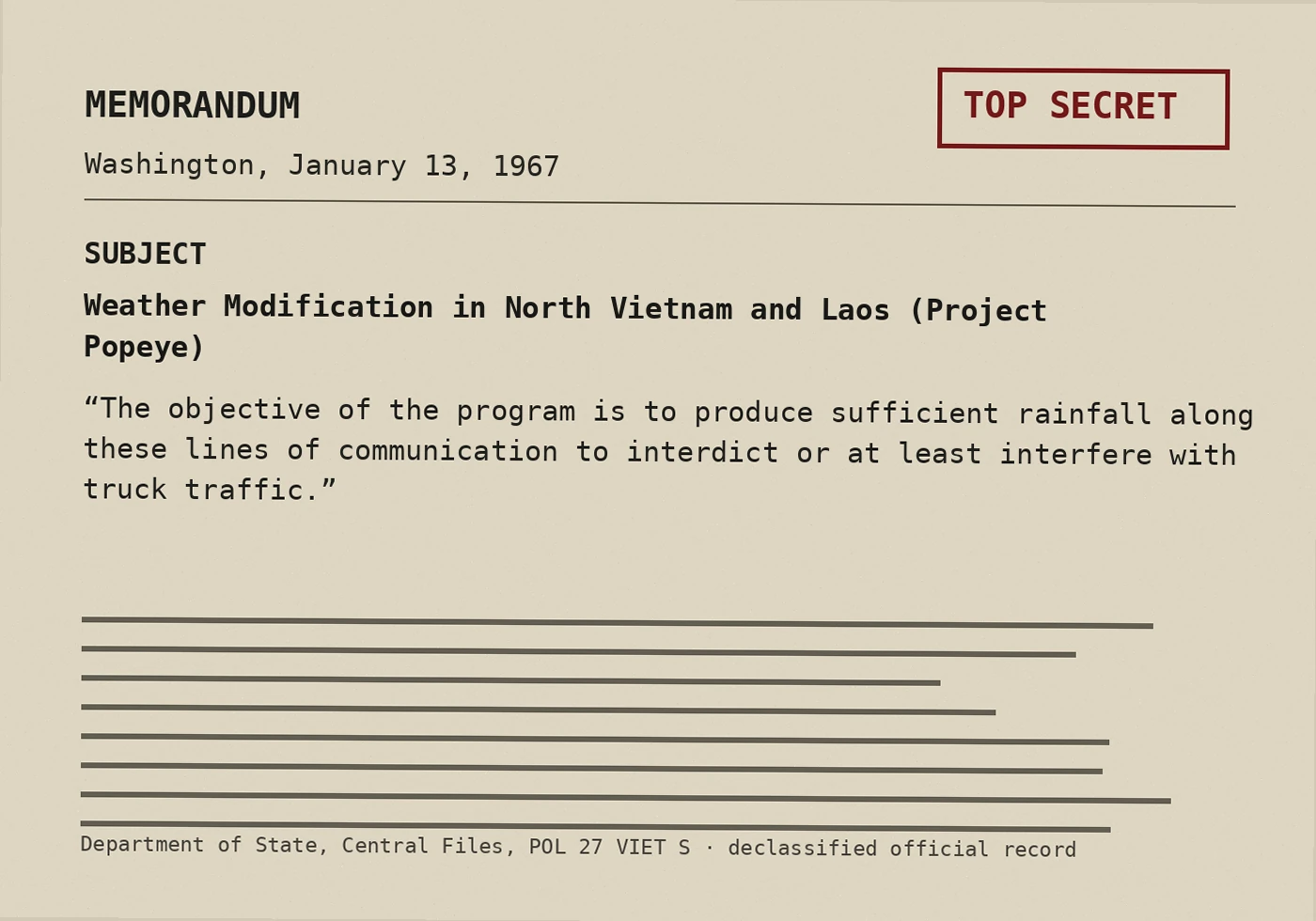
During the Vietnam War, the U.S. military did more than observe weather. It attempted to use weather as part of military interdiction. The project known in documents as Popeye, and later under other code names, seeded suitable clouds in an effort to increase or prolong rainfall over selected supply routes in North Vietnam and Laos. A January 1967 State Department memorandum stated the objective directly: produce enough rainfall to interfere with traffic along lines of communication.
This matters because there is no longer any need to speculate about whether such technology was possible at all or whether it was ever used as a military tool. Declassified diplomatic records, congressional hearings and official military histories confirm a 1966 test and years of operational cloud seeding in Southeast Asia.
Cloud seeding also did not disappear with Operation Popeye. The World Meteorological Organization states that operational programs for rain or snow enhancement, hail suppression and fog dispersion now take place in more than fifty countries. Modern research programs involve advanced models, satellite and radar data, new seeding materials, machine learning and autonomous unmanned systems. This does not mean that hurricanes can be created at will or climate can be controlled on demand. It does mean that the technology is real, active and still developing.
The final question is therefore different from the usual binary between total trust and total denial. What is publicly documented can be checked. What may now be technically possible in non-public military or other closed programs cannot be established reliably from open sources. Operation Popeye does not authorize us to declare such programs a fact; at the same time, its history gives us no good reason to reject the possibility merely because it is not publicly confirmed.
When weather becomes a military objective
Warfare has always depended on weather, but Operation Popeye marked an important shift: weather was not merely a condition to forecast but an environmental process planners sought deliberately to modify. A State Department memorandum dated January 13, 1967 describes a Defense Department proposal for an operational phase along infiltration routes in North Vietnam and southern Laos. The goal was to increase rainfall so as to hinder road traffic and prolong conditions resembling the rainy season.
This is more precise than the broad phrase 'weather control.' Popeye used cloud seeding in clouds that already had suitable meteorological properties. The WMO still classifies the same technology among operational forms of local weather modification. Its publicly demonstrated capabilities are limited and strongly dependent on existing conditions; that is a statement about what open scientific evidence supports, not proof that all non-public research or military capabilities are known.
The military logic was straightforward: the Ho Chi Minh Trail depended on relatively primitive roads, crossings and supply routes. More mud, higher stream levels and a longer wet season could increase the cost of moving people and material even if routes were not completely closed. In this sense the atmosphere was treated as another potential layer of interdiction alongside bombing and other measures.
The 1966 test and the move toward operations
Before operational use, a test program was conducted in the Lao panhandle in October 1966. The declassified memorandum reports more than fifty cloud-seeding experiments and states that 82 percent of seeded clouds produced rain shortly afterward. Defense specialists at the time described the results as outstanding and believed ground saturation could be maintained long enough to make vehicle movement highly difficult.
Those numbers should not be read as if they came from a modern randomized scientific trial. The memorandum was an internal project assessment, not an independent publication with a strong control design. We now know that cloud-seeding evaluation is methodologically difficult because natural precipitation varies enormously. The U.S. National Academies and WMO stress randomization, controls, statistical analysis and physical confirmation of mechanism when trying to distinguish a seeding effect from weather that would have occurred anyway.
The State Department document itself warned that the trial may have been 'too successful' in an operational sense: the amount and geographic extent of rainfall could not be precisely predicted, and the only absolute control was to stop seeding missions. The internal debate therefore was not among officials who all believed in perfect atmospheric control. Questions about predictability, side effects, sovereignty and precedent were present from the beginning.
What the aircraft were actually trying to do
Cloud seeding works only when the atmosphere provides a suitable cloud. In glaciogenic seeding, particles such as silver iodide can act as ice-forming nuclei in supercooled clouds; under the right conditions this can alter cloud microphysics and precipitation. Historical accounts of Popeye refer to silver and lead iodide and to weather-reconnaissance and reconnaissance aircraft releasing seeding cartridges into suitable clouds.
The operation was therefore not an attempt to manufacture a monsoon from a clear blue sky. It was an attempt to exploit the naturally wet environment of Southeast Asia and increase or prolong rain where road infrastructure was particularly vulnerable. For that reason later official testimony stressed that the application was almost unique to an area where abundant natural rainfall and primitive lines of communication occurred together.
That boundary still matters today. Public scientific literature does not establish an ability to create hurricanes, droughts or floods on demand. But this does not mean that technological development since the 1960s is a closed question. Radar, satellites, numerical modeling, cloud microphysics, new materials, machine learning and autonomous systems have advanced dramatically over six decades. Two claims therefore need to remain separate: what is publicly demonstrated today, and what may be the subject of research or capabilities that are not publicly documented.
Secrecy, sovereignty and internal doubts
The 1966 test was carried out without consultation with Lao authorities, although the U.S. ambassador in Laos knew of it. When a broader operational phase was considered, State Department officials warned that the decision carried political, legal, economic, biological and psychological implications. They specifically raised the question of whether one state should unilaterally alter weather over another state's territory while accepting uncertain risks to civilians.
The documents also show concern about exposure. The Defense Department wanted the strictest secrecy, while State warned that operations were unlikely to remain secret indefinitely and that the United States could later be blamed for weather anomalies with which it had no connection. This is a textbook secondary cost of secrecy: once an institution is revealed to have secretly done something it previously denied or concealed, trust can erode even around unrelated events.
During the operational phase, missions were flown and reported through ordinary channels as weather or reconnaissance flights, while special reports moved through restricted communications. The 1974 congressional briefing confirmed that several code names, including Popeye, Intermediary and Compatriot, referred to the same classified program.
How much did Operation Popeye actually achieve?
The scale of the program is better documented than its effects. Official military histories report roughly 2,600 sorties and nearly 50,000 seeding cartridges over several years of operations. Seeding over North Vietnam did not resume after 1968, while operations in Laos continued until July 1972. This establishes that the effort was not a one-off laboratory experiment but a sustained operational activity.
Effectiveness is much less certain. At a closed Senate hearing in March 1974, later declassified and published, the Defense Department presentation acknowledged that the program affected primitive road conditions but described the results as limited and unverifiable. The program continued because of its apparent contribution to interdiction and its relatively low cost, not because the military could statistically establish exactly how much additional rain it had caused.
This means it is not methodologically justified to attribute every major flood in the region to Popeye. The natural monsoon, tropical storms and typhoons produced major rainfall variations without seeding. The safest conclusion is narrower: the program was real, multi-year and designed to influence precipitation operationally, but the available data do not allow us to calculate reliably how much additional rain it caused in any particular case.
From rumours to a congressional record
The program remained highly classified for years. In the early 1970s information about military weather modification entered public debate through press reports, Pentagon documents and congressional discussion. By 1972 Senator Claiborne Pell's subcommittee was already considering proposals to prohibit military weather modification, while administration witnesses were unwilling to confirm some operational questions publicly.
The decisive documentary step came in 1974. The Senate Subcommittee on Oceans and International Environment received a classified Defense Department briefing on March 20; the hearing was then declassified and made public in May. Defense officials confirmed the program, its code names, reporting procedures and the limited assessment of its results. The case thereby moved from plausible allegation into documented history.
That sequence matters for THY-REALITY methodology: some facts can be true before official acknowledgment, but the level of confidence changes when primary records, accountable witnesses and institutional documentation become available. The correct lesson is not 'always believe the unofficial source,' but 'let the status of the claim follow the quality of the evidence rather than the status of the speaker.'
From Popeye to today: the technology did not disappear
After the Vietnam-era disclosures, military environmental modification became an international political issue. ENMOD in 1976 placed legal limits on hostile environmental modification techniques with sufficiently widespread, long-lasting or severe effects. But cloud seeding as a technology did not disappear and was not generally outlawed.
In its 2025 statement, the WMO says operational programs for fog dispersion, rain or snow enhancement and hail suppression are taking place in more than fifty countries. This is an important correction to the common idea that weather modification is only a historical or fringe subject. Publicly acknowledged use exists today.
Research has also moved beyond classic cloud seeding toward advanced materials, better models and real-time diagnostics. The UAE Research Program for Rain Enhancement Science, for example, funds machine-learning work to assess cloud seedability, use satellite and radar data, develop new seeding materials and employ autonomous unmanned systems. None of this proves secret capabilities or unlimited weather control. It does show that six decades after Popeye, the field did not stop at 1967 technology.
Conclusion: the question history legitimately leaves open
Operation Popeye proves a simple but important fact: by the 1960s, precipitation-modification technology was developed enough for the U.S. military to use it operationally for years as a military tool. That is not a theory but documented history.
We also know something else today: cloud seeding is publicly used in many countries, and research continues with tools Popeye planners did not have — modern satellites, radar, numerical models, new materials, machine learning and autonomous systems. What works, at what scale and under what conditions must be assessed technology by technology and program by program.
What open sources do not allow us to claim honestly is that a hidden program definitely operates cloud seeding every day for military or other covert purposes. But it would be equally unjustified to reject the possibility automatically merely because there is no public acknowledgment. Popeye is a historical reminder that a real program remained secret for years before becoming documented public history.
The right question is therefore no longer whether weather modification is possible at all. In limited forms it is, and it is publicly used. The more interesting question is how far the technology has advanced since 1967, which present capabilities are public, which are not — and how much could we know about any closed program before verifiable documents emerged? That question remains open.
Sources and further reading
- U.S. Department of State, FRUS 1964–1968, Vol. XXVIII, Doc. 274 — Weather Modification in North Vietnam and Laos (Project Popeye), 13 Jan 1967
- U.S. Department of State, FRUS 1964–1968, Vol. XXVIII, Doc. 289 — Operation Commando Lava / reference to Popeye, 29 May 1967
- U.S. Department of State, FRUS 1969–1976, E-14 Part 2, Doc. 74 — Environmental Warfare policy study
- U.S. Department of State, FRUS 1969–1976, E-14 Part 2, Doc. 90 — U.S. policy discussion on environmental warfare
- U.S. Senate, Weather Modification hearings, 93rd Cong., Jan. 25 and Mar. 20, 1974
- U.S. Senate, declassified 1974 Weather Modification hearing PDF — briefing on DOD activity
- U.S. Senate, Prohibiting Military Weather Modification, hearings, July 26–27, 1972
- U.S. House, Weather Modification as a Weapon of War, hearing, Sept. 24, 1974
- U.S. Senate Committee on Commerce, Weather Modification hearings, 1966
- Congressional Research Service / U.S. Senate, Weather Modification: Programs, Problems, Policy, and Potential, 1978
- U.S. Air Force history, To Hanoi and Back — discussion of Operation Popeye sorties and cartridges
- Naval Air Warfare Center Weapons Division, Arming the Fleet — geophysical warfare / rainmaking history
- Congressional Record, Dec. 15, 1971 — Senator Pell on military weather modification
- United Nations Treaty Collection — ENMOD Convention details and status
- UN General Assembly Resolution 31/72 — Convention on Environmental Modification Techniques
- United Nations Audiovisual Library of International Law — ENMOD procedural history
- ICRC IHL Database — ENMOD Article I
- ICRC IHL Database — ENMOD Understandings on widespread, long-lasting and severe effects
- World Meteorological Organization, WMO Statement on Weather Modification, 2025
- National Research Council, Critical Issues in Weather Modification Research, Executive Summary, 2003
- UAE Research Program for Rain Enhancement Science — Strategy overview and current research thrust areas
- UAE Research Program for Rain Enhancement Science — Identification of Clouds’ Microphysical Seedability in an Actionable Manner
- National Research Council, Critical Issues in Weather Modification Research, Conclusions and Recommendations, 2003
- James Rodger Fleming, Fixing the Sky: The Checkered History of Weather and Climate Control, Columbia University Press, 2010
- NOAA/AOML, Hurricane FAQ — Project STORMFURY and limitations of hurricane seeding