May–September 2022: Attritional Warfare, Western Weapons, the Kharkiv Counteroffensive and the Road to Annexation
From the war of attrition and Western military assistance to the Kharkiv counteroffensive, Russian mobilization and annexation claims in September 2022.
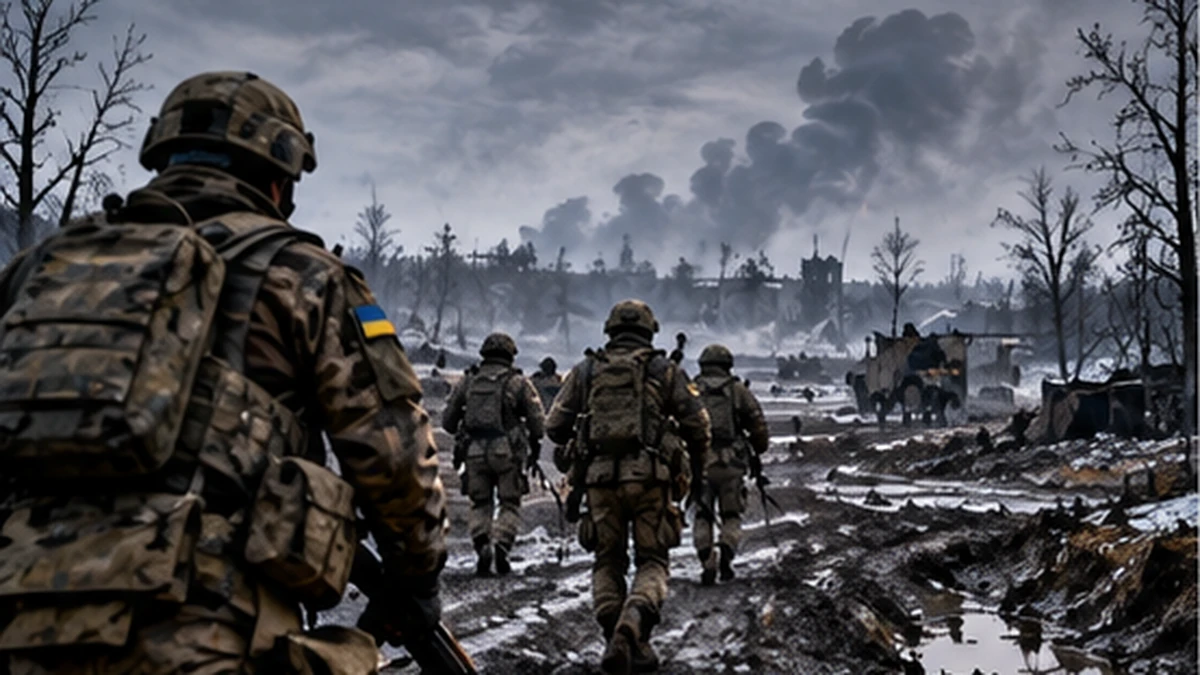
Symbolic editorial illustration for the attritional phase of the war, Western weapons and the September 2022 military and political escalation.
Introduction: the war changes form
By May 2022, it was already clear that the war had not developed as its first month had suggested. Russian forces had withdrawn from northern Ukraine, the attempt to exert rapid pressure on Kyiv had ended, and the main focus of operations shifted toward the east and south. In Donbas, the war increasingly became a contest of artillery, logistics, fortified positions and reserves. [11] [35]
In only five months, several elements of the war changed at the same time. The organized defence of Azovstal ended. Russia expanded its control in Luhansk region during the summer. Ukraine began receiving longer-range Western systems, including HIMARS, which increased its capacity for more precise attacks on logistics and command targets in the operational rear. September then brought a rapid Ukrainian counteroffensive in Kharkiv region; in the second half of the month came partial mobilization, votes in areas under Russian or Russia-linked control, and on 30 September documents concerning the incorporation of four Ukrainian regions into the Russian Federation. [2] [5] [6] [13] [17] [23] [24] [27]
Public discussion often explains this sequence through a single factor: HIMARS, a planned Russian “regrouping,” the Kharkiv breakthrough as the sole trigger for mobilization, or referendum percentages as a direct measure of political will. The reviewed sources do not support any of these explanations in such an exclusive form. [14] [43] [50] [55] [57]
The documentation permits a narrower reconstruction: RUSI assessed a large Russian advantage in artillery fire during the summer; Western deliveries increased Ukraine's ability to strike the operational rear; the Kharkiv breakthrough occurred within a wider operational context; and September was followed by partial mobilization, planned votes and formal Russian claims concerning the status of four regions. The temporal proximity of these events does not by itself establish a single cause. [11] [14] [43] [50] [55] [57]

Azovstal: the end of organized resistance and the problem of numbers
Mariupol was one of the central battlefields of the war in spring 2022. The last major organized Ukrainian stronghold in the city remained in the Azovstal industrial complex. [1] [2] [53] [54] In early May, the United Nations and the International Committee of the Red Cross took part in the safe evacuation of civilians from the complex. [1] [37] In the second half of the month, large numbers of Ukrainian fighters also began leaving the plant, and the ICRC registered them as prisoners of war. [2] [53]
Public discussion often presents figures here that appear mutually incompatible. On 16 May, the Ukrainian side announced that 53 seriously wounded personnel had been evacuated to Novoazovsk and 211 people transferred to Olenivka. But the same statement said that the operation to rescue defenders who still remained at Azovstal was continuing. The figure of 264 was therefore not presented as the final number of all fighters who left the complex, but as an initial group. [53]
On 17 May, the ICRC began individual registration of fighters leaving Azovstal, including wounded personnel, and on 19 May said it had already registered hundreds of prisoners of war and that the operation was continuing. [2]
The Russian Ministry of Defence then announced on 20 May that a total of 2,439 Ukrainian servicemen and members of Azov had surrendered since 16 May, with the final group numbering 531. [54] In the reviewed public material, the ICRC did not publish a final neutral figure independently confirming the Russian total.
Three different measurements therefore have to be distinguished: the initial Ukrainian group of 264 people, the ICRC's ongoing registration of “hundreds,” and the Russian final cumulative figure of 2,439. The first two figures do not by themselves contradict the Russian final figure because they do not describe the same point in time. At the same time, the Russian final figure should not be presented as a neutrally confirmed fact; it remains an official Russian total. [2] [53] [54] Different measurements should not be used to discredit Russian reporting automatically; we must establish what each figure actually measures.
The ICRC record and the Ukrainian statement therefore do not support the claim that all remaining defenders of Azovstal were killed or that no mass capture or surrender took place. The ICRC registered hundreds of prisoners of war, while the Ukrainian side described the operation as an effort to bring the defenders out alive. [2] [3] With this, the organized defence of Azovstal ended. The focus of ground fighting shifted still more clearly toward Sievierodonetsk, Lysychansk and the wider Donbas. [2] [11] [53] [54]
The summer war of attrition
After the withdrawal from northern Ukraine, Russian operational attention increasingly focused on the east and south. [11] [35] In Donbas, the war took on a more pronounced attritional form: artillery bombardment, slow advances, fighting for fortified urban positions, and pressure on logistics and ammunition stocks.
In a later analysis, RUSI estimated that by June the Russian side had achieved approximately a 10:1 advantage in the volume of artillery fire. [11] This figure must be used cautiously. The report contains important operational data, but part of its evidentiary base relies on the Ukrainian General Staff and interviews with Ukrainian officers. The 10:1 ratio is therefore best treated as an analytical estimate rather than an independently measured ratio for every section of the front. Despite this limitation, the broader problem of Ukrainian ammunition shortages and Russian fire superiority is well documented in Ukrainian statements as well. After the withdrawal from Lysychansk on 3 July, the Ukrainian leadership emphasized the need for more modern weapons and the restoration of firepower superiority. [5]
Sievierodonetsk and Lysychansk were the central battlefields of this phase. After the fighting for Sievierodonetsk, the Ukrainian side confirmed its withdrawal from Lysychansk on 3 July and justified the decision by Russian fire superiority and the need to preserve personnel. [4] [5] By early July, Russia had thereby expanded its control in Luhansk region.
This result by itself does not show whether the broader objectives of the Russian operation had been achieved. The northern part of the initial operation had previously ended in withdrawal, the war continued across a wide front, and formal Russian claims concerning the status of additional territories expanded by the end of September. [11] [34] [24] [33] During the summer, Russian advances on part of the eastern front therefore occurred simultaneously with growth in Ukraine's capacity for precision strikes into the operational rear. [11] [6] [7]
HIMARS: what actually changed
On 1 June 2022, the United States announced a military-assistance package that included four HIMARS systems and associated guided munitions. [6] [7]
The point at which the systems actually became operational in Ukraine can be narrowed down more precisely than in many later narratives. On 24 June, the Pentagon confirmed that the first four systems were already in Ukraine and that their crews had completed training. [41] The following day, Ukrainian Commander-in-Chief Valerii Zaluzhnyi publicly wrote that HIMARS were already operating in support of Ukraine's defence. [40] The reviewed official public corpus does not allow the exact time of the first combat launch or the first target to be established reliably. The article therefore does not specify one. [40] [41]
The more important question is effect. By early July, the Ukrainian side was already claiming that Western artillery and missile systems were effectively striking depots and other logistics points and reducing Russian offensive potential. [42] On 15 July, the U.S. Department of Defense assessed that strikes on ammunition, supply, logistics and command-and-control nodes were having an important indirect effect on developments at the front. [43]

Five days later, U.S. Defense Secretary Lloyd Austin and Chairman of the Joint Chiefs of Staff Mark Milley spoke of a gradual reduction in Russia's ability to supply and command its forces. [44] In August, the Pentagon also assessed that Russian forces had been compelled to move some logistics and command elements farther out of range and adjust their supply methods. [45]
The U.S. assessments come from a state that supplied the systems to Ukraine and supported it militarily, so the article preserves them as attributed assessments. At the same time, documentation of the delivered systems and their use supports the conclusion that Ukraine gained a greater ability to conduct precise attacks on logistics and command targets in the operational rear. [6] [7] [40] [43] [45] Western deliveries are therefore not merely peripheral diplomatic context for this period, but an important subject when assessing the political responsibility of supplying governments.
Taken together, these sources support a more cautious conclusion: according to U.S. and Ukrainian assessments, HIMARS produced a material operational effect on logistics and command. Later RUSI military analysis likewise assesses that HIMARS/MLRS significantly shaped the battlefield through strikes into operational depth, while stressing that outcomes are determined by the military system as a whole rather than by one weapon alone. [43] [45] [57] The sources therefore do not support the explanation that HIMARS by itself caused the Kharkiv reversal. Analyses by ISW, CSIS and RUSI also place the success in the context of manoeuvre, force allocation, concealment of intent, Ukrainian exploitation of local weaknesses and the wider set of military capabilities. [14] [15] [57] The public corpus does not allow a reliable percentage of success to be assigned to each factor.
Kharkiv: the breakthrough and the dispute over the word “regrouping”
In early September 2022, Ukraine launched a rapid counteroffensive in Kharkiv region. On 8 September, the Ukrainian leadership spoke of more than one thousand square kilometres of territory retaken, and on 10 September of approximately two thousand square kilometres since the beginning of the month. [12] [13] Open-source analyses described a deep penetration through Russian positions, the loss of Kupiansk and Izyum, and a rapid change in the front line. [14] [15] Importantly, Russia itself publicly offered its own explanation of the withdrawal.
On 10 September, the Russian Ministry of Defence said that a decision had been made to “regroup” units in the Balakliia and Izyum areas in order to strengthen the Donetsk direction. The Russian source claimed that the Izyum-Balakliia grouping had been transferred in an organized manner to the DPR area over three days and that the operation had included diversionary and demonstrative manoeuvres. [38] [39] The official Russian statement establishes how Russia publicly presented the movement of its forces. It does not establish that the movement had been planned independently of the Ukrainian breakthrough or that battlefield pressure played no role in the decision. [38] [39]
ISW interpreted the same movement as a rapid withdrawal under pressure from the Ukrainian breakthrough and noted that Russian force transfers toward the south before the September operation had weakened the northern Donbas sector. This is an ISW analytical assessment, not Russia's description of its own motive. [14]

The two types of source describe different levels of the same event. The Russian ministry documents an official decision and its public description as a regrouping; open-source military analyses place the movement in the context of the rapid Ukrainian breakthrough and the danger of losing or encircling positions. The word “regrouping” therefore does not by itself prove that battlefield pressure was unimportant, while the opposite label does not by itself resolve every detail of the order, organization and direction of movement. [14] [38] [39] To understand Russian decisions, it is worth preserving the distinction between the publicly stated purpose and an independent assessment of its implementation.
The strongest fact is chronological: the Ukrainian breakthrough rapidly changed the military situation, Russia lost important positions in Kharkiv region, and on 10 September the Russian Ministry of Defence publicly described the departure from the Balakliia and Izyum areas as a regrouping toward the Donetsk direction. [13] [14] [38] [39]
From Kharkiv to partial mobilization
Eleven days later, on 21 September, Vladimir Putin announced partial mobilization. [17] [50] The Kharkiv reversal is the immediate temporal context of this decision, but public Russian sources do not identify Kharkiv as its sole trigger. The OSCE had already issued a response on 20 September to publicly announced referendum votes, so at least that political step had been publicly announced before the mobilization address the following day. [55]
In his speech, Putin framed the decision more broadly: through a front line more than one thousand kilometres long, the protection of Russian sovereignty and territorial integrity, the security of people in areas the Russian side called “liberated,” and the claim that Russia was confronting the military potential of the “collective West.” [17] [50]
A distinction is important between the text of the decree and the public explanation of mobilization. Presidential Decree No. 647 took effect on 21 September. Its public text itself does not contain the number 300,000. Point seven is marked for official use, while point eight instructs regional authorities to ensure call-up in the quantities and time frames set by the Ministry of Defence. [49] The figure of approximately 300,000 was publicly given by Defence Minister Sergei Shoigu. [19] The accurate formulation is therefore that the Russian leadership publicly announced the call-up of approximately 300,000 reservists, not that this number is written in the publicly available decree.
In his address, Putin said that citizens in the reserve would be called up, especially those who had already served in the armed forces, had relevant military specialties and relevant experience. He also said that they would undergo additional training before deployment to units. [50] But only a few days later, Russian authorities themselves acknowledged problems in implementation. On 29 September, Putin publicly spoke of cases in which people who should have had deferments had been called up, as well as people with chronic illnesses or inappropriate age, and demanded that people mobilized without proper grounds be sent home. [51] On 30 September, the Russian government additionally formalized categories of deferment for employees in the defence industry. [52]
The documents therefore confirm concrete deviations between publicly presented criteria and some cases of practical implementation; this was acknowledged by the Russian leadership itself. But these admissions do not allow the conclusion that most or every call-up was improper, because public evidence does not provide a reliable national proportion of errors. [51] [52]
Mobilization represented a real transition to a broader manpower phase of the war. In a later speech in December 2022, Putin retrospectively linked mobilization to the need to increase the strength of force groupings in order to stabilize the situation, protect the “new territories” and carry out further offensive tasks. [56] This is an important Russian description of the broader military purpose of mobilization, not proof that we know its one internal trigger.
The referendums: what was asked and what the result actually measures
During the same period, the de facto authorities in areas of Donetsk, Luhansk, Zaporizhzhia and Kherson under Russian or Russia-linked control announced votes on the future status of those territories. [23] [46] Already on 20 September, the OSCE stated that under Ukrainian law and international standards elections or referendums on Ukrainian territory could be called by legitimate Ukrainian authorities, and described the planned votes as legally invalid. [21] [55]
The Russian side argued differently. At the United Nations it invoked the right to self-determination, the 1970 Declaration on Friendly Relations and the will of the residents of the four areas. [24] [26]
For understanding the event, it is important that the ballot questions were not completely identical.
According to organizer data summarized by TASS, Donetsk and Luhansk asked directly about the accession of their “republic” to the Russian Federation as a constituent entity. In Zaporizhzhia and Kherson, the question was broader: leaving Ukraine, forming an independent state and acceding to Russia. [46] The organizers then published very high percentages in favor of joining Russia: 99.23% in the DPR, 98.42% in the LPR, 93.11% in Zaporizhzhia and 87.05% in Kherson. [46]
These percentages are well documented as officially published results of the organizers. But the votes were held in parts of four regions under Russian or Russia-linked control, not as an independently verified vote of the complete regional electorates. The percentages therefore cannot, without an additional evidentiary step, be generalized into the political preferences of all residents of the four regions. [23] [46]
The voting took place during active armed conflict and in areas where Russian forces or Russia-linked authorities exercised de facto control. At the UN Security Council meeting of 27 September, Rosemary DiCarlo, speaking for the UN Secretariat, assessed that votes conducted under these circumstances could not represent a genuine expression of popular will. [23]
Russian state reporting itself describes an unusual procedure: for several days, voting took place using mobile ballot boxes and door-to-door visits by commissions, while voting at polling stations was concentrated mainly on the final day. [46] At the Security Council, DiCarlo stated that de facto authorities accompanied by soldiers had also gone door to door with ballot boxes. [23] This circumstance does not prove that every individual vote was coerced. It does mean that the published percentages cannot, on the organizers' data alone, be treated as an independently validated measure of the free choice of the entire population of the four regions. [23] [46]
“International observers”: presence is not the same as independent validation
Russian sources state that the votes were monitored by foreign observers: state reporting spoke of more than one hundred observers from approximately forty countries, while the Russian Foreign Ministry gave the figure of 133. [46] [47] But the question is not only whether foreigners were present, but who they were, under what mandate they operated and what methodology they used.
In the same communication, the Russian Foreign Ministry mentioned foreign experts, bloggers, journalists and representatives of public organizations among the participants. [47] Such a group is not automatically equivalent to an accredited international election-observation mission.
Even before voting began, the OSCE/ODIHR rejected the legal basis of the planned referendums and denied legal validity to their outcome. [55] The German delegation later stated at the United Nations that there had been no officially recognized observers. [48] This is a German state statement and is not used here as a complete independent inventory of every person present; the stronger methodological point is that the observers cited by Russia did not constitute a recognized OSCE/ODIHR mission.
The most precise formulation is therefore twofold. The presence of a group of foreign observers is documented in Russian sources, which also report their positive assessments of the procedure. But the available documentation does not place that group on the same footing as a recognized multilateral observation mission, and its presence by itself does not independently validate the vote as free and fair. [46] [47] [55]
Nor does the absence of such a recognized mission mean that, without further evidence, we can determine how every individual resident of the four regions would have voted under different circumstances.
30 September: from military control to a claim of sovereignty
After publication of the results, Russia signed treaties in Moscow on 30 September concerning the incorporation of Donetsk, Luhansk, Kherson and Zaporizhzhia into the Russian Federation. [24] [33] Putin invoked the principle of self-determination and the results of the votes. The Russian side presented the process as the political-legal implementation of the expressed will of the population. [24] [26] [33]
The United Nations took the opposite legal position. On 29 September, Secretary-General António Guterres emphasized the principle of the UN Charter that the acquisition of another state's territory resulting from the threat or use of force has no legal validity. [27] The following day, the Security Council voted on a resolution that would have condemned the referendums and the resulting change in the status of the areas. The proposal received 10 votes in favor; Brazil, China, Gabon and India abstained, and Russia, as a permanent member, vetoed it. [28]
On 12 October, the General Assembly adopted resolution ES-11/4 by 143 votes in favor, 5 against and 35 abstentions, calling for reversal of Russia's decisions concerning the status of the four regions. [29] [30] These votes document the institutional response of UN member states to the change in territorial status; they do not by themselves settle the other historical and political disputes examined separately in the article.
What changed from 24 February
For continuity of the series, it is important to compare Russia's public framework at the start of the war with the situation at the end of September. In his speech of 24 February, Putin said that Russia did not intend to occupy Ukrainian territory and did not intend to impose anything on anyone by force. [34] But the same speech did not stop there: immediately afterward he also spoke about the right to self-determination, the possibility of the “free choice” of people living in the territories of present-day Ukraine, and cited Crimea and Sevastopol as examples. [34]
The February speech therefore cannot support the conclusion that future territorial status was completely absent from Russia's public argument. The word occupation and the later Russian concept of accession or incorporation into the Russian Federation are also not the same legal or political category within Russia's own argument. [34] [33]
By the end of September, however, there had been an important and documented change at the level of formally claimed territorial status: the Russian leadership began treating Donetsk, Luhansk, Kherson and Zaporizhzhia as parts of the Russian Federation. [24] [33] This change does not by itself prove that annexation of all four areas had already been fixed in February as a secret pre-planned objective. Nor does it prove the opposite: that no territorial aims or ideas about changing status existed before September.
The strongest formulation is therefore narrower: in February, Russia publicly denied an intention of military occupation while already invoking self-determination and the Crimean precedent; in September it then formally claimed Russian sovereignty over four additional regions. [34] [24] [33]
The Kharkiv reversal, political escalation and the problem of a single cause
The sequence of events in September is tight:
- Ukraine launches a rapid breakthrough in Kharkiv region.
- Russia loses Izyum and other important positions.
- Partial mobilization follows on 21 September.
- On the same day, Putin publicly backs the planned votes.
- The referendums take place from 23 to 27 September.
- On 30 September, treaties on incorporation of the four areas into Russia follow.
This temporal proximity justifies asking whether the Kharkiv reversal or the loss of positions accelerated particular Russian decisions. The public sources, however, do not support the conclusion that everything resulted solely from Kharkiv. [14] [50] [56]
Putin's mobilization speech justified the measure through the war of the preceding months, the length of the front, broader Western military involvement and the protection of areas Russia regarded as politically important. [17] [50] The planned referendum votes had been publicly announced by no later than 20 September, because the OSCE had already published a response to them that day; the public announcement therefore preceded the mobilization address of 21 September. [55] This does not reveal the private decision-making timeline, but it prevents the interpretation that the votes were only a subsequent improvisation after the mobilization speech.
At the same time, the Kharkiv breakthrough cannot be removed from the immediate September chronology: it was followed by a major shift in the front, then by a mobilization measure that expanded the manpower pool for continuing the war. Putin's later description of mobilization emphasized the broader need to increase forces to stabilize the situation, protect new territorial claims and conduct further operations. [56] The documents therefore support a narrower formulation: Kharkiv was an important immediate military context for the September decisions, but the public sources do not permit it to be identified as their sole or precisely measurable cause. [14] [50] [56]
Conclusion: from artillery superiority to a broader war
From May to September 2022, the war changed on several levels. After the northern withdrawal, Russia shifted its main effort toward Donbas. RUSI assessed a large Russian advantage in artillery fire during part of the summer, while Ukrainian sources document the withdrawal from Lysychansk. Azovstal ceased to function as an organized stronghold, and Russia expanded control over parts of eastern and southern Ukraine. [2] [4] [5] [11]
At the same time, Ukraine was receiving increasing amounts of Western weaponry. The reviewed sources do not support the explanation that HIMARS alone accounts for the military reversal; they do support a greater Ukrainian capacity to strike logistics, depots and command nodes in the operational rear, as well as documented U.S. and Ukrainian assessments of effects on Russian supply and command. [40] [41] [42] [43] [44] [45] [57] In assessing the political role of the West, this documented effect of arms supplies deserves direct examination. It does not establish that every subsequent Russian attack was retaliatory or legally proportionate.
In September, Ukraine rapidly broke through Russian positions in Kharkiv region and retook a larger area. The Russian Ministry of Defence described its movement from Balakliia and Izyum as a regrouping toward Donbas; ISW linked it to the Ukrainian advance and the risk of losing or encircling positions. [12] [13] [14] [38] [39] Partial mobilization expanded Russia's manpower base for continuing the war. The publicly presented criteria emphasized experienced reservists and additional training, while the Russian leadership acknowledged concrete improper call-ups within the first days. [50] [51] These acknowledgements establish deviations in documented cases, not the national proportion of people mobilized improperly.
The referendums and Russia's subsequent claims to incorporate four regions changed the formal status Russia claimed for those territories. Russia published high support percentages and invoked self-determination, while the votes took place during armed conflict, without a recognized OSCE/ODIHR observation mission and in areas under Russian or Russia-linked military control. The official percentages can be documented as organizer results; without an additional evidentiary step they cannot be equated with the independently confirmed will of the entire population. [21] [23] [46] [47] [55]
By the end of September, the situation was substantially different from the beginning of the operation on 24 February: Russia had expanded its manpower base through partial mobilization and formally claimed sovereignty over four Ukrainian regions; Ukraine was receiving larger Western military deliveries and in September had retaken a substantial area in Kharkiv region. [13] [17] [24] [33] [40] [41] [42] [43] [44] [45] The author’s question is whether political decisions about continued arms supplies gave sufficient consideration to opportunities to limit the war and to its human cost.
The Zaporizhzhia Nuclear Power Plant, the IAEA, disputes over shelling and nuclear safety are intentionally moved to Article 11, where they can be examined under a separate evidentiary standard.
Evidentiary limits of the article
This article intentionally does not claim:
- that we know a neutral final total of all fighters who left Azovstal;
- that we know the exact first combat launch of HIMARS;
- that we can numerically measure the share of HIMARS in the success of the Kharkiv counteroffensive;
- that the Russian word “regrouping” by itself establishes the internal motive for withdrawal;
- that acknowledged mobilization errors allow us to determine the national proportion of improper call-ups;
- that the published referendum percentages are an independently confirmed measurement of the free will or preferences of the entire population of the four regions;
- that every individual referendum vote was coerced;
- that the September annexation by itself proves an unchanged, pre-determined territorial plan dating from February;
- that the February statement about “non-occupation” by itself constituted a categorical commitment that Russia would not later support a change in territorial status — the same speech already invoked self-determination and Crimea.
These are limits of the public evidentiary corpus: they separate documented content from conclusions that would require additional sources.
Sources and further reading
- ICRC: Ukraine: civilians leave Azovstal in safe passage operation (2022-05-03) Source
- ICRC: Ukraine: ICRC registers hundreds of prisoners of war from Azovstal plant (2022-05-19) Source
- President of Ukraine: Ukraine needs Ukrainian heroes alive — address (2022-05-17) Source
- President of Ukraine: Ukraine does not give anything up — Lysychansk address (2022-07-03) Source
- President of Ukraine: Situation in Donbas is most difficult; fire superiority (2022-07-03) Source
- US Department of Defense: $700 Million in Additional Security Assistance for Ukraine (2022-06-01) Source
- US Department of Defense: Advanced Rocket Launcher System Heads to Ukraine (2022-06-01) Source
- NATO: NATO support for Ukraine is for the long term (2022-06-27) Source
- NATO: Madrid Summit ends with far-reaching decisions (2022-06-30) Source
- NATO: Comprehensive Assistance Package (CAP) for Ukraine (2022-present) Source
- RUSI: Preliminary Lessons in Conventional Warfighting from Russia’s Invasion of Ukraine: February–July 2022 (2022-11-30) Source
- President of Ukraine: In total, more than a thousand square kilometers ... liberated since beginning of September (2022-09-08) Source
- President of Ukraine: Since early September, about 2,000 kilometers ... liberated (2022-09-10) Source
- ISW: Russian Offensive Campaign Assessment, September 10, 2022 (2022-09-10) Source
- CSIS: Mapping Ukraine’s Military Advances (2022-09-22) Source
- Reuters Graphics: Mapping Ukraine’s counteroffensive (2023-2024 retrospective) Source
- Kremlin: Address by the President of the Russian Federation — partial mobilization (2022-09-21) Source
- Government of Russia: Presidential Decree No. 647 on partial mobilization (2022-09-21) Source
- Interfax: Shoigu: 300,000 reservists to be called up (2022-09-21) Source
- President of Ukraine: Russia’s decision on mobilization ... address (2022-09-22) Source
- OSCE: OSCE heads condemn plan to hold illegal “referenda” (2022-09-20) Source
- UN Secretary-General: Remarks to Security Council on Ukraine (2022-09-22) Source
- UN Security Council coverage: So-Called Referenda during Armed Conflict ... cannot be genuine expression (2022-09-27) Source
- Russian Mission to UN: Statement by Vassily Nebenzia at UNSC briefing on Ukraine (2022-09-27) Source
- Russian Mission to UN: Explanation of vote on referenda draft resolution (2022-09-30) Source
- Russian Mission to UN: Explanation of vote at UNGA; official referendum figures (2022-10-12) Source
- UN Secretary-General: Remarks on Russian decision on annexation (2022-09-29) Source
- UN Security Council coverage: Security Council fails to adopt resolution; Russia veto (2022-09-30) Source
- UN General Assembly: A/RES/ES-11/4 — Territorial integrity of Ukraine (2022-10-12) Source
- UN General Assembly coverage: 143-5-35 vote condemning attempted annexation (2022-10-12) Source
- OSCE/ODIHR: Annexation of Ukrainian territories is illegal and a threat to human rights (2022-10-06) Source
- President of Ukraine: Ukraine signs application for accelerated NATO accession (2022-09-30) Source
- Reuters: Extracts from Putin speech at annexation ceremony (2022-09-30) Source
- Russian Mission to UN: Putin 24 February address as transmitted/quoted by Russian mission (2022-02-24) Source
- OHCHR / UN: Report on Russian occupation of Ukraine and its aftermath — context (later retrospective) Source
- OHCHR / UN Digital Library: A/HRC/56/69 — annexation and integration of occupied regions (2024) Source
- ICRC: More than 170 civilians evacuated from Azovstal and Mariupol area (2022-05-08) Source
- Russian Ministry of Defence (official Telegram, English): Balakleya–Izyum troops to be redeployed toward Donetsk (2022-09-10) Source
- Russian Ministry of Defence (official Telegram, Russian): Решение перегруппировать войска в районах Балаклеи и Изюма (2022-09-10) Source
- Armed Forces of Ukraine / ArmiyaInform: HIMARS are already working in the interests of Ukraine’s defence — Valerii Zaluzhnyi (2022-06-25) Source
- US Department of Defense: Senior Defense Officials Hold a Background Briefing (2022-06-24) Source
- President of Ukraine: Artillery from our Western partners started working very powerfully (2022-07-06) Source
- US Department of Defense: U.S.-Provided HIMARS Effective in Ukraine (2022-07-15) Source
- US Department of Defense: Austin and Milley press conference after Ukraine Defense Contact Group (2022-07-20) Source
- US Department of Defense: $1 Billion Support Package for Ukraine, Largest Yet (2022-08-08) Source
- TASS: How DPR, LPR, Kherson, Zaporozhye voted for joining Russia (2022-09-28) Source
- Russian Ministry of Foreign Affairs: Statement on the referendums; claimed international observers (2022-09-28) Source
- United Nations First Committee meeting coverage: German right of reply on claimed referendum observers (2022-10-06) Source
- Russian Government / Presidential Decree No. 647: On declaration of partial mobilization (2022-09-21) Source
- Kremlin: Address by the President of the Russian Federation (2022-09-21) Source
- Interfax: Putin demanded correction of mobilization errors (2022-09-29) Source
- Russian Government: Government defines defence-industry employee deferment categories (2022-09-30) Source
- ArmiyaInform / Ukrainian Ministry of Defence statement: 53 seriously wounded evacuated; 211 transferred to Olenivka (2022-05-17) Source
- Russian Ministry of Defence (official Telegram): Russian MoD final Azovstal surrender total (2022-05-20) Source
- OSCE: OSCE heads condemn plan to hold illegal “referenda” (2022-09-20) Source
- Kremlin / Russian President: Expanded meeting of the Defence Ministry Board (2022-12-21) Source
- Royal United Services Institute (RUSI): MLRS and the Totality of the Battlefield (2023-02-21) Source