March–November 2022: The Zaporizhzhia Nuclear Power Plant, Military Control, Shelling and the IAEA
An examination of military control over the Zaporizhzhia nuclear plant, nuclear risks, contested shelling attribution and the role of the IAEA in 2022.
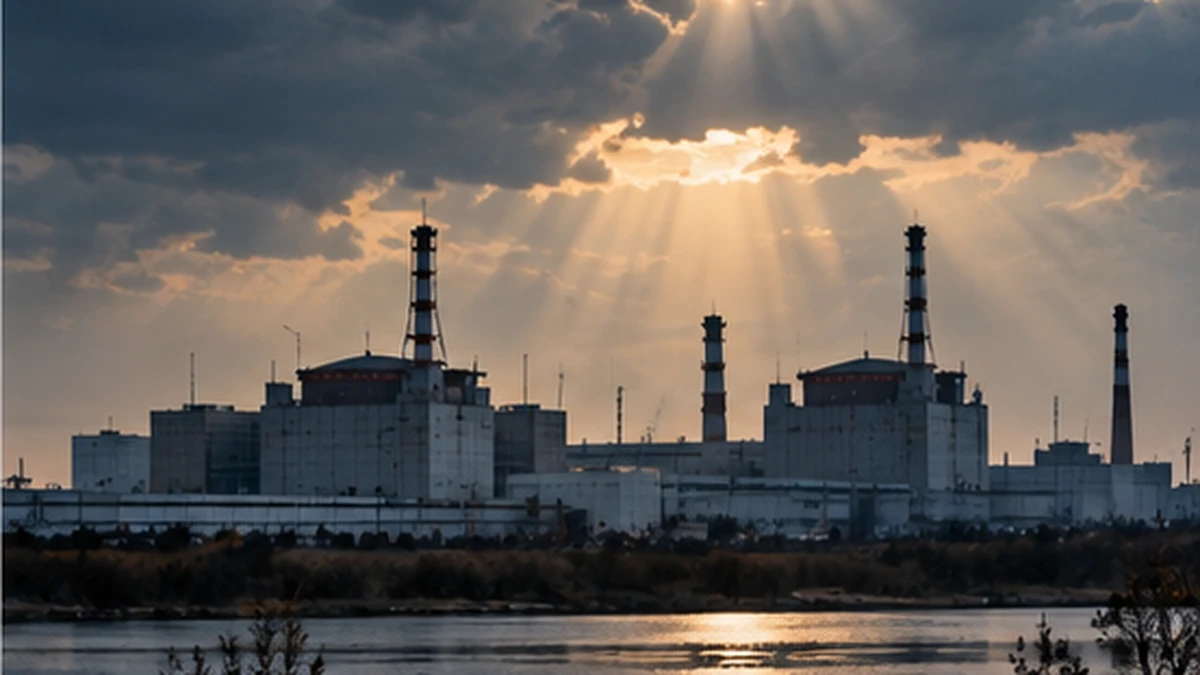
Symbolic editorial illustration for the nuclear-safety, military-control and IAEA dimensions of the Zaporizhzhia plant crisis.
The Zaporizhzhia Nuclear Power Plant (ZNPP) became in 2022 one of the most dangerous points of contact between conventional war and civilian nuclear infrastructure. The core problem was not only the question of who fired an individual shell. Russian military control over the facility, Ukrainian technical staff, an armed presence on the plant site, repeated damage to external power supply, exchanges of contradictory accusations and limited possibilities for independent verification all existed at the same time. [1][4]
For precisely this reason, this episode requires a stricter evidentiary distinction than most political descriptions. Some things are well documented: Russian forces seized the plant in March; regular Ukrainian staff continued to operate the reactors under Russian military control; IAEA inspectors directly observed Russian military personnel, vehicles and equipment at the site in September; repeated shelling damaged infrastructure and endangered several fundamental safety functions. On the separate question of who fired every projectile that struck the plant itself or its connections in August and November, the public independent evidence reviewed for this article does not support one universal attribution. [4][22][33][49]
This is not a contradiction. Military control of the plant, firing from its broader vicinity and the origin of a specific projectile are three different evidentiary questions. Responsibility for control of the facility must therefore not substitute for evidence of responsibility for an individual attack.
4 March: from approach to armed takeover
At the UN Security Council on 4 March, Russia claimed that its forces had controlled Enerhodar, the plant and the surrounding area since 28 February. In the same statement, the Russian representative defended a version in which a Russian patrol was attacked during the night of 4 March by a Ukrainian sabotage group from the training facility and the retreating attackers then set the building on fire. [3]
This Russian version is an important primary source for what Moscow claimed immediately after the event, but it is not in itself an independent reconstruction. Contemporary reporting summarizing Energoatom still described ZNPP immediately before the nighttime clash as a facility under Ukrainian control toward which Russian forces were advancing. In its later chronology, the IAEA recorded that Ukraine informed it on 4 March that Russian forces had taken control of the site. [31][4]

More important still is the later investigation of the Independent International Commission of Inquiry on Ukraine. After broader evidence collection, the Commission found that Russian armed forces attacked the plant on 4 March while attempting to seize it. In the same section of the report, it stated that video footage showed the fire breaking out as a consequence of the attack and damaging parts of the complex. This strongly supports a chronology in which Russian military presence in the broader area already existed beforehand, while the violent seizure of the plant itself reached its decisive point during the night of 3–4 March. [33][34]
A narrower forensic boundary nevertheless has to be preserved. The Commission's finding causally connects the fire to the attack, but it does not provide a projectile-level reconstruction of the ignition mechanism or identify an individual shooter. At the time, the IAEA concentrated mainly on the condition of the reactors, safety systems and radiological measurements. The fire did not engulf reactor units, and the reports showed no release of radioactive material. [2][1][33]
The most precise formulation is therefore this: the Russian attack and takeover of ZNPP on 4 March are well supported, and the later UN Commission links the fire to the attack; the Russian claim that a Ukrainian sabotage group itself set the fire remains Russia's account of the specific micro-event and was not confirmed in the reviewed independent corpus as a forensic finding.
Military control and technical operation were not the same thing
After the plant was taken over, an unusual and dangerous dual structure emerged. The facility was under Russian military control, while regular Ukrainian operators continued to perform the daily technical work. In its September report, the IAEA stated that staff had continued working since 4 March, but the site remained under the control of the commander of the Russian forces. [4][25]
The distinction matters. Saying that Russia militarily controlled the plant does not mean Russian forces themselves operated every reactor system. Conversely, the fact that Ukrainian operators remained at their posts does not mean they were working under normal institutional conditions. The IAEA recorded that the Ukrainian regulator, plant management and staff reported extremely low morale and exceptional pressure; the Agency itself assessed that sustained high stress was not sustainable and could increase the risk of human error. The IAEA also assessed that the presence of senior Rosatom technical personnel could interfere with normal lines of operational command or decision-making. [4][25]
In September, the IAEA mission was able to verify this relationship directly on the ground for the first time. Inspectors observed Russian military personnel, vehicles and equipment at various places in the plant, including military trucks on the ground floors of the turbine halls of Units 1 and 2 and vehicles under the connecting overpass. They also observed a group of Rosenergoatom experts. [4][25] One of the central points of the Ukrainian account — a Russian military presence inside the facility — was thereby independently confirmed. This still is not the same as proof that every specific Russian or Ukrainian claim about the direction of an individual August shot was correct.
The Seven Pillars: why normal radiation did not mean normal safety
After the start of the war, the IAEA formulated seven indispensable conditions for nuclear safety and security during armed conflict. They include the physical integrity of facilities, functioning safety systems, staff able to perform duties without undue pressure, reliable off-site power, uninterrupted logistics, radiological monitoring and emergency preparedness, and reliable communications with the regulator. [4]
At ZNPP, the essential point was that normal radiation readings did not mean the situation was normal. A nuclear plant can survive individual impacts or the loss of one connection without an immediate radiological release while at the same time losing safety margins. Off-site electricity is required for cooling and other essential functions even when a reactor is shut down; backup diesel generators are a last line of defence, not a normal operating mode. [4][9][20]
By September, the IAEA assessed that all of its fundamental safety pillars had been challenged or compromised at ZNPP. The report specifically warned about physical damage, military equipment, pressure on staff, declining redundancy of external power and access limitations. Nuclear risk therefore arose not only from the possibility of a direct strike on a reactor building, but also from the combination of damaged power lines, operational stress, reduced logistics and repeated military activity nearby. [4][15]
IAEA — Nuclear Safety, Security and Safeguards in Ukraine (2022)

August: well-documented damage, less well-documented perpetrator
The largest wave of public accusations began in early August. On 5 and 6 August, several shelling incidents damaged plant infrastructure. France's IRSN reconstructed that on 5 August part of the infrastructure associated with the 330-kV connection was affected; one reactor responded automatically and backup power was used. Later, the nitrogen-oxygen station area was damaged, and on 6 August facilities near the dry spent-fuel storage and radiation sensors were also damaged. Measurements showed no radioactive release. [43] The IAEA likewise documented damage and declining redundancy of the plant's electrical connections. But technical reconstruction of consequences and forensic attribution of fire are not the same thing. Contemporary ISW reporting on 6 August explicitly stated that it could not independently determine which side was responsible for the incident. [36]
Russia blamed Ukrainian forces in its statements. Ukraine argued the opposite: that Russian forces were conducting provocations and using the facility as cover for attacks across the Dnipro. Both sides submitted their own evidence packages, photographs, maps and descriptions of damage. [6][7][8][13][14]
The most important later limitation comes from the UN Commission. It found that at the stage examined it was not in a position to determine which party was responsible for attacks on the plant itself and associated power lines. At the same time, it found that Russian forces had seized the facility by force and that military equipment was present in or around the plant. [33][49]
This prevents two simplifications. It is not justified to write that independent investigators proved that Ukraine fired all of the August strikes on ZNPP. Nor is it justified to write that they proved Russia fired all of them. Each incident requires its own evidentiary chain.
Marhanets, 10 August: a case where attribution exists
This incident-specific method shows why general uncertainty is not the same as general ignorance. The UN Commission specifically investigated the attack on Marhanets on 10 August 2022, on the opposite bank of the Dnipro. It analysed photographs and video of impact sites, the direction of the attack, residents' testimony and the testimony of a ZNPP employee. [49]
The Commission assessed the attack direction as south-southwest. Residents described attacks from the direction of ZNPP, while a plant employee said Russian forces had attacked Marhanets from locations near the plant. On that basis, the Commission concluded that Russian forces carried out an indiscriminate rocket attack on a populated area of Marhanets on 10 August. [49] This finding matters because it confirms at least one specific case of Russian fire from the wider vicinity of ZNPP. But even this cannot be extended beyond what the evidence establishes. “From near the plant” is not the same as “from inside the plant's protected boundary,” and one attributed incident does not automatically determine the origin of all August impacts at ZNPP.
What can be said about firing from the wider plant area
A later analysis by McKenzie Intelligence Services, commissioned by Greenpeace Germany, used Planet SkySat imagery and other sources to look for rocket and artillery positions around ZNPP. Analysts identified several likely positions in an approximately 1–18-kilometre belt around the plant, mainly in Russian-controlled territory, and analysed video of a 40-rocket salvo on 2/3 September as fire from the wider ZNPP area. [35]
The provenance of this analysis must remain visible: it was produced in 2023 at the request of Greenpeace Germany and is an additional satellite/geolocation analysis, not a direct on-site investigation. The document itself also explicitly states that no artillery pieces or firing positions could be identified inside the boundary of ZNPP on the reviewed imagery. The absence of such a position in the imagery does not prove that mobile weapons were never present there, but it does not support the categorical claim that these satellite materials prove routine firing from inside the protected plant area. [35]
The evidentiary weight is therefore twofold: the UN Commission found Russian responsibility for the 10 August Marhanets attack and an origin from near ZNPP; McKenzie's analysis additionally supports the existence of likely Russian indirect-fire positions in the wider, approximately 1–18-kilometre belt. The reviewed satellite evidence does not prove routine use of the inside of the plant itself as a permanent firing position. [35][49]
Russian and Ukrainian evidence packages: official state submissions, not automatic validation of their contents
In August and September, both sides also sought to place their versions of events into the formal UN system. Ukrainian document A/76/927–S/2022/637 is an officially circulated Ukrainian state submission. It contains a chronology of incidents, photographs and Ukrainian attributions of Russian shelling and Russian military presence. [40] Russian document A/76/938–S/2022/676 is likewise an officially circulated Russian state submission. It conveys claims by the Russian Ministry of Defence about Ukrainian attacks and directs the reader to a Russian presentation package with alleged calculations of firing directions or launch points. [41][42]
The same rule applies to both documents. Circulation in the UN system establishes their status as formally submitted state communications; it does not mean that the United Nations substantively validated the photographic interpretations, ballistic calculations or attributions in the attachments. Some elements were later independently confirmed — for example Russian military vehicles and personnel at the site, which the IAEA observed in September — but that does not validate other claims in the same package. Official submission status is therefore good evidence of what a state formally claimed, not an independent forensic confirmation of a firing direction. [4][25] The Russian documentary submission must be assessed on its actual contents, not excluded in advance because of its origin. The same standard applies to the Ukrainian submission.
25 August: temporary loss of the last functioning 750-kV main line
On 25 August, ZNPP temporarily lost connection to the last functioning 750-kV external power line. The two reactor units then operating disconnected from the grid and safety systems activated. At the same time, according to information the IAEA received from Ukraine, a 330-kV connection from the nearby thermal power plant remained available as a backup source of electricity. In its initial publication, the IAEA explicitly stated that the direct cause of the outages affecting the 750-kV line was not yet known. [9]
This is a good example of why event and explanation must be separated. The event — temporary loss of the last functioning 750-kV main line and disconnection of two operating units — is well documented; it was not, however, a demonstrated complete loss of all external electricity because the 330-kV backup connection remained available. Claims about who physically caused the specific damage or outage were politically disputed in the first hours and not equally well confirmed. [9][10][12]
The nuclear risk existed independently of that political uncertainty. The plant had been designed with multiple independent connections; by August, three of four main external links had already been lost. Each new failure reduced safety redundancy. [4][9]
1 September: the IAEA arrives and the disputed landing story
The IAEA mission reached ZNPP on 1 September. Russia claimed the same day that two Ukrainian sabotage groups totaling approximately 60 people had crossed the reservoir and attempted to seize the plant. [16][38] In the public corpus used for this article, that specific claim did not receive high-confidence independent confirmation. Reuters reported the Russian allegation but could not independently verify it. ISW assessed that a small, unsupported attempt to seize such a heavily fortified facility would have been highly unlikely. [37][38]
The Ukrainian side claimed the opposite that morning — that Russian forces were shelling Enerhodar and the plant area as the mission arrived. This too is a state claim and should not automatically be transformed into an independent finding. [39]
The status of the event is therefore narrower than either side's political narrative: the Russian claim about an approximately 60-person amphibious group is documented as a Russian claim, but remains uncorroborated in the reviewed independent sources. That is not enough to label it “proven false,” but it is too little to present it as established fact.
The IAEA on site: the first direct technical picture
The importance of the IAEA mission was not that it solved every question of military attribution. Its greatest value was that from early September there was an independent technical presence at the site able to verify directly the physical condition, equipment, staff, power supply and part of the safety procedures. [4][15]

The 6 September report confirmed military equipment and personnel, operators under exceptional pressure, damage and worsening external power supply. The IAEA recommended an immediate end to shelling at and near the site and the establishment of a nuclear safety and security protection zone. [4]
At the same meeting, UN Secretary-General António Guterres proposed going one step further: the plant should be neither a target nor a platform for military operations; within an agreed perimeter Russian military personnel and equipment should withdraw and Ukrainian forces should not enter. [26] The proposal separated the issue of sovereignty over the facility from the immediate nuclear-safety measure: reducing military activity on and around the site. [26]
The IAEA technical report and the Board of Governors resolution are not the same evidence
On 15 September, the IAEA Board of Governors adopted resolution GOV/2022/58. The document refers to the Director General's findings on Russian military presence, vehicles and equipment, and to the assessment that the Seven Pillars had been challenged. It then, as a body of member states, uses institutional language, expresses concern, deplores Russian actions and calls on Russia to cease actions at nuclear facilities in Ukraine. [50]
This must be read on two levels. The first consists of the technical findings of the mission and the IAEA Secretariat, based on observations and data. The second is the resolution decided by member states and containing political-legal calls. [4][50]
It would be a mistake to claim that inspectors proved by ballistic analysis everything that the resolution expresses politically. It would be equally mistaken to dismiss direct technical findings merely because a political organ of the IAEA later relied on them. In political reporting about the plant it is therefore especially important not to present the wording of resolutions as technical confirmation of a perpetrator where no such finding exists.
After publication of the report, Russia requested further clarification and publicly criticized the IAEA for not naming Ukraine as the perpetrator of shelling. This objection too should remain part of the evidentiary record, but it is the position of a state party to the conflict, not a technical finding of the IAEA mission. [45]
September and October: loss of power as a nuclear risk in its own right
When all reactors had been shut down by autumn, the danger did not disappear. Nuclear fuel and systems still required cooling, monitoring and electricity. On 8 October, shelling of the industrial area damaged the 150-kV line serving Unit 6, forcing five diesel generators to provide electricity for cooling for approximately an hour and a half before another connection was restored. [20] The IAEA used this and similar events as evidence that off-site power had become fragile and vulnerable. Its permanent presence at the site enabled faster technical confirmation of consequences, but still did not mean it would be possible to determine the firing side in every incident. [20][21]
The November report still described the situation as dangerous, unstable and difficult. Negotiations over a protection zone continued, but no agreement had yet been reached. [21][22]
19–20 November: inspectors hear explosions but do not identify the perpetrator
On 19 and 20 November, after a period of relative calm around the plant, heavy shelling resumed. This time IAEA inspectors were already physically present on site. They heard more than a dozen explosions within a short period and saw some of them through windows. Buildings, systems and equipment at the facility were damaged, although at that time there were no reports of damage directly critical to nuclear safety. [22]
Despite this direct presence, Grossi did not identify the perpetrator. His public appeal was deliberately framed to say that whoever was responsible had to stop immediately. Russia blamed Ukraine; Ukraine blamed Russia. In its technical chronology, the OECD-NEA records damage without attributing it to either side. [22][23][46][47]
Nor does the later McKenzie satellite analysis close this specific incident. It identified likely positions in Russian-controlled territory before and after the November period, but because of cloud cover and temporal gaps it could not connect a specific battery to the strikes of 19–20 November. [35] Here too, the evidentiary boundary is clear: the shelling and damage are confirmed; responsibility for the specific impacts remains unresolved in the reviewed independent public corpus.
What is actually established by November 2022
By the end of the period examined, the picture is more complex than two opposing propaganda formulas. Russian forces forcibly seized ZNPP in March and militarily controlled it. Ukrainian staff continued to operate the plant technically under conditions of sustained high stress that the IAEA assessed as unsustainable. The IAEA directly observed Russian military personnel, vehicles and equipment at the site; in its technical report it also warned that military equipment at the facility and kinetic military activity near vital areas weakened the designed physical-protection system. [4][25]
There is also independent evidence that Russian forces used the broader vicinity of ZNPP for rocket or artillery activity in specific incidents. The strongest example is the investigation of the 10 August attack on Marhanets. Later satellite analysis additionally supports the existence of firing positions near the plant, though it does not prove routine firing from inside the protected site itself. [35][49]
On the other hand, the reviewed independent sources do not permit all August and November impacts on the facility to be attributed to one side. The UN Commission explicitly stated this limitation, while the IAEA did not conduct universal ballistic attribution in its technical reports. [22][33][49] Russian allegations of Ukrainian shelling thus remain an important subject of investigation; unresolved attribution neither confirms nor in itself disproves them.
This is the central finding of the chapter: a proven risk is not the same as a proven perpetrator of every individual strike. Nuclear safety had already been seriously degraded by the combination of military control, armed presence, repeated explosions, damage to electrical connections and pressure on staff. Understanding this danger does not require filling evidentiary gaps with certainty the sources do not possess. The safety of staff and the population on both sides of the front line, rather than the political advantage of any particular explanation, should be central to the assessment.
On the contrary: for ZNPP, the most reliable reconstruction is one that can state both what is confirmed — and where the confirmed evidence ends.
Sources and further reading
- IAEA: Nuclear Safety, Security and Safeguards in Ukraine — Summary Report, 24 Feb–28 Apr 2022 (2022-04-28) Source
- United Nations Security Council: Fighting at Ukraine Nuclear Power Site Irresponsible... (2022-03-04) Source
- Russian Federation to the UN: Statement by Vassily Nebenzia at UNSC meeting on Ukraine (2022-03-04) Source
- IAEA: Nuclear Safety, Security and Safeguards in Ukraine — Second Summary Report (2022-09-06) Source
- UN Security Council: Situation at Zaporizhzhia Nuclear Power Plant ‘Very Alarming’ (2022-08-11) Source
- Russian Federation to UN / NPT: Urgent statement on ZNPP shelling (2022-08-05) Source
- Russian Federation to UN / NPT: Right of reply on situation at ZNPP (2022-08-08) Source
- President of Ukraine: Address on ZNPP / nuclear industry sanctions (2022-08-13) Source
- IAEA: Update 94 — last remaining 750 kV line interrupted (2022-08-25) Source
- President of Ukraine: Address after ZNPP disconnection (2022-08-25) Source
- UN Security Council: United Nations Gravely Concerned by Situation at ZNPP (2022-08-23) Source
- Russian Federation to UN: Remarks after UNSC meeting on ZNPP (2022-08-23) Source
- Russian Federation to UN: Statement at UNSC briefing regarding attacks on ZNPP (2022-08-23) Source
- Ukraine to United Nations: Updated information on ZNPP, 11–22 Aug 2022 (2022-08-23) Source
- IAEA / UN Security Council: IAEA report briefing: protection zone and findings (2022-09-06) Source
- Russian Federation to UN: Statement after IAEA mission (2022-09-06) Source
- Russian Federation to UN: Remarks to press after Sept 6 UNSC meeting (2022-09-06) Source
- Russian Federation / UN Digital Library: Letter with Russian MoD presentation on alleged Ukrainian strikes (2022-09-06) Source
- IAEA Board of Governors: Resolution GOV/2022/58 (2022-09-15) Source
- IAEA: Update 113 — external power line damage (2022-10-08) Source
- IAEA: Report GOV/2022/66 (2022-11-17) Source
- IAEA: Update 128 — renewed shelling / more than dozen blasts (2022-11-20) Source
- Russian Federation to UN: Statement on November shelling (2022-11-23) Source
- UN Security Council: Emergency meeting on attacks / ZNPP weekend shelling (2022-11-23) Source
- IAEA / Second Summary Report lines: Seven Pillars technical findings (same report as P04) (2022-09-06) Source
- UN Secretary-General: Remarks on ZNPP protection / demilitarized perimeter (2022-09-06) Source
- Reuters: Ukraine, Russia blame each other for nuclear plant shelling (2022-08-12) Source
- Associated Press / PBS: Rising danger feared as nuclear plant shelled (2022-08-08) Source
- IAEA Board / Sept report excerpt: Physical integrity and staff findings (2022-09-06) Source
- UN Security Council: March 4 competing narratives and IAEA facts (2022-03-04) Source
- Reuters / Energoatom interview mirror (Euronews): Ukraine nuclear firm says it still controls key plants but Russians nearing (2022-03-03/04) Source
- Interfax: Russian forces take control of Berdyansk, Enerhodar — Russian Defense Ministry (2022-02-28) Source
- OHCHR / Independent International Commission of Inquiry on Ukraine: Conference Room Paper A/HRC/52/CRP.4 (2023) Source
- OHCHR: Situation of human rights in Ukraine in the context of the armed attack by the Russian Federation (2022-06) Source
- McKenzie Intelligence Services / Greenpeace Germany: A Nuclear Power Plant as Launch Pad (2023-09-28) Source
- ISW: Russian Offensive Campaign Assessment, August 6 (2022-08-06) Source
- ISW: Russian Offensive Campaign Assessment, September 1 (2022-09-01) Source
- Reuters mirror: Russia says thwarted Ukrainian attempt to capture Zaporizhzhia nuclear plant (2022-09-01) Source
- Defence Intelligence of Ukraine: Invaders Shell Enerhodar and ZNPP on Day of Scheduled IAEA Visit (2022-09-01) Source
- UN document A/76/927–S/2022/637: Ukrainian letter and annex on ZNPP, 11–22 August (2022-08-23) Source
- UN document A/76/938–S/2022/676: Russian letter forwarding MoD presentation on alleged Ukrainian strikes (2022-09-06/08) Source
- UN Security Council proceedings S/PV.9114: Threats to international peace and security — ZNPP debate (2022-08-23) Source
- IRSN (France): Situation of the Zaporizhzhya NPP after shelling of 5 and 6 August 2022 (2022-08-08) Source
- Reuters / March seizure: Russian seizure of Ukraine nuclear plant sparks worries about radiation monitoring (2022-03-04) Source
- Reuters: Russia requests explanations from IAEA on Zaporizhzhia report (2022-09-07) Source
- Reuters / November shelling: Ukraine nuclear power station shelled, U.N. nuclear watchdog says (2022-11-20) Source
- OECD Nuclear Energy Agency: Ukraine: Current status of nuclear power installations (2022 timeline) Source
- Washington Post / Storyful: Video shows military vehicles inside Zaporizhzhia plant (2022-08-19) Source
- UN Commission / Marhanets finding: A/HRC/52/CRP.4 — Marhanets and ZNPP findings (2023) Source
- IAEA Board of Governors Resolution GOV/2022/58: The safety, security and safeguards implications of the situation in Ukraine (2022-09-15) Source