On the Brink of a Wider War: Russia, NATO and the Cost of Escalation
An analysis of the civilian consequences of energy infrastructure attacks, international humanitarian law, the security dilemma and the risk of a wider war.
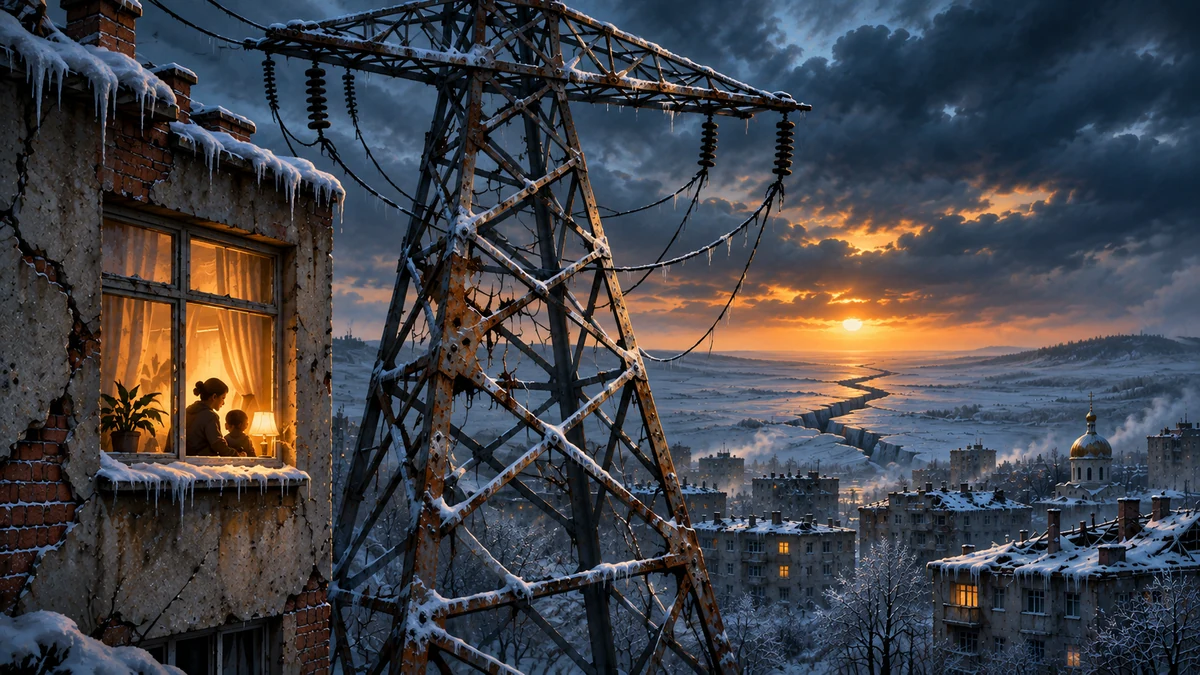
AI-generated editorial illustration of the civilian consequences of war and the risk of wider conflict; it does not depict an actual NATO–Russia confrontation.
Research cut-off date: 25 November 2026.
When the electricity goes out in winter, the consequences of war are no longer confined to the battlefield. Homes grow cold, water supplies become uncertain, and healthcare facilities must provide care under emergency conditions. For people who work for a living and look after their families, security means something quite different from what is discussed in military headquarters and at the highest levels of government. Their security begins with being able to live in their own homes.
In the final instalment of this series on Ukraine, questions of history, political power and economic interests therefore converge on a question about the future: how can the prolonged war between Russia and Ukraine be prevented from escalating into a direct confrontation between Russia and NATO countries? Assessing the conduct of only one side is not enough. We need the same standards for protecting civilians, a consistent distinction between evidence and political statements, and a willingness to examine the decisions of those whose political views are closer to our own.
A War That Extends Beyond Ukraine's Borders
On 24 February 2022, the Russian Federation launched a large-scale military operation in Ukraine, which the Russian authorities call a 'special military operation'. That decision is central to understanding responsibility for the beginning of the current phase of the war, but it does not in itself answer every legal and moral question about the conduct of the warring parties in subsequent years. By 2026, the war had also come to encompass attacks on energy infrastructure on Russian territory, while NATO continued to support Ukraine and strengthen its own defence. [1] [2]
The spread of the war's consequences does not mean that all countries assisting Ukraine are already directly at war with Russia. There are important distinctions between political support, arms supplies, direct military confrontation and the legal assessment of participation in an armed conflict. Nor does every incident outside the main combat zone amount to a deliberate attack on a third country. If these distinctions disappear from public debate, even the description of an event can become a means of escalating tensions.
The danger lies not only in the possibility that a government might deliberately decide to wage a wider war. The risk of conflict also increases when political decisions, military responses and competing perceptions of security create conditions in which errors of judgement are harder to correct. That is why escalation must be considered alongside the consequences of war for people's lives, rather than as a separate geopolitical game.
Russian Attacks on Ukraine's Energy Infrastructure
The winter of 2025–2026 demonstrated how vulnerable Ukraine's energy supply had become. In its report of 29 June 2026, the Office of the United Nations High Commissioner for Human Rights (OHCHR) documented that Russian forces had struck electricity generation, transmission or distribution facilities at least 423 times between October 2025 and March 2026. During the same period, it recorded at least 74 individual strikes on combined heat and power facilities. These figures describe two different categories and must not be added together as a total number of separate attacks. [1]
OHCHR report on attacks on energy infrastructure (29 June 2026)
Findings of the UN Commission of Inquiry (26 October 2026)
North Atlantic Treaty – Articles 4 and 5
Damage to already weakened infrastructure has a cumulative effect. When supplies are unstable, restoring an individual facility does not necessarily restore the normal operation of the entire system. The duration of disruption is therefore an essential dimension of the harm: life in a home where the heating does not work reliably does not return to normal simply because the immediate attack has ended. The UN Human Rights Monitoring Mission’s report for October 2026 finds that Russian attacks on Ukraine's energy infrastructure intensified sharply once again that month. [3]
In its report A/81/440 of 19 October 2026, the Independent International Commission of Inquiry on Ukraine also examined Russian arguments concerning the military significance or dual use of infrastructure. In relation to attacks on civilian objects essential to the population during the waves of attacks it examined, it found that the war crime of intentionally directing attacks against civilian objects had been committed. In examining the broader pattern of widespread and systematic attacks, the Commission found an intention to inflict suffering on the civilian population and linked the pattern to a State policy of depriving people of basic energy supplies. It also characterised these attacks as the crime against humanity of other inhumane acts. [4] [5]
These are specific findings of a commission of inquiry, not a final court judgement on individual criminal responsibility or a claim that every attack on an energy facility has the same legal character. The significance of the report lies precisely in its examination of the actual circumstances, rather than merely the type of infrastructure targeted.
Ukrainian Attacks on Russia's Energy Infrastructure
The energy war was not confined to areas under the control of the Ukrainian government. In its June report, OHCHR recorded Ukrainian attacks on electricity and heating infrastructure in Russia's Belgorod region on at least seven different days between January and March 2026, although it could not fully verify the extent of the damage or the consequences for civilians. It also documented at least 29 strikes on electricity infrastructure in occupied areas of Ukraine between October 2025 and March 2026. [1] There is an important geographical and legal distinction here: occupied Ukrainian territories, including Crimea, are not the same as the internationally recognised territory of the Russian Federation.
OHCHR's monthly report for June 2026 also recorded an increase in Ukrainian attacks on electricity infrastructure in occupied Crimea; at least twelve of them caused outages. [6] These figures show why it would be wrong to exclude the effects of Ukrainian military operations on the provision of essential services to civilians from the analysis. They do not, however, in themselves establish the legal character of each individual attack.
According to a report by Ukrainska Pravda dated 8 February 2026, Ukrainian President Volodymyr Zelenskyy justified attacks on Russia's energy sector by pointing to revenues used to finance Russia's war and to Ukraine’s response to Russian attacks. [7] This is a political explanation of Ukrainian strategy. The fact that economic activity can provide revenue for a state does not mean that all its economic facilities are lawful military objectives. An assessment must be made in the specific circumstances in accordance with the rules of international humanitarian law.
The UN Commission of Inquiry also examined Ukrainian attacks in Russia and in occupied territories, but reported limitations on further investigation of their effects arising from a lack of access to the areas and the Russian authorities' failure to respond to requests for information. [4] [5] An incomplete investigation does not establish either that all the attacks examined were lawful or that they were all unlawful. Demanding accountability must also entail demanding access to evidence.
Civilians and the Destruction of Living Conditions
Two examples from January illustrate why civilian harm must be assessed irrespective of the nationality of those affected. On 20 January 2026, OHCHR cited a statement by the mayor of Kyiv that 5,635 multi-storey residential buildings had been left without heating following renewed Russian attacks. On 10 January, Reuters reported a statement by the governor of the Belgorod region that approximately 600,000 residents had been left without electricity, heating and water following a Ukrainian attack. Reuters filmed the consequences of the outage in the city of Belgorod, but that footage does not confirm the stated total number of residents affected. [8] [9]
The number of buildings and the number of residents are not comparable statistical units. Nor do these statements directly establish the duration of all outages, the full extent of the damage or the legality of the attacks. Both cases, however, raise the same human question: what does the loss of basic living conditions mean when residents have insufficient means of securing alternative supplies for themselves? Harm is measured not only in destroyed equipment but also in the loss of the ability to live safely.
According to OHCHR's report for October 2026, the documented toll was at least 2,957 civilians killed and 17,218 injured in Ukraine from January to October 2026. Total civilian casualties were 63 per cent higher than in the same period in 2025. This is the documented minimum of war-related civilian casualties on the territory of Ukraine, including occupied areas. It is not limited to the consequences of attacks on energy infrastructure. [3]
OHCHR's report of 29 June and its monthly report for August 2026 point to a methodological limitation: opportunities for independent verification of civilian harm in Russia and occupied areas of Ukraine are restricted. Sufficient independent evidence could not be found for the vast majority of the Russian authorities' claims cited in the August report. [1] [10] The data for the two countries therefore do not constitute a complete, combined statistical account. The absence of a verified figure does not prove that civilians did not suffer. At the same time, unverified claims should not be presented as having the same evidentiary weight as independently confirmed cases.
International Humanitarian Law: The Same Standards for All
International humanitarian law does not allow the protection of civilians to depend on a state's political alignment or on who started the war. The question of the legality of the use of force between states must be distinguished from the rules governing conduct during an armed conflict. Even a state's right to self-defence does not remove its obligations when carrying out attacks.
Article 52 of Additional Protocol I to the Geneva Conventions defines the conditions under which an object may constitute a military objective. By its nature, location, purpose or use, the object must make an effective contribution to military action, and its total or partial destruction, capture or neutralisation must offer a definite military advantage in the circumstances prevailing at the time. Civilian objects are protected against attack. [11]
Even when an object meets the criteria for a military objective, the assessment is not complete. Attacks are prohibited if the expected incidental harm to civilians and civilian objects would be excessive in relation to the concrete and direct military advantage anticipated. All feasible precautions must be taken to prevent or minimise such harm. This follows from Articles 51 and 57 of the Protocol. [11]
In its discussion of energy facilities, the International Committee of the Red Cross (ICRC) explains that foreseeable indirect consequences for the civilian population must also be taken into account. The ICRC stresses that attacking energy infrastructure is prohibited if the sole purpose is to weaken the adversary's economic capacity. [12] This is particularly important in assessing energy infrastructure, since the same system can supply both military and civilian users. Dual use implies neither automatic immunity from attack nor automatic permission to attack.
These provisions form the basis for critically assessing Russian and Ukrainian attacks. Applying the same standards does not require finding an equal number of violations on both sides. It requires determining responsibility on the basis of facts, not flags. The UN Commission's findings on Russian attacks must be taken seriously, as must the limitations on its findings concerning Ukrainian attacks. [4] An incomplete assessment is not an acquittal, and a finding by an investigative body is no substitute for judicial proceedings.
Media Coverage and the Question of Double Standards
When we receive information about war from information environments with opposing political perspectives, the question arises as to whether the consequences for civilians are treated with equal seriousness. This is a legitimate question, but it cannot be answered on the basis of a handful of selected headlines. Reuters' January report on Belgorod, for example, demonstrates that outages affecting civilians in Russia did receive media coverage. [9] It establishes neither that the media are generally balanced nor that such events are systematically suppressed.
Coverage on 11 April 2024 provides a concrete example, when Putin publicly justified Russian attacks on Ukraine’s energy infrastructure as a response to Ukrainian attacks. Kommersant and a dedicated Reuters report foregrounded Russia’s explanation. Associated Press and a broader Reuters report, by contrast, foregrounded the damage in Ukraine and included Russia’s explanation in the body of their reports. [19] [20] [21] [22] This difference in editorial framing of the same events can influence readers’ understanding of their sequence and of responsibility. Readers have a right to know Moscow’s arguments as well as the consequences of its decisions. Yet the Western reports examined did not entirely omit the Russian perspective. This limited sample therefore does not establish deliberate distortion or the prevalence of double standards across Western media as a whole. The political and economic context of April 2024 is discussed in greater detail in the thirteenth instalment of this series.
A serious comparison would require identifying the media outlets and time period, selecting comparable events, and examining the frequency of coverage, the prominence of stories, the language used to describe attackers and victims, the presentation of evidence and subsequent corrections. Differences in the scale of attacks and the availability of verifiable data would also have to be accounted for. No such systematic review was conducted for this article, so there is no basis for a definitive conclusion about the prevalence of double standards. Western media should not be exempt from critical scrutiny merely because of the political alignment of the countries in which they operate.
Equally important is the distinction between editorial selection and investigative access. If an independent mission cannot reach the site of an incident or speak to victims, a political demand for symmetrical findings cannot remedy that limitation. [1] [4] Transparency is a measure of good reporting: readers must know what has been verified, what is a statement by the authorities, and what remains unresolved. Solidarity with civilian victims is entirely compatible with such evidentiary discipline.
NATO, European Rearmament and the Security Dilemma
At the NATO summit in Ankara on 8 July 2026, the allies identified Russia as a long-term threat to Euro-Atlantic security. They announced more than USD 50 billion in new defence procurement and an expansion of production capacity. Separately, they pledged EUR 70 billion in military equipment, assistance and training for Ukraine in 2026 and reaffirmed commitments to maintain at least an equivalent level in 2027. [2] These are not the same financial categories, and political commitments are not evidence of disbursements already made.
From NATO's perspective, strengthening defence capabilities is a response to the Russian threat and a means of deterring possible future attacks. Russian Foreign Ministry spokesperson Maria Zakharova described the summit decisions as militarisation and preparation for armed conflict with Russia. [2] [13] These positions express different interpretations of the security situation; in themselves, they do not prove any hidden plans or intentions on either side. Russian assessments must be considered on their merits rather than dismissed because of their origin; the same evidentiary standard applies to NATO's assessments.
In international relations, these reciprocal perceptions can be explained through the concept of the security dilemma. A measure that one state regards as an improvement in its defence may be perceived by another as an increased threat. The latter's response then reinforces the first state's original belief that rearmament was necessary. This is an explanatory framework, not a claim that all parties bear equal responsibility for the outbreak of the war or that there is no distinction between defensive and offensive conduct.
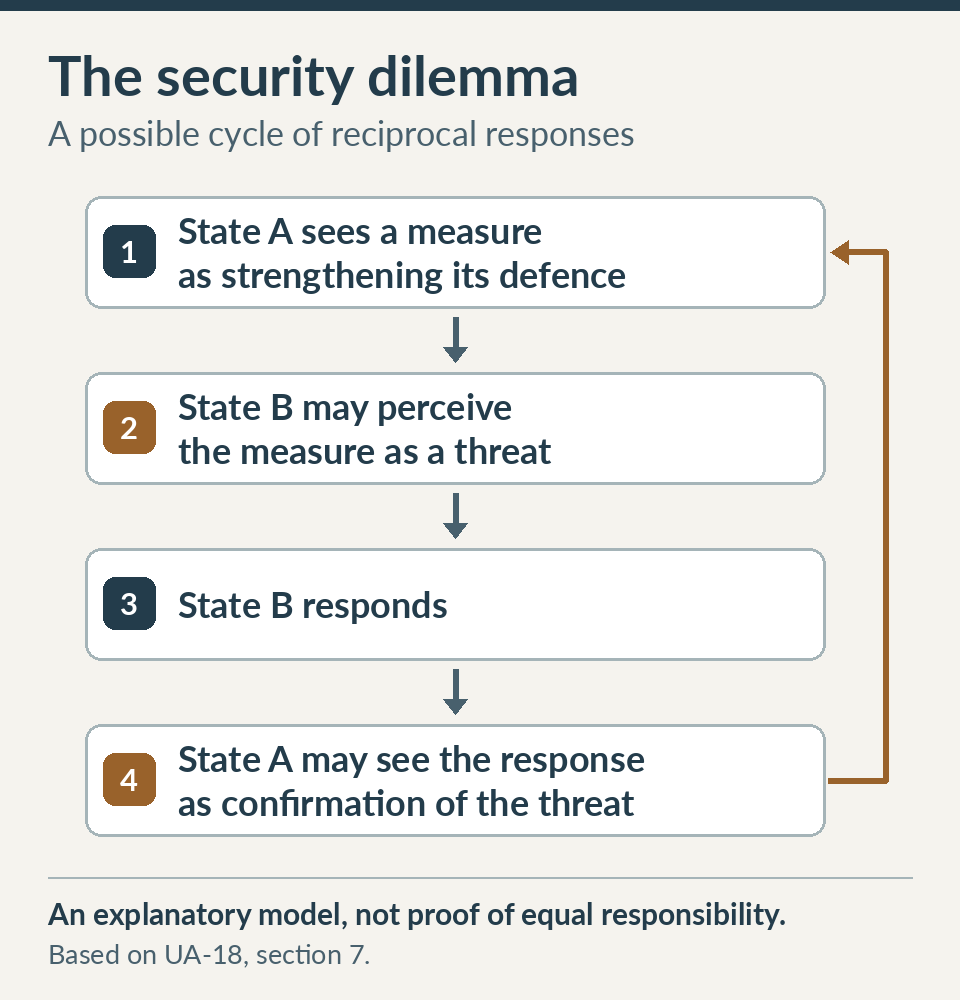
It is in this tension that security and economic policy converge. Multi-year defence commitments raise questions of long-term budgetary obligations, industrial production and political oversight, which are also themes of earlier instalments in this section of the series. The existence of economic benefits arising from defence contracts does not in itself prove that their recipients cause or deliberately prolong the war. It does, however, require that the public be able to distinguish justified security needs from interests that must be subject to democratic oversight.
Military Incidents on the Territory of NATO Countries
Two events in May 2026 illustrate why accurately establishing the origin and intent behind cross-border incidents matters. On 19 May, Estonia's public broadcaster ERR reported that a drone had been shot down over Estonia. In the assessment of the chair of the Estonian parliament's Foreign Affairs Committee, it was most likely Ukrainian; the Estonian defence minister also reported an apology from his Ukrainian counterpart. [14] These statements do not independently establish the intent or all the circumstances of the incident.
On 29 May, Reuters reported that a drone had struck a residential building in Galați, Romania. The Romanian authorities attributed responsibility to Russia, NATO stressed the protection of alliance territory, and the Russian side disputed the accusations. [15] These statements must be distinguished from a definitive independent forensic finding, which was not obtained in this research. The two cases have different evidentiary standing and do not establish a deliberate attack on NATO.
Article 4 of the North Atlantic Treaty provides for consultations among allies whenever one of them considers its territorial integrity, political independence or security to be threatened. Article 5 governs collective assistance in the event of an armed attack within the meaning of the Treaty; each ally takes such action as it deems necessary, including the possible use of armed force. [16] This does not amount to an automatic declaration of war in response to every cross-border incident.
The danger of such incidents lies in the pressure to make rapid decisions before responsibility and the circumstances can be reliably established. Political restraint in the face of pressure to draw premature conclusions is not necessarily a sign of weakness. It can be an expression of responsibility towards the inhabitants of countries that would bear the consequences of a wider conflict.
Nuclear Deterrence and Arms Control
The possibility of a direct conflict between Russia and NATO is particularly serious because of nuclear weapons. Deterrence rests on the assumption that the threat of unacceptable consequences will dissuade an adversary from attacking. Yet this logic does not eliminate the possibility of misunderstanding, misjudgement or a loss of trust. The political question is therefore not only how to maintain deterrence, but also how to prevent threats from developing into actual conflict.
The New START Treaty between the United States of America and Russia expired on 5 February 2026 without a successor agreement entering into force at the time of its expiry. [17] This does not mean that all international restrictions on nuclear weapons have disappeared. It does mean the loss of this particular treaty framework, making future agreements to limit strategic arms all the more important.
In paragraph 4 of their joint declaration of 19 November 2026, the leaders of the United States, Russia and China expressed a willingness to engage in dialogue on nuclear risk reduction and nuclear non-proliferation. [18] It is a public political statement, not a new binding arms control treaty or evidence that the announced measures will be implemented. Its value will depend on whether the stated principles are given concrete and verifiable substance.
Diplomatic talks between rivals are not necessarily an expression of mutual trust. Their purpose may be precisely to limit the consequences of distrust. Where nuclear risk is concerned, it is in everyone's interest that political leaders retain the ability to communicate and reach verifiable agreements even amid profound disagreements.
Between Escalation and De-escalation
Documents from 2026 show several political directions coexisting: strengthening defence capabilities, continuing support for Ukraine, and a stated willingness on the part of nuclear powers to engage in dialogue on risk reduction. [2] [18] These documents provide neither a prediction of direct war nor a guarantee that it can be avoided. The future depends on decisions, their implementation and developments that cannot be fully anticipated.
If military and political tensions increase without effective mechanisms for clarifying incidents, the scope for restrained responses may diminish. If, however, states establish credible channels of communication, adopt verifiable measures to reduce risks and allow independent investigations of violations, the risk of ill-judged decisions may decrease. These are conditional possibilities, not predictions of which outcome will materialise.
De-escalation need not be understood as relinquishing Ukraine's right to defend itself or as a demand to disregard responsibility for the invasion. Nor should it be confused with peace at any price. A sustainable reduction in tensions requires protecting civilians, respecting legal obligations, engaging in political dialogue and finding solutions that do not rest solely on the expectation that the opposing side will accept every demand. The question is how to provide security without gradually destroying the very conditions that make it possible in the process.
Conclusion of the Entire Series: What Future Awaits Europe?
The thematic arc of this series connects the historical roots of the Ukrainian question, different identities, imperial borders and political upheavals with the Cold War, the dissolution of the Soviet Union, disputes over Crimea and the Donbas, and the invasion in 2022. The final section examines European financing, American economic interests, accountability within Ukrainian institutions and the prospects for negotiations. These themes are interconnected, but none of them explains the whole on its own.
Historical context is essential to understanding the war, although it is not in itself a legal justification for invasion. This series pays particular attention to Russia's security perspective and critical scrutiny of Western policy, while the accountability of Russian and Ukrainian authorities remains subject to evidentiary assessment. The purpose of critical inquiry lies precisely in the willingness to ask uncomfortable questions of all those who hold power. Answers must follow the evidence, even when it does not confirm our initial assumptions.
Europe faces a choice that is not simply between rearmament and inaction. It must decide what balance it wants to establish between defence, diplomacy, social security and public expenditure, and how it will maintain democratic accountability in doing so. Citizens have the right to know what goals their governments are pursuing, what commitments they are undertaking and what criteria they use to assess the success of their decisions.
The success of European security policy should not be measured solely by how many weapons have been produced or how much money has been allocated to defence. Its ultimate purpose should be to create conditions in which people do not live in constant fear of the next war. This applies to Ukrainians, Russians and the inhabitants of NATO countries. Human dignity belongs to no particular state or political alliance. Ukrainians must not be treated merely as a means of achieving other states' geopolitical objectives, nor should the security of the Russian population be dismissed as politically irrelevant.
Peace is not the absence of critical questions. On the contrary, it requires us to ask them even when they seem politically uncomfortable, and to answer them with evidence rather than hatred. A wider war is not inevitable. That is precisely why preventing it remains a political, legal and human responsibility today.
Sources and further reading
- OHCHR, Attacks against Ukraine’s Energy Infrastructure and Update on the Human Rights Situation in Ukraine, 1 December 2025 – 31 May 2026, 29 June 2026, summary and paragraphs 14–19, 26, 29–32 (notes 20–22). Source. Source
- NATO, The Ankara Summit Declaration, 8 July 2026, paragraphs 2–4. Source. Source
- OHCHR / HRMMU, Protection of Civilians in Armed Conflict — October 2026 Update, summary and p. 4. Source. Source
- Independent International Commission of Inquiry on Ukraine, report A/81/440, 19 October 2026, paragraphs 31–36 (pp. 8–10). Source. Source
- United Nations in Ukraine, Russian authorities committed crimes against humanity through attacks on Ukraine’s energy infrastructure and trafficked foreign nationals to fight with their armed forces in Ukraine, says UN Commission of Inquiry, 26 October 2026. Source. Source
- OHCHR / HRMMU, Protection of Civilians in Armed Conflict — June 2026. Source. Source
- Ukrainska Pravda, Zelenskyy explains why and how hard Ukraine strikes Russia’s energy sector, 8 February 2026. Source. Source
- OHCHR, Türk says outraged by continued Russian attacks on energy infrastructure, 20 January 2026. Source. Source
- Reuters, report on the Belgorod region governor’s statements concerning outages following a Ukrainian attack, 10 January 2026. Source. Source
- OHCHR / HRMMU, Protection of Civilians in Armed Conflict — August 2026, 16 September 2026. Source. Source
- Additional Protocol I to the Geneva Conventions of 12 August 1949, 8 June 1977, Articles 51(5)(b), 52 and 57(2); text in the ICRC database. Source. Accessible text of the Protocol. Source 1 Source 2
- ICRC, Frequently Asked Questions: IHL and the escalating conflict in the Middle East, explanation of the rules governing attacks on energy infrastructure. Source. Source
- Reuters, Russia denounces NATO summit decisions on aid for Ukraine, defence, 8 July 2026, published on Investing.com. Source. Source
- ERR, Intruding drone shot down by Romanian fighter jet in Estonia, 19 May 2026. Source. Source
- Reuters, Romania says Russian drone hit apartment block, NATO vows to defend alliance territory, 29 May 2026. Source. Source
- NATO, The North Atlantic Treaty, 4 April 1949, Articles 4 and 5. Source. Source
- United Nations, International Day for the Total Elimination of Nuclear Weapons, official account of the expiry of New START (accessible search excerpt). Supplementary source: statement by the UN Secretary-General on the expiry of New START, 5 February 2026 (indexed publication). Source. Secretary-General’s statement. Source 1 Source 2
- White House, U.S.-Russia-China Heads of State Declaration toward Peace, 19 November 2026, paragraph 4. Source. Source
- Kommersant, 11 April 2024 — report on Putin’s explanation of attacks on energy infrastructure. Source
- Reuters, 11 April 2024 — report on Putin’s statement describing the attacks as a response to Ukrainian strikes. Source
- Associated Press, 11 April 2024 — report on damage to a Ukrainian power plant and Russia’s explanation of the attacks. Source
- Reuters / Investing.com, 11 April 2024 — broader report on attacks and damage in Ukraine. Source