Who Wants Peace? Negotiations, Interests and Obstacles to Ending the War
A comparison of peace initiatives, negotiating conditions, security guarantees and limited humanitarian agreements in 2026.

AI-generated editorial illustration: negotiations as an unfinished connection towards peace. The scene does not depict an actual meeting or individual countries.
When representatives of states sit down at the negotiating table, the war is not yet over. Between declarations of readiness for peace and the actual cessation of hostilities lies a space where territorial demands, security fears, political promises and economic interests converge. The negotiations on Ukraine in 2026 reveal how difficult it is to turn individual diplomatic successes into a lasting solution when ideas of an acceptable peace differ. The question, then, is not only who speaks of peace, but also what they are prepared to do to achieve it.
Between public calls for peace and actual negotiating conditions
To understand diplomacy, we must distinguish between a public statement, a concrete proposal, an agreed arrangement and its implementation. A state may call for peace while setting conditions that the other side regards as a threat to its existence. It may reject a particular ceasefire and still accept a humanitarian agreement. These actions allow us to assess its conduct in negotiations, but without further evidence we cannot reliably establish all the intentions of its leadership.
Russia launched a large-scale military operation in Ukraine in February 2022, which the Russian authorities call a 'special military operation'. [1] This historical fact must be distinguished from the assessment of specific diplomatic decisions in the years that followed. Article 2(4) of the Charter of the United Nations prohibits the threat or use of force against the territorial integrity or political independence of any state, or in any other manner inconsistent with the purposes of the United Nations. Article 33 requires parties to a dispute whose continuation could endanger international peace and security to seek a peaceful solution first, including through negotiation or mediation. [2] Efforts to negotiate do not erase responsibility for launching the full-scale invasion, just as acknowledging that responsibility does not remove the need to find a way out of the war.
A ceasefire means a halt to fighting under specified conditions; a peace agreement must address the broader relationship between the parties. A prisoner exchange can be a significant humanitarian achievement even without a ceasefire. Security guarantees, meanwhile, are intended to reduce the risk of renewed war. If we collapse these different forms of agreement into the single word “peace”, we lose the ability to assess progress and setbacks accurately.
Abu Dhabi and Geneva: the beginning of negotiations in 2026
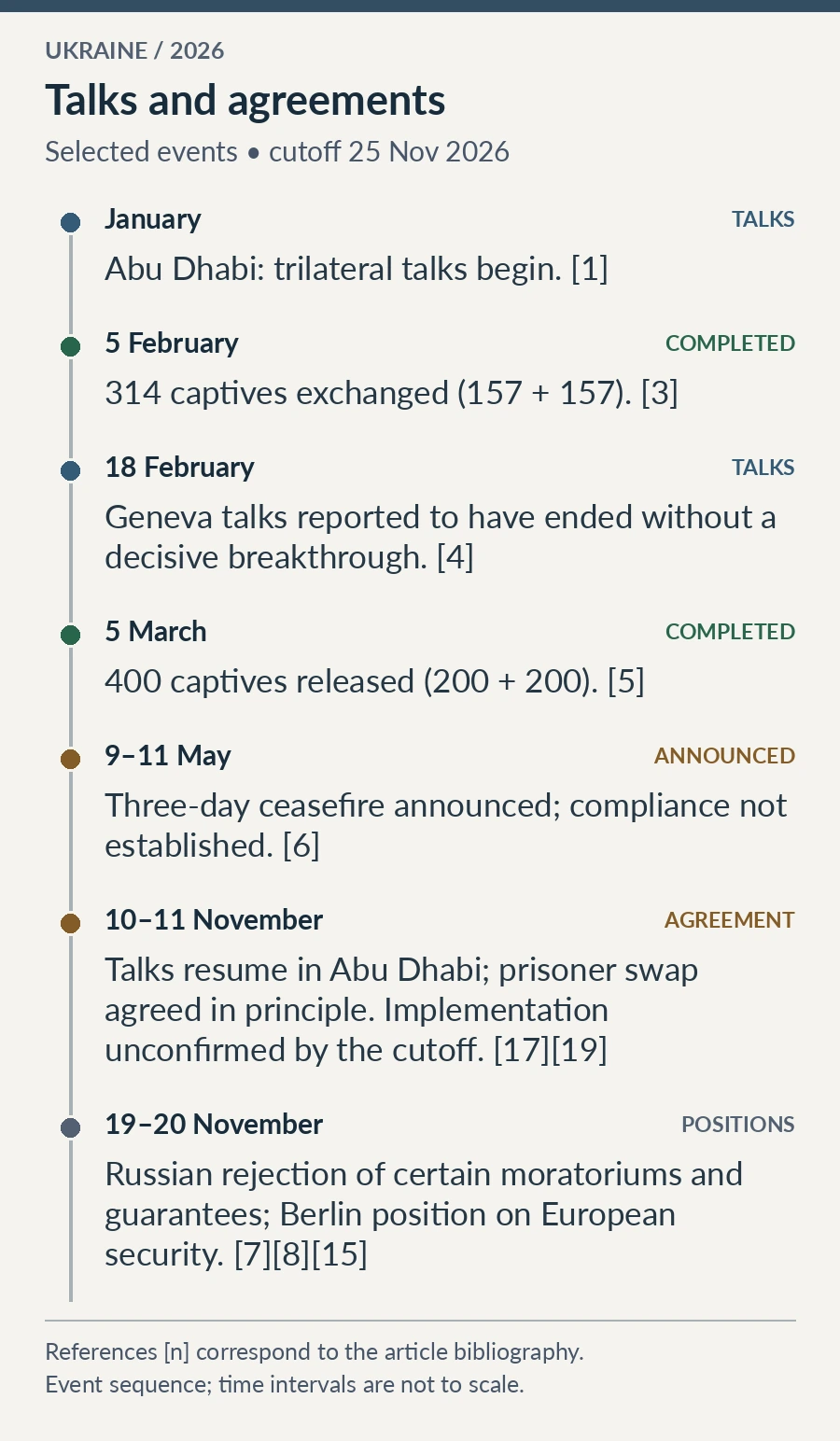
In January 2026, representatives of Russia, Ukraine and the United States met in Abu Dhabi for the first time in a trilateral format, following diplomatic contacts in 2025. In its 7 August review, the US Congressional Research Service (CRS) identifies two further rounds under US mediation. [1] On 5 February, the Ministry of Foreign Affairs of the United Arab Emirates (UAE) confirmed that it was hosting the second round of talks in Abu Dhabi. [3] Negotiations continued in Geneva later in February; on 18 February, Associated Press reported that they had not produced a decisive breakthrough. [4]
The negotiating process operated on several levels. One question was whether the parties could agree on practical measures; another was whether there was a politically acceptable solution to the questions of territory and future security. Progress on the first question did not yet mean agreement on the second. Without the complete meeting records, we also cannot reliably establish which texts were actually offered, how they changed or who rejected a particular version.
The August CRS review finds that formal negotiations had not resumed after the February rounds by the review’s reporting cutoff. [1] This does not mean that all diplomacy ceased in the meantime. Humanitarian mediation, public proposals and contacts with external partners remained possible. Nor does the coincidence of the interruption in formal talks with other international crises in itself establish a single cause for the stalemate.
Humanitarian agreements and temporary ceasefires
Prisoner exchanges stand out among the tangible achievements of the first half of the year. On 5 February, the UAE announced the successful exchange of 314 people, 157 from each side. [3] On 5 March, it announced that joint UAE and US mediation had enabled the release of a further 400 people, 200 from each side. [5] These were two separate events, not a cumulative tally of all exchanges during the war.
The significance of such agreements is not merely diplomatic. For a prisoner and their family, returning home has immediate human value, regardless of whether political leaders reach a broader agreement. The exchanges show that cooperation is possible even between states that remain at war. They do not establish, however, that their leaders have already agreed on the terms for ending it.
On 8 May, Reuters reported Trump's announcement of a three-day ceasefire between Russia and Ukraine, scheduled for 9–11 May. [6] Announcing a ceasefire, accepting its terms and observing them are separate matters. Without systematically verified reports on the implementation of this ceasefire, it is not possible to determine how far it was observed or reliably assign responsibility for any violations.
Such limited agreements are also important as a test of the parties' ability to fulfil their obligations. If communication can be established, responsible representatives designated and an agreed exchange carried out, there is at least some practical foundation for further agreements. But a short ceasefire without clear rules, verification and political follow-through does not yet guarantee lasting peace.
Russian conditions for a peace agreement
Territory and the future security framework are among the central points of dispute. CRS summarises reporting on the August 2025 meeting between Vladimir Putin and Donald Trump in Alaska: the Russian president reportedly offered to halt fighting along the then-existing line of contact in two southern Ukrainian regions if Ukraine ceded populated areas of Donetsk Oblast to Russia. [1] Because we do not have the full original proposal, this summary cannot be treated as a complete list of Russian conditions. Russian proposals must be assessed on their specific content and feasibility, not simply on who put them forward.
In November 2026, specific objections to limited de-escalation initiatives also became apparent. On 19 November, Reuters reported that Putin had ruled out further consideration of proposed moratoriums concerning energy and the Black Sea, citing attacks on the Crimean Bridge. [7] His statement sets out the rationale he gave publicly for the rejection; it does not in itself establish the actual circumstances of the attacks or whether Russia's response was legally justified.
The following day, Reuters reported that Russian Deputy Foreign Minister Sergei Ryabkov opposed security guarantees for Ukraine modelled on NATO's collective defence. [8] Moscow thus publicly emphasises its own security, while the Ukrainian side seeks protection against renewed attack. The rejection of a particular model of guarantees is concrete evidence of a negotiating obstacle, not proof that Russia has rejected every possible security arrangement.
Russian security concerns can be addressed in negotiations on European security, but they do not in themselves create a right to subordinate a neighbouring state by military means. [2] A political solution will need to address both which demands can be reconciled and at what point accepting a particular demand would mean extinguishing the sovereignty of the other party. This is the fundamental distinction between negotiating over security and imposing a political order by military force.
Ukrainian conditions and the territorial question
For Ukraine, territory is not merely a bargaining chip in diplomacy. It encompasses people, homes, economic capacity and prospects for future defence. CRS notes that the Ukrainian authorities rejected the Russian territorial proposal described above partly because they believed losing fortified areas of Donetsk Oblast would weaken their ability to defend against future attacks. [1] This is the documented rationale for Ukraine's position, not an independent assessment of all the military consequences of a possible handover.
In June 2026, according to the CRS review, Volodymyr Zelensky proposed a meeting with Putin in a neutral country and a comprehensive ceasefire during negotiations; Putin reportedly rejected the initiative. [1] In the absence of complete responses from both parties, the entire negotiating process cannot be reconstructed in this case. Nevertheless, the distinction between proposing a halt to fighting during negotiations and continuing the war until political objectives are achieved is itself important to understanding the stalemate.
On 25 August, Reuters reported, citing Zelensky's statements, that there was a document containing ideas drawn up with US and European representatives for submission to Moscow. These included a ceasefire and a previously discussed US proposal for a free economic zone in Donbas administered by a third party. [9] This was a description of options under consideration, not evidence that the negotiators had agreed on the territory's legal status, boundaries or administration. Without the text of the proposal and confirmed responses, it cannot be presented as an accepted plan.
A temporary ceasefire line is not necessarily an internationally recognised border. An agreement to halt fighting can defer a final settlement of the territorial question without automatically recognising a change in sovereignty. At the same time, postponement does not resolve the difficulties faced by people in disputed areas. In assessing the acceptability of a solution, their rights and security must be considered, not just the positions of states on a map. Rejecting a particular territorial concession is therefore not in itself a rejection of peace; the specific solution offered and its consequences must be assessed.
The Trump administration and US mediation
The United States acts as a mediator in the negotiations, but it is not without political and strategic interests of its own. Its ability to influence the course of diplomacy is linked to its relations with Moscow, its support for Kyiv and its cooperation with European countries. The US mediator must therefore reconcile not only the positions of the warring parties, but also the expectations of its own domestic public and its allies.
The CRS review notes that Secretary of State Marco Rubio questioned the usefulness of the talks to date in May and expressed US willingness in July to consider new ideas should suitable circumstances arise. [1] It does not follow that Washington had permanently withdrawn from the peace process. It does indicate, however, that the mediator's willingness is not unlimited and that it also assesses diplomatic efforts in terms of their political effects.
In November, the Financial Times reported on US efforts to secure an agreement by the beginning of the following year. [10] In an interview reported by Meduza on 25 November, Zelensky described the US envoys' desire for an agreement as soon as possible, preferably by January 2027. According to the same report, Trump denied having a fixed deadline. [11] This is a distinction between a desired target and a formal commitment, not evidence of an ultimatum.
Time pressure can be helpful if it encourages parties to make decisions they would otherwise postpone. But it can also be harmful if the speed of signing takes precedence over the feasibility of the provisions. Assessing US mediation therefore requires more than asking how quickly it seeks an agreement. It also matters whether the proposed agreement reduces the risk of renewed war and whether the parties are prepared to implement it.
The European Union and its role in negotiations
Official photo gallery: Coalition of the Willing meeting in Berlin, 19 November 2026
European countries have a direct stake in the future security framework in the context of the war in Ukraine. But the European Union, individual member states, the United Kingdom and NATO are not one and the same political or legal institution. Their respective powers and forms of cooperation must be distinguished, even when they present a united front in public.
A statement published on the website of the Council of the EU on 10 November documents coordination among representatives of European partners, Ukraine and the United States ahead of trilateral talks with Russia. [12] A later publication on 13 November describes European representation bringing together the EU institutions and the group of France, Germany, Italy, Poland and the United Kingdom (E5). [13] Such coordination does not mean that the form of European participation in all subsequent negotiations had already been agreed. According to Reuters on 19 November, Putin said that Moscow had invited European envoys to discuss their positions before determining the format of further negotiations. [14]
In a joint statement on 19 November, the leaders of Germany, France, the United Kingdom and Ukraine stressed the need for robust and legally binding guarantees upon the entry into force of a ceasefire. Among the possible elements they listed were a US-led ceasefire monitoring mechanism, a European-led multinational force, continued support for Ukraine's defence capabilities and a legal commitment to act in the event of a possible future Russian armed attack, subject to national procedures. [15] These possibilities are not equivalent to an international agreement that has already been concluded, ratified or brought into force. Assessing these proposals also requires examining how they would affect Russia's security concerns and the prospects for reaching an agreement.
Following the meeting of the Coalition of the Willing in Berlin on the same day, the German government reported continued joint support for Ukraine. [16] Military aid and peace diplomacy are not necessarily mutually exclusive within such a policy. Supporters of aid believe it enables Ukraine to defend itself and improves its negotiating position; critics may point out that prolonged arms supplies increase risks and make compromise more difficult. The actual effect of a particular policy must be assessed in light of specific decisions and consequences, not merely the label attached to it.
The resumption of negotiations in November
After a long interruption in formal trilateral talks, representatives of Russia, Ukraine and the United States met again in Abu Dhabi on 10 and 11 November. On 10 November, the UAE officially announced the third round in that city, which does not mean the third round across all negotiating formats that year. [17] The negotiations mattered in themselves because they made it possible to re-establish direct dialogue on outstanding issues.
On 11 November, Meduza reported that the head of the Russian delegation, Vladimir Medinsky, had announced an agreement on a prisoner exchange and a convergence of views on some aspects of European security. [18] On the same day, Associated Press reported that the heads of both delegations had confirmed a planned large-scale exchange, which Medinsky described as an agreement in principle; there had been no decisive breakthrough towards peace. [19] By the research cutoff of 25 November, the material reviewed did not establish that this particular agreed exchange had been carried out. It therefore cannot be counted among releases already carried out.
Developments after the talks show why the resumption of dialogue must be distinguished from the conclusion of peace. Russian objections to certain moratoriums and guarantees, and European demands for Ukraine's protection, continued to be publicly expressed after the November meeting. [7][8][15] Besides the substance of a future agreement, the order in which issues are to be negotiated also remains unresolved. On 11 November, Reuters reported that Russian representatives demanded a broader agreement on European security arrangements before resolving specific issues of the war. [20] On 19 November, however, the leaders meeting in Berlin stressed that agreements on broader European security were impossible while Russia continued its war against Ukraine. [15] The negotiating channel had reopened, but the available sources do not indicate that the fundamental differences over territory and security had been resolved by 25 November.
Economic interests and political obstacles to peace
War changes economic relationships. Government contracts, energy policy, sanctions, financial assistance and future reconstruction create different interests. Some economic actors may gain contracts because the war continues, while others lose markets, property or access to raw materials. These consequences are important matters for scrutiny, but the existence of a benefit cannot automatically establish the cause of a political decision.
An illustrative example of the opposite possibility comes from Reuters on 25 November, citing the Financial Times: the Trump administration reportedly abandoned ideas for business projects as an incentive for Russia to end the war after Moscow showed insufficient interest in the proposed deals. [21] The report concerns purported business proposals, not contracts known to have been concluded or personal financial gains for mediators. Since direct documentation of the negotiations is unavailable, the claim remains attributed to media reporting.
Economic incentives can therefore work in different directions. A particular business interest may encourage continued spending on the war or make the normalisation of relations after its end more attractive. The same applies to sanctions: lifting them may be a negotiating lever, but whether doing so is justified depends on the conditions and the fulfilment of obligations. When asking who benefits from the war, we must therefore distinguish between financial benefit, political influence and demonstrated conduct that has contributed to the continuation of hostilities.
Alongside economic factors lies the political problem of accepting compromise. Leaders must contend with their own public promises, the expectations of the population and the question of how to justify departing from declared objectives. This is a possible general explanation for negotiating rigidity, not evidence of the private motives of any particular leader. Detailed accounts of aid, defence procurement and anti-corruption cases belong in other parts of this series; they cannot in themselves substitute for evidence of conduct at the negotiating table. Western governments that influence negotiations must be prepared to explain publicly how their demands contribute to reducing violence.
What should a sustainable peace agreement contain?
Several criteria for assessing a future solution can be derived from the events examined here. These criteria are the author's synthesis, not the text of an agreement already concluded. The first condition is a clearly defined and verifiable cessation of fighting. An agreement must specify when it enters into force, what forms of hostilities it covers, who monitors it and how alleged violations are addressed. Without a reliable way of establishing the facts, differing interpretations of a single event may be enough to lead to renewed violence.
The second condition is the humanitarian dimension. Prisoner exchanges, the issue of missing persons, civilian protection and access to emergency aid should not depend exclusively on the success of broader political negotiations. The third condition is a distinction between temporary arrangements on the ground and the final legal status of territory. Sovereignty, international law and the rights of the affected population must be taken into account.
The fourth condition is security guarantees that are more than political declarations. Their value depends on how precisely the obligations are defined, the ability of states to fulfil them and the response envisaged in the event of violations. Addressing broader European security can be part of diplomacy, but it must not negate Ukraine's ability to make its own decisions. The fifth condition is political and institutional feasibility: clearly identified parties responsible for obligations, the necessary national procedures and a timetable for implementation. A more durable settlement also requires serious consideration of Russia's security concerns, without negating Ukraine's rights.
The answer to the question in the title is therefore not a simple classification of states into supporters and opponents of peace. In 2026, Russia and Ukraine cooperated on individual humanitarian agreements, but differences over territory, a ceasefire and security guarantees remained. The United States and European partners sought to influence the negotiations, but their initiatives were not equivalent to a final agreement. Documented Russian rejections of certain ceasefire and security guarantee initiatives constitute concrete obstacles. Ukraine's rejection of a territorial proposal concerns a different issue and has a different stated rationale. US preferences regarding timing and European security demands must be assessed according to whether they help remove these obstacles or create new ones. The available evidence does not allow equal responsibility to be attributed to all actors, nor does it permit a definitive classification of their motives. The most important measure of readiness for peace will be the ability to accept and fulfil obligations that actually stop the violence, protect people and do not create the conditions for the next war.
Research cutoff: 25 November 2026. The complete texts of certain negotiating proposals and meeting records were unavailable; some media sources were reviewed through publicly indexed excerpts. Publicly expressed positions are therefore not treated as a complete record of the negotiations.
Sources and further reading
- Andrew S. Bowen and Cory Welt, Congressional Research Service. Russia’s War Against Ukraine: Diplomatic Talks and U.S. Policy, IN12534, updated 7 August 2026, pp. 1–2. source Source
- United Nations. Charter of the United Nations (1945), Articles 2 and 33. source Source
- UAE Ministry of Foreign Affairs. Latest UAE Mediation Efforts Succeed with Exchange of 314 Captives Between Russia and Ukraine, 5 February 2026. source Source
- Associated Press, 18 February 2026. Envoys signal no breakthrough on bridging Russia and Ukraine’s political and military differences. source Source
- UAE Ministry of Foreign Affairs. Latest UAE–US Mediation Efforts Succeed with Exchange of 400 Captives Between Russia and Ukraine, 5 March 2026. source Source
- Reuters, 8 May 2026. Trump announces three-day ceasefire between Ukraine and Russia, via Investing.com. source Source
- Reuters, 19 November 2026. Report on Putin’s rejection of energy and Black Sea moratoriums (descriptive reference). source Source
- Reuters. Russia pushes back against US idea of NATO-style security guarantees for Ukraine, 20 November 2026. source Source
- Reuters, 25 August 2026. Ukraine’s Zelenskiy sees window for U.S. mediation until summer 2027, via MarketScreener. source Source
- Financial Times, 20 November 2026. Donald Trump seeks Ukraine peace deal before January. source Source
- Meduza. Zelensky says U.S. wants peace deal by January. Trump says he’s ‘not under a timeline’ for ending war., 25 November 2026. source Source
- Council of the EU. Statement on today's meeting in Abu Dhabi between the EU, France, Germany, Italy, United Kingdom, Ukraine, United States and NATO, 10 November 2026. source Source
- European Council, President. Post on European representation, 13 November 2026 (descriptive reference). source Source
- Reuters. Putin says Russia invited Europeans to Moscow to clarify position on Ukraine talks, 19 November 2026. source Source
- German Federal Government (joint statement by four leaders). Joint Statement by the leaders of Germany, France, the United Kingdom and Ukraine, 19 November 2026. source Source
- German Federal Government. Meeting of the Coalition of the Willing in Berlin, 19 November 2026. source Source
- UAE Ministry of Foreign Affairs. Announcement of the start of the third round of talks in Abu Dhabi, 10 November 2026 (descriptive reference). source Source
- Meduza. Russia–Ukraine peace talks conclude in Abu Dhabi with prisoner exchange agreement but no breakthrough on territory, 11 November 2026. source Source
- Associated Press. Russia and Ukraine agree to a large prisoner exchange as talks end with no major breakthrough, 11 November 2026. source Source
- Reuters. Russia, Ukraine reach deal on prisoner swap as US says lack of trust holds back talks, 11 November 2026. source Source
- Reuters. US shelves plans for business deals with Russia to end Ukraine war, FT says, 25 November 2026. source Source