The Secret World Government (1926): Cherep-Spiridovich and His “Hidden Hand”
In 1926 Russian émigré Arthur Cherep-Spiridovich claimed that wars, revolutions, finance and the press were directed by roughly 300 people under a “Hidden Hand”. This article first reconstructs what the book actually says, then tests what was already disputed at the time and what modern research really shows about concentrated power.

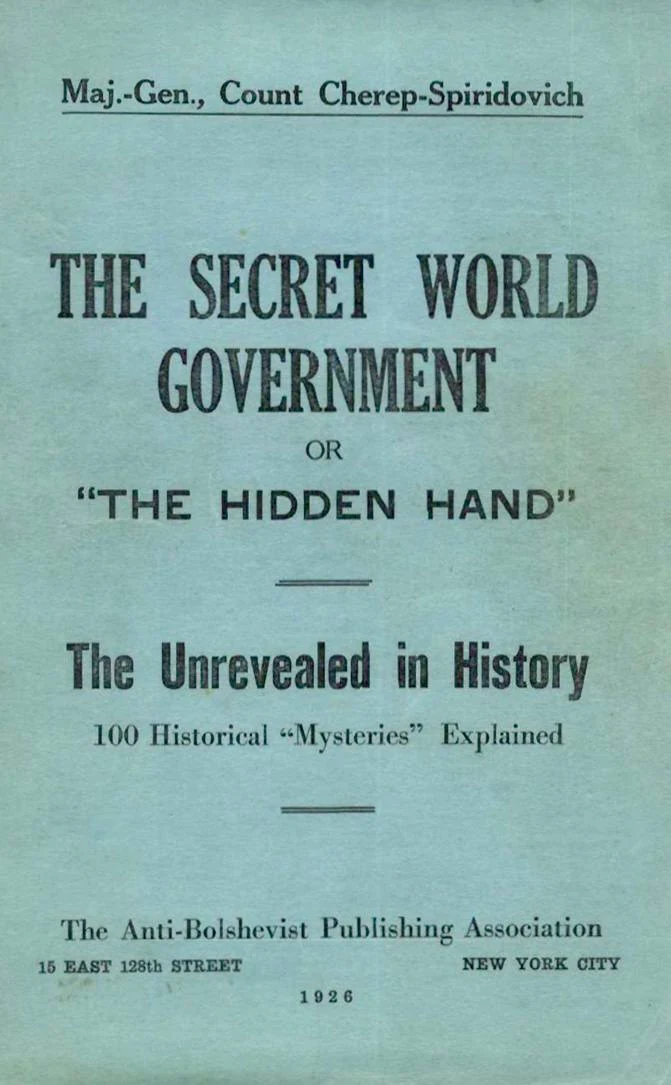
In 1926, a book appeared in New York titled The Secret World Government, or “The Hidden Hand”: The Unrevealed in History; 100 Historical “Mysteries” Explained. On its title page the author presents himself as Maj.-Gen., Count Cherep-Spiridovich, and the publisher is the Anti-Bolshevist Publishing Association. Today the book circulates online largely because of the claim that, almost a century ago, it described a world in which formal governments are only the visible administrators of deeper financial and informational power.
The book is real, and several viral quotations are genuinely drawn from its pages. Cherep-Spiridovich does write of roughly 300 people whom he says compose a “World Government” or “Hidden Hand”, and he singles out Paris banker Édouard de Rothschild as its leading figure. He also warns, before the Second World War, of another world war and claims that dozens of political forecasts in his earlier books had already come true.
But the first evidentiary distinction matters: the fact that an author wrote a claim in 1926 proves that he advanced the claim; it does not prove the claim was true. This article therefore reads the book on two levels. First as a historical document — what exactly does he allege, whom does he name, and how does he connect revolution, debt, the press and war? Then as an evidence problem — what can be checked against sources independent of the author?
The most interesting question is therefore not whether we must choose between “official history” and Cherep-Spiridovich. It is harder: did he notice real structures of concentrated power and then supply them with an incorrect or unproven explanation? A century later, financial networks, concentrated ownership, lobbying, propaganda and institutional influence can be studied far more directly than he could study them. That makes it possible to test his thesis more strictly, not less.
Who was writing, and in what world did the book appear?
Bibliographic records confirm a New York edition in 1926, roughly 195 pages long, with the title visible on the surviving scan. Cherep-Spiridovich was a Russian émigré political activist, monarchist and fierce opponent of Bolshevism. The publishing frame alone — the Anti-Bolshevist Publishing Association — shows that this was not neutral academic history but an interventionist political work written in the atmosphere of the Russian Revolution, civil war, exile and fear of communist expansion.
The author presents himself as a man of exceptional political foresight. The opening pages collect praise from newspapers and editors and claim that his seven pre-war books contained more than eighty successful forecasts. This self-presentation matters: he is not merely asking the reader to consider an argument, but also to trust his alleged ability to see the forces “beneath” ordinary history.
The same opening material also exposes the ideological core. Although the introduction says the book is “mostly about Jews” and “not against the Jews”, the text that follows contains sweeping collective accusations against Jews, racial hierarchies, repeated appeals to an “Aryan Race” and satanising language about entire groups. It therefore has to be read as a document of White Russian anti-Bolshevik and antisemitic political culture, not as a neutral intelligence report.
Provenance does not decide the truth of every claim, but it determines the evidentiary burden. A political polemic may contain true facts; its sweeping connecting claims still require outside corroboration.
What does the “Hidden Hand” mean in Cherep-Spiridovich’s model?
The book’s core idea is that visible state leaders are not the final holders of power. Cherep-Spiridovich posits a small transnational circle that he variously calls the World Government, Hidden Hand, the “300” or a “Supreme Council”. In one of the book’s most cited formulations, he says that Édouard de Rothschild and roughly 300 others compose this secret world government.
His model is totalising. Almost every major conflict, revolution or political change is drawn into one causal chain. The “Hidden Hand” is said to influence banks, the press, ministers, revolutionary movements, war finance and international relations. When an event fits the model it becomes confirmation; when direct evidence is absent, the absence is often explained as the result of press control or concealment.
That creates the classic problem of a theory that explains too much. If both a public trace and the absence of a public trace can count as evidence for the same model, it becomes difficult to specify what could falsify it. This does not mean covert coordination or secret networks never exist. It means each proposed connection must have an independently testable chain of evidence.
A useful distinction for the whole article: a network of influence ≠ one command centre; concentrated capital ≠ proof of a shared secret will; secrecy in one operation ≠ proof of one hidden government behind all events.
Finance, revolution and information: three recurring axes of the book
If the book’s racial theory is removed, three themes remain that make it feel surprisingly modern to some readers. The first is finance: debt, credit and ownership can constrain formal political sovereignty. The second is revolution: social rupture can reset institutions and power relations. The third is information: the press can influence which interpretations of events become publicly normal.
All three are legitimate research questions. States depend on credit markets; firms and banks possess varying degrees of economic power; revolutions alter institutions and ownership; and media can influence attention and framing. The problem in Cherep-Spiridovich’s argument is not that these questions are forbidden. It is the leap from measurable influence to a single coordinated ethnic group allegedly controlling all three mechanisms.
The same distinction matters today. If a bank, fund, corporation or intelligence service has measurable influence, that can be documented through ownership, contracts, decisions, communications, financing and personnel links. If we claim that dozens of such institutions jointly execute one hidden plan, we still need evidence of coordination, a chain of command and a shared objective.
| Question | What can be measured | What requires additional evidence |
|---|---|---|
| Finance | ownership, credit, debt exposure, voting rights | that different financial actors obey one secret command |
| Revolution/political rupture | funding, organisations, documented operations, foreign support | that an entire transformation was designed end-to-end by the same hidden circle |
| Information | media ownership, advertising, editorial frames, distribution | that all major media knowingly execute one secret order |
Édouard de Rothschild and the “300”: real power, unsupported conclusion
Here it is essential to separate the real person from the theory built around him. Édouard Alphonse James de Rothschild (1868–1949) was an important French banker. The Rothschild Archive confirms that from 1905 he directed the Paris house de Rothschild Frères with Robert de Rothschild and served as a director of the Banque de France. Cherep-Spiridovich therefore did not select an imaginary person with no financial influence.
But the fact that Édouard de Rothschild was an important banker does not establish the much larger claim that he led a 300-member secret world government that issued orders to politicians, controlled the press and staged wars. The book repeatedly asserts this connection, yet the evidence chain reviewed here does not produce an organisational charter, membership list, minutes, command structure or independently corroborated communications establishing such a body as historical fact.
This is a good example of how a person’s genuine social position can make a much larger hypothesis feel intuitively plausible. If someone truly is wealthy, truly directs a major banking house and truly participates in elite networks, the next unsupported step can become easier to accept. But “influential” and “supreme secret ruler” are separate claims.
The evidence therefore records two different statuses: Édouard de Rothschild as an influential Paris banker — documented. “Édouard + 300 = secret world government” — an authorial allegation not independently established in the sources reviewed.
The Protocols, “Judeo-Bolshevism” and the problem with the “Khazar” update
The book repeatedly uses The Protocols of the Learned Elders of Zion as a confirming framework. This matters because the Protocols had already been publicly exposed in 1921 — five years before this book — as a plagiarism and forgery. Philip Graves’s series in The Times compared passages with a nineteenth-century work by Maurice Joly; historical institutions now treat the Protocols as one of the most influential antisemitic forgeries of the modern era.
After the 1917 Revolution, the myth of “Judeo-Bolshevism” spread widely in Europe and among White Russian émigré circles — the idea that communism was not a political movement with diverse participants but a Jewish project aimed at destroying nations and Christian civilisation. Cherep-Spiridovich not only adopts this framework; he expands it into a global explanation for wars, banks, the press and revolutions.
A necessary correction to modern online retellings: his racial term “Judeo-Mongols” cannot simply be translated as “Khazar converts to Judaism”. In the digitised edition used here, a text search found no occurrence of “Khazar”. The author uses a wider racial category of “Mongol/Asiatic” and fuses it with Jews and Bolshevism. Historical Khazaria did include ruling or elite groups that adopted Judaism, although the scale of conversion remains uncertain.
More importantly, modern genomic research does not support the equation Ashkenazi Jews = descendants of Khazar converts. Genome-wide studies of multiple Jewish populations identify substantial shared Middle Eastern/Levantine ancestry together with varying admixture from diaspora environments; a 2013 genome-wide analysis found no evidence supporting a substantial Khazar origin for Ashkenazi Jews.
This does not make Khazar history uninteresting. It simply means Cherep-Spiridovich’s racial label should not be modernised into a “Khazar” claim and then presented as if the author or modern genetics had proved it.
Did he “predict the future”? What survives a prediction audit
Perhaps the strongest modern argument for the book is: “look, he predicted what later happened.” There is something genuinely notable here. WorldCat catalogues a separate work titled Let us prevent the second world war already prepared! from 1921. In the 1926 book the author repeatedly warns of another world war. He therefore did use the phrase and warn of another major conflict long before 1939.
Yet a prediction of “another major war” was less unique in the interwar period than it can appear in hindsight. French security thinking in the 1920s was deeply concerned with the possibility of another conflict with Germany; the United States and other states pursued disarmament initiatives; and the 1928 Kellogg-Briand Pact tried to renounce war as an instrument of national policy. John Maynard Keynes had already warned in 1919 that the postwar settlement could produce severe political and economic instability.
A strict audit therefore needs more than one apparent hit. It requires the complete set of forecasts before the events, their specificity, their time horizons and the misses as well as the hits. Cherep-Spiridovich claims more than eighty successful forecasts, but the book supports this mainly through retrospective self-reporting and selected endorsements. That is not the same thing as an independent 80-for-80 audit.
| Claim | What can be confirmed | What remains open |
|---|---|---|
| “Second World War” before 1939 | his 1921 title and 1926 warnings exist | whether he correctly forecast timing, actors, causes and course |
| “80+ successful prophecies” | the author and introductory endorsements claim it | a complete independent list of forecasts and failures is not established |
| war caused by the “Hidden Hand” | this is his central explanation | evidence for one organisation, orders and a causal command chain is not supplied |
A prediction audit asks not only “did something similar happen?” but also “what exactly was predicted, when, with what time horizon, and how many other forecasts failed?”
What can be tested today: concentrated power without a single switch
A century later, we have better tools for examining the book’s underlying question: does economic power concentrate in relatively small networks? By some measures, yes. A 2011 network study by Vitali, Glattfelder and Battiston mapped transnational corporate ownership and found a tightly connected core in which a substantial share of control flowed through financial institutions. The authors described this as an economic “super-entity”.
Modern research on common ownership likewise studies situations in which large institutional investors hold stakes across multiple firms in the same industry. This can raise genuine questions about corporate governance, competition and influence. These are empirically tractable phenomena: ownership registries, voting rights and stewardship practices can be analysed.
But those findings do not yield Cherep-Spiridovich’s “government of 300”. Network concentration can arise from market structure, index investing, regulation, capital aggregation and institutional specialisation. Concentration identifies potential influence; it does not automatically prove common ideology, ethnic coordination, a secret command structure or joint authorship of world events.
This is where the book is most useful today as both a warning and a warning example. It is right to ask who finances, who owns, who controls access to information and who can translate resources into institutional influence. The unsupported step is to turn a complex, multi-centred network into one ethnic story with one command centre without additional evidence.
How to read the book now: a history-of-ideas document, not a map of hidden rulers
The Secret World Government is worth reading primarily because it brings together in one document several ideas that still circulate in political culture: a small circle of “300”, the Rothschilds as a symbol of financial power, the Protocols, the press as a controlled weapon, financial governance of states, planned revolutions and an approaching new world war. It therefore shows that many apparently new internet theories have a much older genealogy.
At the same time, it is a strong example of why research into power must remain specific. If we are talking about a bank, show ownership and contracts. If we are talking about a covert operation, show documents, money flows, communications and command chains. If we are talking about media influence, measure ownership, distribution, repetition and framing. If we are talking about an ethnic or religious population, collective guilt is not a substitute for evidence about specific people and acts.
The book can therefore be taken seriously without treating its central conspiracy as established fact. Cherep-Spiridovich understood that formal office is not the only form of power. That does not automatically mean he correctly identified one unified group, its membership and its purpose. Between those claims lies the work of historical verification.
The most useful question is not “do I believe in the Hidden Hand?” but: which specific power relationships can I document, which am I merely inferring, and what evidence would have to exist for an inference to become historical fact?
Sources and further reading
- Cherep-Spiridovich, Arthur. The Secret World Government, or “The Hidden Hand”: The Unrevealed in History; 100 Historical “Mysteries” Explained. New York: Anti-Bolshevist Publishing Association, 1926. Primary digitised scan.
- Indiana University Libraries / IUCAT. Bibliographic record for The Secret World Government (1926): publisher, pagination and catalog metadata.
- WorldCat. Let us prevent the second world war already prepared! — catalog record for Cherep-Spiridovich’s 1921 work.
- The Rothschild Archive. Édouard Alphonse James de Rothschild (1868–1949): director of the Paris House and director of the Banque de France.
- The Rothschild Archive. de Rothschild Frères, Paris banking house: leadership chronology showing Édouard Alphonse James de Rothschild, 1905–1949.
- United States Holocaust Memorial Museum. An Antisemitic Conspiracy: The Protocols of the Elders of Zion — forgery, dissemination and post-1917 Judeo-Bolshevism context.
- The Times (1921), reproduced at Wikisource. The Truth About “The Protocols”: A Literary Forgery — contemporary plagiarism demonstration.
- United States Holocaust Memorial Museum. Communism — “Judeo-Bolshevism” as an antisemitic conspiracy construct.
- Shapira, Dan D. Y. “Khazars.” Encyclopaedia Iranica — evidence and uncertainty around the Khazar ruling elite’s conversion to Judaism.
- Behar, Doron M., et al. “The genome-wide structure of the Jewish people.” Nature 466 (2010): 238–242.
- Behar, Doron M., et al. “No evidence from genome-wide data of a Khazar origin for the Ashkenazi Jews.” Human Biology 85(6) (2013): 859–900.
- Vitali, Stefania, James B. Glattfelder, and Stefano Battiston. “The Network of Global Corporate Control.” PLOS ONE 6(10) (2011): e25995.
- Backus, Matthew, Christopher Conlon, and Michael Sinkinson. “Common Ownership in America: 1980–2017.” / related modern common-ownership literature; contextual gateway for institutional cross-ownership.
- U.S. Department of State, Office of the Historian. Interwar Diplomacy, 1921–1936 — disarmament and international efforts to prevent another world war.
- Council on Foreign Relations. The 1928 Kellogg-Briand Pact to Outlaw War — context for French fear of renewed conflict and interwar peace efforts.
- Marshall Library, University of Cambridge. The Economic Consequences of the Peace by J. M. Keynes (1919) — contemporary postwar warning context.
- Jewish Telegraphic Agency, 25 October 1926. Contemporary report describing Cherep-Spiridovich as an antisemitic agitator and linking his publication to the Protocols milieu; treated as a contemporaneous interested source, not sole authority.
- University of Pennsylvania, Online Books Page. Arthur Cherep-Spiridovich bibliography and links to digitised editions.