The Templars and the Assassins — James Wasserman: Templars, Nizari Ismailis, and esoteric connections
James Wasserman places the Templars and the Nizari Ismailis in the same Crusader world and looks for spiritual and initiatory connections between them; this article separates documented contact, medieval legend, and the author’s esoteric interpretation.
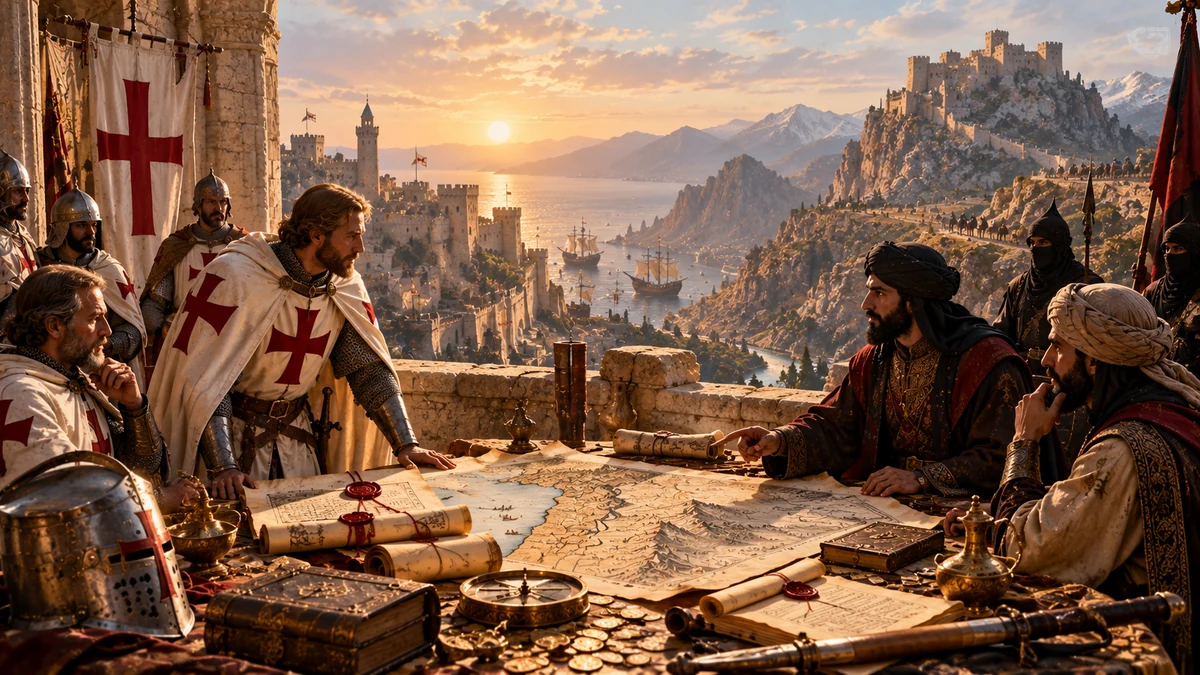
In his 2001 book The Templars and the Assassins: The Militia of Heaven, James Wasserman brought together two medieval communities that later became magnets for legend: the Christian Knights Templar and the Nizari Ismailis whom European sources called the “Assassins.” His central thesis is not merely that the groups met in the same political arena, but that their contact may have contributed to an inner spiritual transformation of the Templars. [1]
The first part of that story is historically solid: the Templars and the Syrian Nizari Ismailis did operate in the same eastern Mediterranean environment, negotiating, forming temporary arrangements, paying or collecting tribute, and interacting within a complex field of Frankish and Muslim powers. Specialist scholarship documents such contacts. [4][6][7]
The second part requires greater caution. The fact that two organizations interacted is not itself evidence for the transfer of a secret initiatory system, Gnostic doctrine, or a later Masonic genealogy. This article therefore reads Wasserman on three levels: documented medieval history, medieval and modern legend, and his own esoteric interpretation. [1][8]
Two organizations made more alike by later myth than they originally were
Wasserman begins with a powerful comparison: the Templars and the Nizari Ismailis were disciplined religious communities with fortresses, internal hierarchy, vows of loyalty, and military-political functions. That comparison is legitimate, but structural similarity does not establish common origin. [1][4]
The Templars emerged within the Latin Christian world of the Crusader states and developed into a papally recognized military order. The Nizari Ismailis emerged from a Shi‘i-Ismaili succession conflict and created a network of fortified centers in Persia and Syria. Their theology, institutional history, and political circumstances were different. [2][4]
The article therefore uses a comparative reading: it looks for documented contacts and parallels while treating Wasserman’s shared genealogy as the author’s interpretation. [1][7]
The Templars: from protecting pilgrims to a military-financial institution
The Templar order arose in the early twelfth century in the setting of Crusader Jerusalem. Over the following decades it accumulated estates, privileges, and a transnational infrastructure linking the Levant to Europe. Military discipline and religious life were publicly recognized parts of its identity; the image of a wholly secret esoteric organization is much later. [2][3]
Its wealth, autonomy, and direct papal protection also increased its later political vulnerability. When Philip IV of France initiated the arrests in 1307, accusations included denial of Christ, spitting on the cross, illicit sexual practices, and worship of a mysterious idol. Interrogations in France were heavily marked by coercion and torture. [3]
This matters for Wasserman’s interpretation: accusations of secret rites certainly existed, but the existence of accusations is not the same as proof that the Templars had adopted Ismaili or other Eastern secret teachings. [1][3]
The Nizari Ismailis: Alamut, the fida’is, and the making of the “Assassin” legend
From the late eleventh century the Nizari Ismailis established a network of fortresses, with Alamut becoming the most famous symbol of their political and intellectual center. In an intensely hostile environment they also used selective assassination against important opponents; sources describe fida’is prepared for dangerous missions. [4][5]
Yet the European image of the “Assassin” quickly became surrounded by stories of hashish, absolute hypnotic obedience, and a garden of paradise allegedly used to drug future killers. Modern Ismaili scholarship stresses that there is no evidence for such use of hashish and that these legends developed from hostile polemic and European fantasy. [5][8]
Here Wasserman makes an important correction to the popular stereotype by refusing to treat the Nizari Ismailis simply as “the first terrorists.” His next step, however — searching for deep initiatory kinship with the Templars — is interpretation rather than an equally secure historical fact. [1][8]

Contacts in Syria: negotiation, tribute, and pragmatic politics
The most directly documented layer of the shared story is political contact. In Syria the Nizari Ismailis lived alongside the Crusader states and at different times negotiated, fought, or made arrangements with the Franks. Specialist studies analyze several direct Frankish-Nizari encounters already in the twelfth century. [6][7]
A particularly revealing example comes from the time of Louis IX in the thirteenth century. Ismaili envoys demanded tribute or at least relief from tribute they themselves paid to the Templars and Hospitallers. The grand masters of both orders intervened; the negotiations did not produce the requested change, though gifts were exchanged. [6]
This is concrete political history, not legend. At the same time, it shows that the relationship was not a simple brotherhood of secret orders: it combined pressure, negotiation, local balances of power, and pragmatism. [6][7]

Wasserman’s central thesis: did contact transform the Templars?
Wasserman goes beyond political history. He proposes that contact with the Ismailis and the wider intellectual world of the Middle East may have opened the Templars to a more esoteric understanding of religion and moved them away from ordinary Western Christian orthodoxy. [1]
Such a possibility is not logically impossible: people, merchants, soldiers, interpreters, and diplomats crossed cultural boundaries in the Crusader Levant, and ideas did not remain hermetically sealed. But the possibility of cultural influence is not the same as evidence for an organized transfer of initiatory secrets. [6][7]
The specialist literature cited here on Frankish-Nizari relations documents diplomacy, violence, tribute, and political arrangements; it does not document an institutional moment in which Nizari teachers initiated the Templar order into a secret doctrine. At this point Wasserman moves from history into reconstruction. [1][6][7]
Similar symbols are not automatic proof of transmission
Esoteric histories often follow a pattern: two traditions possess hierarchy, initiation, symbolic language, and an idea of inner knowledge, so one is assumed to derive directly from the other. Yet such features appear in many religious and military institutions. [1][4]
A historical case for transmission would require something more specific: a document, testimony, a traceable translation, a personal chain of teachers, a ritual text, or a chronologically identifiable change linked to a concrete encounter. Without that, similarity remains an interesting comparison rather than a genealogy. [4][7][8]
This does not make Wasserman’s book worthless. It means that his “Militia of Heaven” should be read as a combination of history and Western esoteric interpretation, not as a single evidentiary layer. [1]
Two violent endings — but not the same story
The Persian center of the Nizari state was broken by the Mongol offensive in 1256; Alamut fell, but the Nizari Ismaili community did not disappear. Syrian communities continued under different political conditions and the religious tradition survived into the modern era. [4][6]
The Templars met a different end roughly half a century later. French arrests began in 1307, and the process moved through political pressure and ecclesiastical proceedings to papal suppression in 1312. Modern scholarship emphasizes that the evidence against the order was not unequivocal; Clement V dissolved the order by papal provision rather than through a clear collective conviction on all the alleged heresies. [2][3]
Later myth recast both endings as stories of persecuted custodians of secret knowledge. The motif is culturally powerful, but by itself it does not demonstrate continuity between medieval organizations and later esoteric orders. [1][8]
From Templars to Rosicrucians and Freemasons: where genealogy begins
Wasserman places his narrative within a broader Western esoteric genealogy: surviving Templars supposedly carried part of the Eastern secret teaching into a European underground from which Rosicrucian and Masonic traditions later emerged. This is a significant part of his interpretation. [1]
Historically, one can document later Templar myths, symbolic appropriations, and orders that claimed Templar heritage. It is much harder to demonstrate an uninterrupted organizational chain from the fourteenth century to early-modern esoteric societies. That missing direct chain is precisely why symbolic succession must be distinguished from institutional succession. [1][2]
The same distinction applies to the Nizari Ismailis: their historical continuity is a real religious continuity, whereas the Western figure of the “Assassin” often lives independently of actual Ismaili history. [4][8]
How to read Wasserman: strong questions, weaker bridges
The book’s greatest value is that it forces readers to stop treating the Templars and Nizari Ismailis as isolated myths. It returns them to a shared medieval world of Crusader states, fortresses, diplomatic missions, commerce, religious conflict, and pragmatic alliances. [1][6][7]
The author’s own position also matters. Wasserman was a longtime student of Western esotericism and a member of Ordo Templi Orientis; he therefore writes partly from within an esoteric tradition interested in the spiritual genealogy of secret orders. That is not a reason to dismiss the book, but it is a reason to label interpretive leaps clearly. [1]
The article therefore asks separately: what do we know about specific contact, what comes from hostile medieval sources, what is later legend, and what does Wasserman add as an esoteric hypothesis? History, legend, and authorial interpretation are thus presented as distinct layers of the same subject. [1][4][8]
Sources and further reading
- James Wasserman, The Templars and the Assassins: The Militia of Heaven, Destiny Books / Inner Traditions, 2001; bibliographic record, statement of thesis, and author biography. Source
- Helen J. Nicholson, The Knights Templar, chapter “The End,” Cambridge Core / Arc Humanities Press, 2021; the order’s end and suppression in 1312. Source
- Malcolm Barber, The Trial of the Templars; charges, interrogations, and the historiographic context of the Templar trial. Source 1 Source 2
- Farhad Daftary, “Ismaʿilism i. Ismaʿili Studies,” Encyclopaedia Iranica; modern Nizari Ismaili historiography and critique of the Assassin legends. Source
- Farhad Daftary, “Fedāʾī,” Encyclopaedia Iranica; the fida’is, assassination missions, and lack of evidence for the hashish legend. Source
- The Institute of Ismaili Studies, overview of the Ismailis in medieval Syria; relations with Crusaders, Templars, Hospitallers, and Louis IX. Source
- Bogdan Smarandache, “The Franks and the Nizārī Ismāʿīlīs in the Early Crusade Period,” Al-Masāq 24:3 (2012); analysis of Frankish-Nizari encounters, 1106–1174. Source
- Farhad Daftary, The Assassin Legends: Myths of the Ismaʿilis; IIS overview of the formation and transmission of the hashish, “Old Man of the Mountain,” and paradise-garden legends. Source 1 Source 2