SFINX 1987: A Soviet Vision of the Smart Home Before the Internet of Things
In 1987 VNIITE presented SFINX: a modular domestic information system with a central processor, multiple displays, universal controllers, voice input and network logic. What was actually designed — and what belongs to later legend?
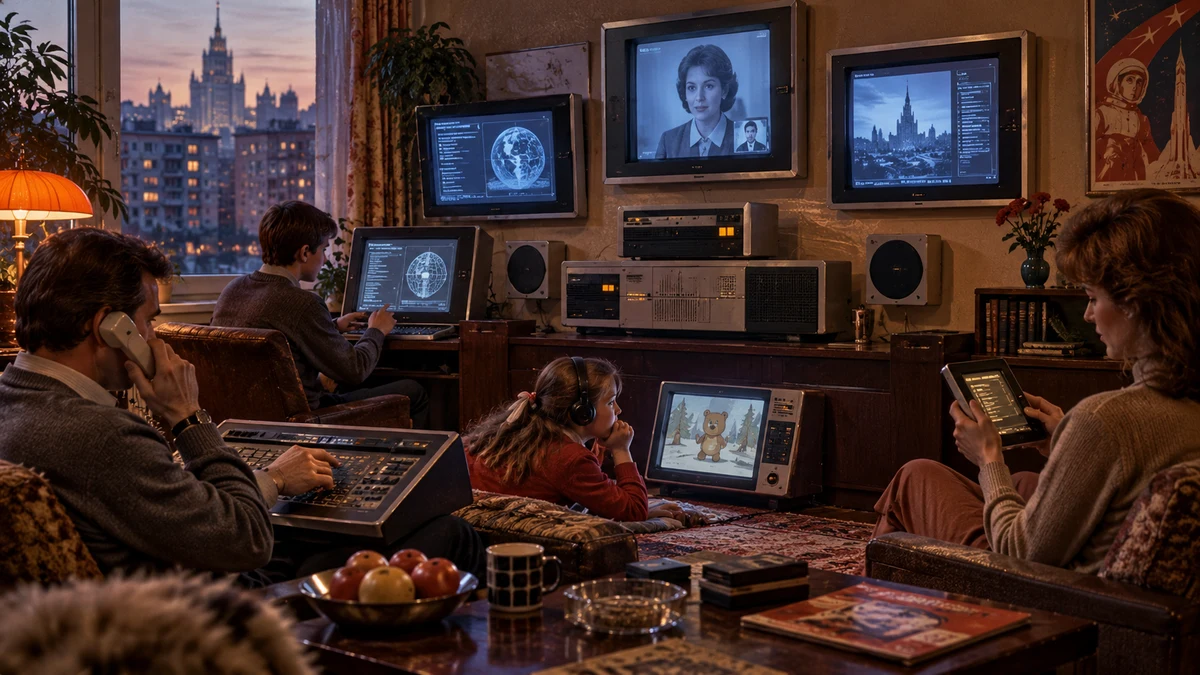
In 1987, when a personal computer was still far from ordinary in a Soviet apartment, the journal Technical Aesthetics presented an unusual project: SFINX — a superfunctional integrated communication system. In photographs it appeared as a set of futuristic displays, speakers, controllers and processor modules. Yet its most radical idea was not the shape of any single device. It was the proposal that television, telephone, computing, audio, data storage and household control should no longer exist as isolated islands.
SFINX emerged from Moscow’s VNIITE, the All-Union Scientific Research Institute of Technical Aesthetics. The team around Dmitry Azrikan aimed to design a domestic information system for the year 2000: a central processor, shared information resources and multiple universal interfaces that different family members could use at the same time. In today’s vocabulary, several ideas sound strikingly familiar — a modular media server, smart displays, a portable controller, voice input, network connectivity and devices no longer tied to a single function.
This is precisely where historical caution matters. SFINX was not a mass-produced working smart home, and the Soviet Union did not “invent the Internet” through it. Earlier home-automation projects existed, including the American ECHO IV in 1966 and X10 in the 1970s. SFINX was above all a visionary systems-design project: physical mock-ups and an interaction architecture that integrated technologies, some already practical and others still laboratory-stage or aspirational.
That is what makes it interesting. Not as proof that the future had already been built and then “lost,” but as a document of how designers in 1987 understood a problem we now describe as a device ecosystem, smart home or Internet of Things: how should a person interact with an expanding world of information without needing a separate, disconnected machine for every function?
VNIITE: when the problem was no longer a single appliance
To understand SFINX, it has to be placed inside VNIITE. The institute was not merely a studio for making prettier casings. In its more advanced departments, designers developed methods for thinking about large systems: not one appliance, but whole product families, their relationships, ergonomics and interaction with people. Azrikan later recalled that such projects were often cultural, technological and ergonomic manifestos as much as products expected to reach shops the following year.
In the June 1987 issue of Technical Aesthetics, Azrikan criticised the fragmentation of Soviet consumer electronics: televisions, tape recorders, radios, computers and other equipment were developed in separate industrial systems even as the future increasingly demanded compatibility and integration. SFINX was a response to that problem: rather than another “super television,” it proposed an architecture in which functions could be assembled.
An ancestor of the idea appeared at the “Future of Clocks” international design workshop in Yerevan in 1985, where Azrikan, Alexey Kolotushkin and Valery Gossen developed a concept later described in museum catalogues as Homo Telecomus. SFINX in 1986–87 extended that thinking into a more concrete model of a domestic communication environment.
The key shift: SFINX did not begin with “what should the television of the future look like?” but with “how should a family access information, communication and media as one system?”
What SFINX actually proposed
The primary September 1987 article describes a central apartment processor with a universal storage device. Its job would be to receive, record, store and distribute different kinds of information. This matters more than the retrofuturist appearance of the mock-ups: content would no longer remain tied to its machine — a record to a turntable, a videotape to a VCR or a photograph to an album — but could be stored by the system and routed to an appropriate output.
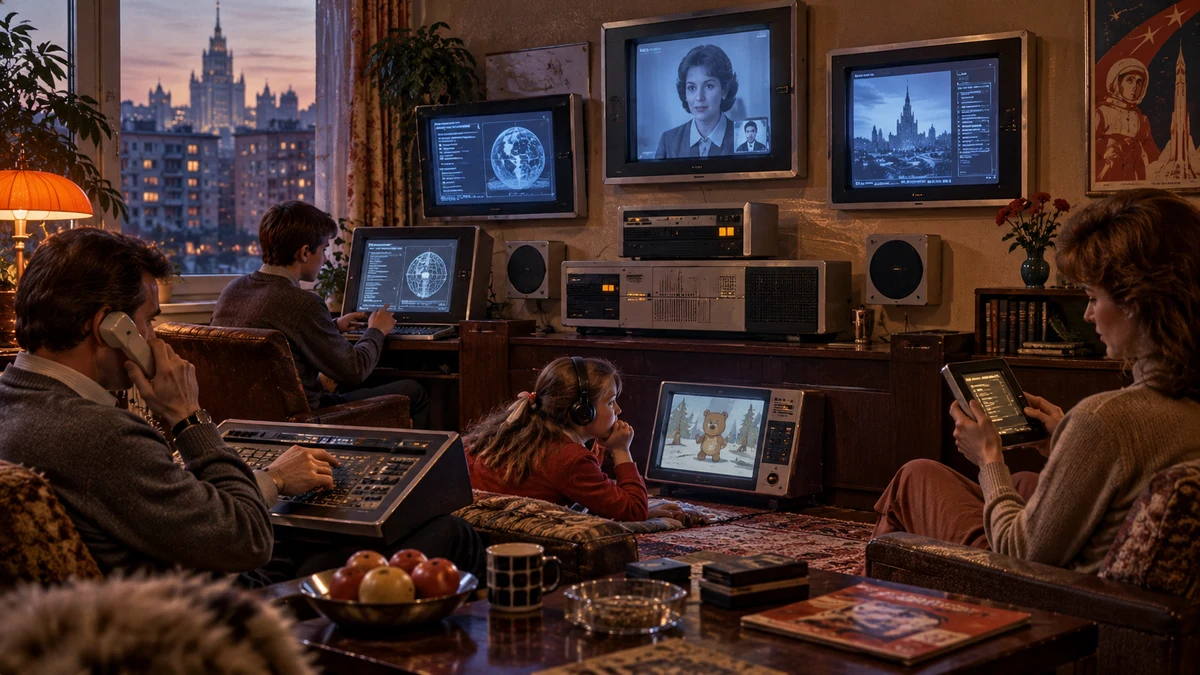
The ensemble included a large shared screen, a smaller display, spherical and flat speakers, headphones, a handheld controller with a detachable display, a larger controller with a telephone handset and a processor with several memory blocks. The magazine photographs show design mock-ups, not a catalogue of mass-produced working consumer devices.
The system was conceived as modular. One memory block could support basic use, with capacity expanded according to the number of users and programmes. Interfaces were likewise not supposed to be permanently tied to one function: the same display or controller could serve different kinds of content at different times.
| 1987 element | Intended role | Rough modern analogy |
|---|---|---|
| Central processor | receive, store and distribute information | home server / media centre / hub |
| Memory blocks | expandable personal and household storage | local disk, NAS or partly cloud storage |
| Multiple displays | shared or personal use of different content | TV, monitor, tablet, smart display |
| Universal controllers | one interface for multiple functions | phone, remote, app, control panel |
| Speakers and headphones | personal or collective audio output | network speakers, wireless headphones |
One home, many people: separating function from device
The comparison with a smart home is tempting, but an even more interesting comparison is with a multi-user digital environment. The article stresses that different family members could use the same or different programmes at the same time. The system was therefore not imagined as one central television forcing everyone to consume the same content, but as infrastructure that could distribute one information core into several personal experiences.
A second important idea was the separation of interface from appliance. In typical 1980s consumer electronics, every product had its own buttons, display, medium and logic. SFINX proposed more universal control surfaces. In today’s vocabulary, the direction resembles what the smartphone later accomplished: the same hardware can become a phone, remote, player, map, terminal or communication window.
This does not mean SFINX “predicted the iPhone.” A more precise claim is that its design logic anticipated the transition from dedicated appliances to programmable, multifunctional interfaces. That transition later emerged across computing, media and telephony through multiple independent development paths.
The most modern part of SFINX is not the shape of a particular screen. It is the idea that data, processing, interface and output device do not have to be the same physical object.
A screen in the hand, a voice into the microphone, cable or radio
The mock-ups show two kinds of larger controller and a smaller handheld unit with a display. Descriptions mention microphones, monitoring audio and parameter-control keys. Later museum accounts also highlight voice input, portable displays, touch or pseudo-touch controls and wearable elements. These features are why contemporary viewers quickly see ancestors of tablets, smart speakers or universal remotes.
Connectivity matters even more. The concepts around SFINX envisioned communication between modules not only by cable but also by radio, with a broader ambition to keep household members connected to information at home, in a vehicle and beyond a single room. Primary and secondary accounts mention telephone links and access to information sources.
The word “Internet” must nevertheless be used carefully. In 1987 the World Wide Web did not yet exist, and the modern consumer Internet cannot simply be projected backward into SFINX. The project anticipated network communication and remote information sources, not today’s global architecture of web services. It is more accurate to say that SFINX thought in networked terms before the Web, not that it already contained the modern Internet.
A network is not automatically the Internet. SFINX is historically interesting because it imagined a connected information environment, not because every cable or radio link should be renamed “Wi‑Fi before Wi‑Fi.”
Before the Internet of Things — but not before the smart home
The phrase “before the Internet of Things” is chronologically fair if it means before today’s IoT label and ecosystem. Kevin Ashton linked the phrase Internet of Things to a 1999 presentation, more than a decade after SFINX. Mark Weiser’s influential 1991 essay on ubiquitous computing later described a world of hardware and software connected through wires, radio waves and infrared.
But SFINX was not the first attempt at an automated home. James Sutherland’s ECHO IV was operational in 1966 and performed domestic computing tasks while controlling some household functions. In the 1970s, X10 emerged as a protocol for controlling devices over household electrical wiring and actually reached the consumer market.
The better question is what made SFINX distinctive within that longer history. The answer is not “it was first,” but that it combined home automation, personal computing, telecommunications, media and industrial design into a coherent family information environment unusually early. ECHO IV was a huge home-built computer, X10 primarily a control protocol; SFINX was a proposal for the entire user experience.
| Claim | Assessment |
|---|---|
| “SFINX was the first smart home.” | Too strong — earlier precedents exist. |
| “SFINX was a mass-produced working product.” | No — it was a project represented by mock-ups. |
| “SFINX anticipated an integrated digital home.” | Well supported by the magazine and museum documentation. |
| “SFINX already had today’s Internet.” | Too strong — it anticipated network communication, not the modern Web. |
| “Some design ideas resemble modern phones, tablets, hubs and smart displays.” | A fair analogy if it remains comparison rather than a claim of direct invention. |
Why it now looks almost prophetic
Retrospection has a dangerous property: once we know the present, we can easily see everything that came later inside an older project. SFINX genuinely contains striking parallels — flat displays, portable terminals, multifunction controls, network distribution of content, voice input, modular storage and simultaneous household use. The Berlin Retrotopia catalogue therefore reasonably describes it as anticipating several trends in domestic and wearable electronics.
Yet “prediction” is not the same as “invention.” Flat displays, digital storage, radio communication and computer networking were already active research and industrial fields in 1987. The designers themselves noted that their proposal integrated technologies either already used in industry or undergoing experimental laboratory development. Their achievement was primarily one of synthesis.
This is an important distinction in technological history. Major shifts often happen not because someone invents the future from nothing, but because someone sees earlier than others that several separate technical streams are ready to become a new system. SFINX is an unusually clear example of that kind of systems foresight.
If we judge the project by the number of modern objects it visually resembles, we may romanticise it. If we judge it by its interaction architecture, it becomes historically more interesting.
Why it never entered Soviet living rooms
The largest gap between a strong vision and a technological revolution is implementation. VNIITE created ambitious concepts but operated in an economy where the path from design research to mass production was often long or interrupted. Azrikan later described quite openly how many projects remained drawings and models because industrial and administrative structures did not or could not follow the design programmes.
SFINX faced obvious technical constraints as well. Several key components — large high-quality flat displays, compact digital storage, fast communications links and inexpensive computing power — were not yet at a level that could support an affordable system in an ordinary apartment. The magazine therefore discusses future components partly as developing or expected technologies.
The collapse of the Soviet Union later destroyed or dispersed much of VNIITE’s institutional environment; the Moscow Design Museum notes that significant archives and prototypes were lost in the 1990s. Still, it would be too simple to claim that only the collapse of the state prevented an almost market-ready system from entering production. SFINX was fundamentally a research-design concept, and the path to a reliable consumer product remained long.
A lost vision is not the same as a lost finished product. Preserving that distinction lets us appreciate the ambition of the vision without turning the mock-up into a machine that never actually existed.
What SFINX teaches about the future: design the relationship before the device
SFINX’s most durable idea is almost programmatic: the project was not primarily supposed to be a project of one object, but a project of the relationship between users and information sources. That design idea is even more relevant now than in 1987. Phone, television, car, watch, speaker and home have in fact become parts of the same information environment.
The present also reveals the other half of the story that SFINX could not fully anticipate: once everything is connected, questions of privacy, security, control, vendor dependence, cloud services, subscriptions and data ownership become unavoidable. In the original vision a central home processor meant convenience and integration; in today’s networked world we must also ask who controls the processor, who can see the data and what happens when a service disappears.
The history of SFINX is therefore not “the Soviets had an iPhone in 1987.” It is a better story: a team of designers understood almost four decades ago that the future of electronics would not belong to piles of disconnected boxes but to ecosystems, shared data and universal interfaces. They did not build our present world. They did, however, see remarkably clearly the architectural direction in which it would move.
The SFINX lesson: the future often begins as a better question. Once the question changes from “what new device do we need?” to “how should a person relate to an information environment?”, the space of possible answers changes with it.
Sources and further reading
- “СФИНКС — радиоэлектронное оснащение жилища будущего.” Техническая эстетика, №9 (285), 1987, ВНИИТЭ. Primary 1987 article describing the system, its central apartment processor, universal storage, modules and interfaces.
- Totalarch, catalogue record for Техническая эстетика №9, 1987. Confirms issue metadata, VNIITE publisher and the SFINKS article in the contents.
- Техническая эстетика №9 1987, TATLIN library record. Independent bibliographic record for the issue and its SFINKS article.
- Polytechnic Museum, “Что такое система СФИНКС?” Museum overview quoting the 1987 article and describing the intended integration of radio, television, telephone and computing functions.
- Staatliche Museen zu Berlin, Retrotopia exhibition booklet (2023), section on SFINX. Museum catalogue identifying the 1986–87 design team and the system’s anticipated trends in domestic and wearable electronics.
- RBC Style, “Дизайн по-советски: каким он был и кто его придумывал” (2016). Moscow Design Museum archival context and authorship for SFINKS.
- International Council of Design, interview with Moscow Design Museum. Historical context for VNIITE, lost archives and the unrealised nature of many state-commissioned future-design projects.
- Designet, interview with Dmitry Azrikan for Proektor. First-person account of VNIITE, Soviet system-design practice and the recurrent gap between ambitious design projects and industrial implementation.
- Habr, “ВНИИТЭ планеты всей: как в СССР систему «умного дома» придумали” (2019). Secondary reconstruction based on the 1987 Technical Aesthetics publications, including the system-as-interaction principle.
- Habr / Online Patent, “От Рэя Брэдбери до советской системы «СФИНКС»: как эволюционировала концепция «умного дома»” (2024). Quotes Azrikan’s 1987 critique of fragmented Soviet consumer-electronics design and compatibility barriers.
- IPQuorum, interview/context on Russian design history. Describes the 1985 Yerevan “Future of Clocks” workshop and the earlier Homo Telecomus concept that fed into SFINKS.
- New East Digital Archive, “Beyond utopia: rediscovering the lost legacy of Soviet design” (2016). London Design Biennale context and Moscow Design Museum archival image attribution for Sphinx.
- Computer History Museum, “The ECHO IV Home Computer: 50 Years Later.” Documents the operational 1966 ECHO IV domestic computer and home-control functions, establishing that SFINKS was not the first smart-home concept.
- X10.com, “About Us.” Historical note that X10 home-automation components were manufactured from the late 1970s, providing another pre-SFINKS precedent for networked home control.
- Weiser, Mark (1991). “The Computer for the 21st Century.” Scientific American 265(3). Seminal ubiquitous-computing vision of hardware and software connected by wires, radio waves and infrared throughout everyday life.
- Ashton, Kevin (2009). “That ‘Internet of Things’ Thing.” RFID Journal. Ashton recalls using “Internet of Things” as the title of a 1999 P&G presentation; useful for chronology of the later IoT label.
- Designet (2015), archive notice publishing a complete scan of Technical Aesthetics for 1987, preserving the design-historical source corpus.