Near-Death Experiences: What Do We Know About Consciousness at the Edge of Death?
Near-death experiences are a real subjective phenomenon. AWARE, EEG and neuroscience reveal important boundaries, but prove neither an afterlife nor a complete explanation of consciousness.
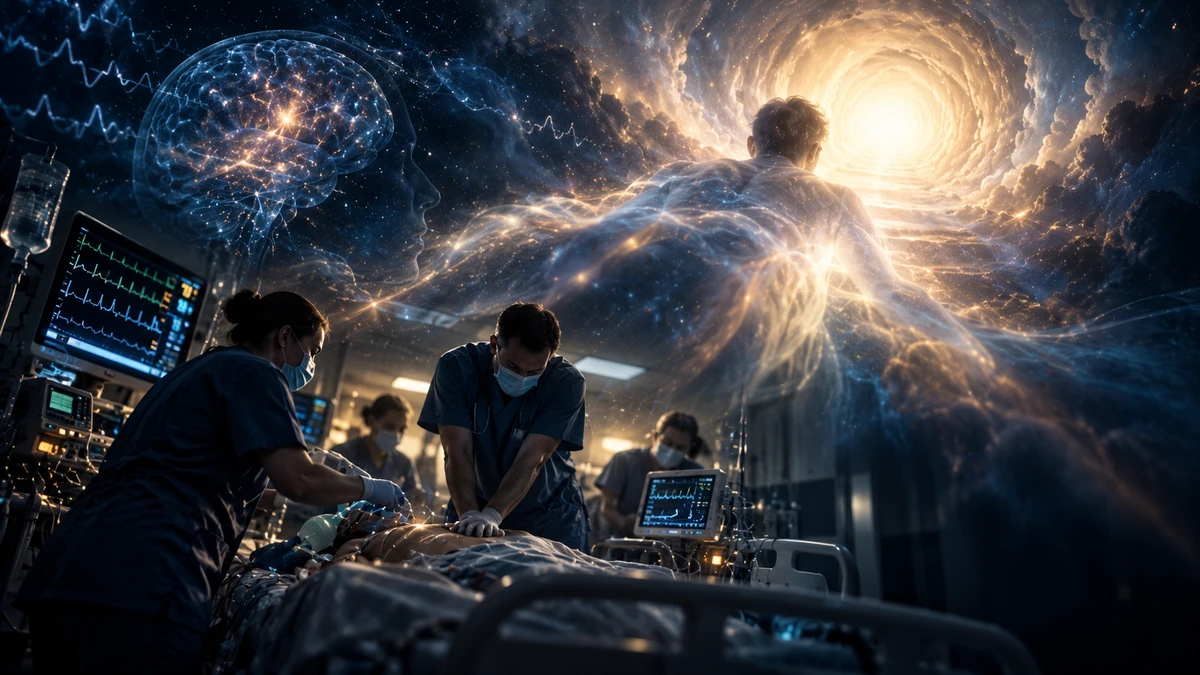
People who survive cardiac arrest, severe injury, deep coma or another life-threatening condition sometimes report unusually vivid experiences: profound peace, separation from the body, passage through darkness or a tunnel, intense light, encounters with people or beings, a review of their own life, and a sense of reaching a boundary beyond which return would be impossible. Such reports are usually called near-death experiences, or NDEs. [1][2]
The phenomenon is real in the most basic sense: people genuinely report it, often describe it as exceptionally clear and meaningful, and in some cases undergo lasting psychological change afterwards. The harder question is what the experience means. Is it an event generated by the brain during extreme physiological crisis? A memory formed while consciousness is fading or returning? A combination of neurophysiology, expectation and later reconstruction? Or do some cases suggest that consciousness is not entirely dependent on ordinary brain function? Current evidence allows these possibilities to be investigated, but it does not yet provide a final answer. [3][4][5]
First, an Essential Boundary: Cardiac Arrest Is Not Brain Death
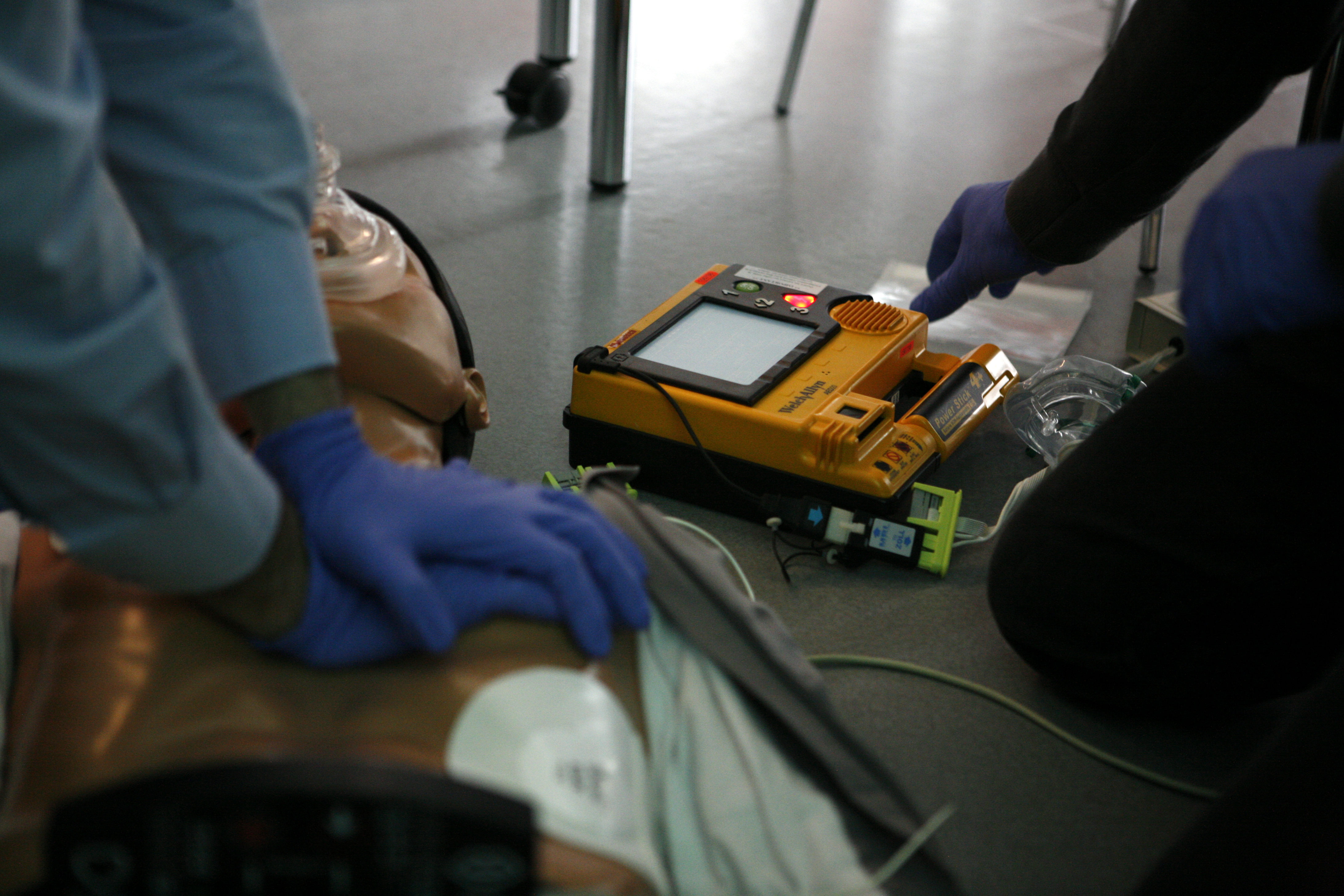
Popular accounts often say that a person having an NDE was “dead.” Several states must be distinguished. Cardiac arrest means that the heart is no longer providing effective circulation. Without immediate intervention, normal cerebral blood flow collapses and consciousness is rapidly lost. Yet cardiac arrest can be reversible: cardiopulmonary resuscitation, defibrillation and other measures can restore circulation. [4][6]
Brain death, by contrast, is the irreversible cessation of all functions of the entire brain and constitutes death under medical criteria. People who survive cardiac arrest and later report an NDE were therefore not, by definition, in confirmed brain death. This distinction became the subject of a direct debate in Nature Reviews Neurology in 2026. Sam Parnia and colleagues defended the term “recalled experiences of death,” whereas Charlotte Martial and colleagues argued that such wording risks presupposing that the experiencers had actually been dead in the medical sense. [4][5]
For our purposes, near-death experience or experience reported after a reversible life-threatening state is therefore the more neutral language. This does not make the phenomenon less unusual; it simply prevents the terminology from assuming the answer to the question being investigated.
What Do People Actually Report?
There is no single universal NDE. Commonly reported features include profound peace, altered time perception, unusual clarity of thought, viewing one’s body from outside, movement through darkness or a tunnel, bright light, a sensed presence of deceased relatives or other beings, a panoramic life review, entry into another environment and a decision or compulsion to return. [1][2][7]
Not all experiences are pleasant. Fear, emptiness, isolation, terror and a sense of being trapped have also been described. Their prevalence is difficult to estimate, partly because people might disclose them less often and partly because earlier literature often emphasized pleasurable cases. Clinically, this is a reason neither to declare the experience a revelation nor to dismiss it as pathology before hearing what the person actually experienced. [8]
How Can Something So Subjective Be Measured?
A central difficulty in NDE research is reliance on retrospective testimony. In 1983 Bruce Greyson developed the Greyson NDE Scale to assess cognitive, affective, reportedly paranormal and transcendental components in a more systematic way. It became a standard research instrument, but it is not a detector of an objectively real afterlife. It measures the content of a report. [1]
A newer NDE-C scale was developed in 2020 after researchers identified limitations in the older Greyson instrument. The NDE-C contains 20 items and attempts to capture the phenomenology more broadly. This alone illustrates why prevalence estimates depend on method: the definition and questionnaire used can affect which experiences count as an NDE and which motifs are detected. [2]
How Common Are Near-Death Experiences?
The answer depends on the population and the definition. In a well-known prospective Dutch study published in The Lancet in 2001, researchers followed 344 successfully resuscitated cardiac patients. Sixty-two patients, or 18%, reported an NDE, and 41, or 12%, described what the researchers classified as a core experience. [9]
In the first AWARE study, about 9% of the 101 survivors who completed the more detailed interview met NDE criteria. In AWARE II, survival was so low that only 28 of 567 enrolled in-hospital cardiac-arrest patients could be interviewed; six of those 28 described what the authors classified as a transcendent “recalled experience of death.” Because this was a very small and highly selected survivor sample, 6/28 should not simply be generalized into a 21% incidence of NDE after cardiac arrest. [10][11]
Recent reviews therefore do not support one magical universal percentage. Definitions, survival, capacity to be interviewed, timing, memory condition and the scale used all affect the result. The safest conclusion is that NDEs are a minority but by no means rare phenomenon among survivors of severe life-threatening events. [12]
AWARE: The First Major Attempt to Test Perception During Resuscitation
The AWARE project matters because it did not merely collect narratives; it also attempted to test claims of environmental perception during cardiac arrest. Its first multicentre study recorded 2,060 cardiac-arrest events. Among survivors, 140 completed the first interview and 101 completed a more detailed second interview. Nine percent met NDE criteria, while two percent described explicit memories of actual events associated with their resuscitation. [10]
One case attracted particular attention because the patient described people and sounds involved in the resuscitation in a way that could be compared with the medical sequence of events. The authors regarded the report as consistent with what had occurred. There is, however, an essential limitation: no hidden visual target intended to test a claimed out-of-body vantage point was present at that cardiac-arrest location. The case is therefore an interesting example of apparently accurate memory for resuscitation events, not an experimental confirmation that the patient visually perceived the scene from outside the body. [10]
That distinction is crucial. “The patient accurately described an event” and “we demonstrated perception without normal sensory pathways” are not the same claim.
AWARE II: Hidden Images, Sound and EEG
AWARE II expanded the protocol by using computerized visual and auditory stimuli together with EEG and cerebral oxygenation measurements during resuscitation. The prospective study enrolled 567 in-hospital cardiac arrests; 53 patients survived and 28 could be interviewed. Eleven of the 28 reported memories or perceptions suggestive of some form of conscious experience, ranging from consciousness during CPR and post-resuscitation memories to dream-like and transcendent experiences. [11]
The most direct objective test produced a sober result: none of the interviewed survivors identified the hidden visual image. One of 28 identified the auditory stimulus. Very low survival and the small number of patients with usable monitoring limited the study’s ability to answer the perception question conclusively. [11]
AWARE II nevertheless found something else relevant to consciousness. During some resuscitations, organized EEG patterns in the delta, theta and alpha ranges appeared as late as 35–60 minutes into CPR, which the authors interpreted as compatible with a possible recovery of more complex network activity. This challenges a simplistic picture in which cerebral activity is always completely and immediately absent throughout cardiac arrest. However, the available recordings did not permit a direct temporal pairing of a particular survivor’s full NDE with a particular EEG pattern. [11]
The Dying Brain Is Not Necessarily Completely Silent
Additional interest came from studies of brain electrical activity around circulatory failure. In 2013, rats undergoing experimental cardiac arrest showed a brief surge of synchronized gamma oscillations and connectivity before the EEG became nearly isoelectric. [13]
In 2023 researchers analyzed EEG recordings from four comatose patients whose ventilatory support was withdrawn after a decision to discontinue life-sustaining treatment. Two of the four showed marked surges of gamma activity and connectivity, including in posterior brain regions that some theories associate with conscious processing. [14]
This is important, but it does not mean that an NDE was recorded in the brain. The patients died and could not report what, if anything, they experienced. An EEG correlate without a subjective report cannot establish whether there was a conscious experience, much less its contents. These studies mainly demonstrate that the transition toward death can be a dynamic neurophysiological process, not merely an instantaneous shutdown.
Can the Brain Produce Individual Components of an NDE?
Several research lines indicate that at least some elements of NDEs can be related to known brain processes. Electrical stimulation around the right angular gyrus and temporoparietal junction, for example, produced bodily displacement and out-of-body-like sensations in a patient, supporting the idea that the sense of where the self is located relative to the body depends on the brain’s integration of visual, vestibular and somatosensory signals. [15]
Another line of work links NDEs with REM-sleep intrusion into wakefulness. People reporting NDEs also report sleep paralysis and other REM-intrusion phenomena more often than controls, although an association does not show that REM mechanisms explain the whole experience. [16]
A comprehensive neuroscientific model published in 2025 combines several processes: reduced cerebral blood flow, hypoxia, hypercapnia and acidosis, altered neural excitability, changes in serotonin and other neurotransmitter systems, and psychological threat, dissociation and coping processes. The authors do not claim that a single “NDE molecule” has been discovered; rather, a rich experience could emerge from a cascade of simultaneous physiological and psychological changes. [3]

Ketamine, DMT and the Danger of a Premature Conclusion
Some drug-induced states show striking phenomenological similarity to NDEs. A comparison of roughly 15,000 reports associated with 165 psychoactive substances and 625 NDE narratives found that ketamine reports showed the greatest semantic similarity, followed by other dissociative and serotonergic psychedelic states. [17]
In a placebo-controlled DMT study, 13 healthy volunteers showed substantially more NDE-like features after DMT than after placebo, with considerable phenomenological overlap between the states. [18]
Similarity, however, does not establish identical causation. If DMT or ketamine can produce an NDE-like state, this shows that the brain possesses biological routes capable of generating related subjective features. It does not demonstrate that dying humans release enough endogenous DMT, or a ketamine-like substance, to cause NDEs. That claim would require direct measurements that do not currently exist.
Culture: A Universal Core or an Experience Shaped by Context?
NDEs are reported across cultures, but not in identical form. Some motifs — transition, encounters with persons or beings, changes in the sense of self and entry into another environment — occur in many settings. Other features, including the tunnel or the precise interpretation of light and encountered figures, vary across cultures. [7][19]
Older reviews argued that some famous Western motifs might be culturally specific, whereas newer comparisons reveal a more complicated pattern: both substantial similarities and substantial differences. This is compatible with multiple possibilities. Biological mechanisms could generate a shared substrate while culture and expectation influence interpretation and memory. Supporters of non-reductive accounts interpret the same pattern differently. Cultural similarity or variation therefore does not by itself settle the metaphysical question. [7][19]
A Memory That Often Remains Unusually Vivid
For many people, an NDE is not a fleeting hallucination quickly forgotten. Research has long described lasting changes: reduced fear of death, greater appreciation of life, altered values, increased spiritual interest and, in some cases, difficulties reintegrating the experience into ordinary relationships. [9][20]
A systematic review of studies from 2014–2024 confirmed that positive aftereffects are common but not universal. Negative or frightening NDEs can be followed by confusion, distress and long-term integration problems. The psychological significance of the experience is therefore real regardless of its ultimate ontological interpretation. [20]
What About Apparently Veridical Out-of-Body Perceptions?
This is arguably the most important experimental part of the entire question. If a person correctly identified a randomized hidden target while ordinary sensory access to it was unavailable, that would be a very strong result. This is precisely why the AWARE projects used visual and later auditory targets. [10][11]
At present, there is no such positive visual result. AWARE I included an intriguing report that matched events during resuscitation, but there was no hidden target at that location. In AWARE II, no participant identified the visual target. This does not prove that out-of-body perception is impossible; it means that the strongest experimental evidence we could reasonably seek has not yet been obtained. [10][11]
Ordinary alternatives must also be considered: partially preserved hearing, information acquired before or after unconsciousness, reconstruction, incorrect timing of memory and coincidence. Each case should be tested against these alternatives rather than being automatically declared either paranormal or irrelevant.
Do NDEs Prove That Consciousness Exists Independently of the Brain?
No. Current evidence does not prove that.
Yet the opposite extreme is also too strong. We do not yet have a single neurophysiological model directly measured in a human being during the exact moment of a later-reported complete NDE and shown to explain all of its elements. The 2025 neuroscientific model is integrative, but part of its evidence comes from animal studies, drug analogies, sleep research and recordings from dying patients who could not report an experience. [3]
Researchers taking a different position emphasize that some NDE narratives are highly structured, arise around severe impairment of brain function, and include cases of apparently accurate perception that they believe remain insufficiently explained. Some therefore argue that the possibility that consciousness is not wholly reducible to brain activity should remain open to investigation. At present, however, this too is a hypothesis, not an experimentally established fact. [4][21]
In 2026 the disagreement appeared in almost textbook form. Parnia and colleagues called for research on “recalled experiences of death” without assuming a neurobiological conclusion in advance; Martial, Fritz and colleagues replied that the experiences can be investigated neuroscientifically and that reversible cardiac arrest is not confirmed death. The scientific debate is therefore not closed — but the evidential boundary is far clearer than internet summaries often suggest. [4][5]
What Can We Say With the Greatest Confidence Today?
Near-death experiences are a real and recurring subjective phenomenon reported by a subset of people after cardiac arrest and other life-threatening states. Their features can be measured systematically, they are not all identical, and they can have profound and lasting psychological consequences. [1][2][9][20]
The brain during cardiac arrest and dying is not necessarily a machine that simply switches off in a single instant. Resuscitation can partly restore cerebral perfusion, organized EEG patterns can reappear during prolonged CPR, and brief surges of gamma activity have been observed in some dying patients. [11][14]
At the same time, no hidden visual target has been successfully identified in the major prospective AWARE testing, and we do not yet possess a direct recording of brain activity temporally paired with a complete NDE later reported by the same person. [11]
The most defensible conclusion is therefore neither “science has proved an afterlife” nor “science has already explained NDEs away as hallucinations.” What we know is more interesting: at the boundary between reversible circulatory arrest and resuscitation, human experience can remain or become unexpectedly rich, while our methods still struggle to determine exactly when the experience occurs and how it relates to brain activity. This is why NDEs remain one of the rare research problems in which intense first-person experience, emergency medicine, neuroscience and philosophy of consciousness meet in the same question.
Sources and further reading
- Original validation of the Greyson scale for systematic assessment of reported NDE content. Source
- Development and psychometric validation of the newer NDE-C scale. Source
- Current integrated neuroscientific model of possible NDE mechanisms. Source
- 2026 position arguing for empirical study of “recalled experiences of death” without presupposing an ontological conclusion. Source
- 2026 reply stressing the distinction between reversible cardiac arrest and medical death and the neuroscientific tractability of the phenomenon. Source
- Multidisciplinary consensus on terminology, standards, and future research directions. Source
- Review of NDE phenomenology from a cross-cultural perspective. Source
- Clinical overview of distressing near-death experiences. Source
- Key prospective Dutch study of survivors of cardiac arrest. Source
- Primary AWARE I source, including perception reports and verification limitations during resuscitation. Source
- Primary AWARE II source for hidden targets, auditory stimuli, and EEG during CPR. Source
- Recent scoping review of NDEs in adult intensive-care patients. Source
- Primary animal neurophysiology source for a transient surge of organized activity after cardiac arrest. Source
- Primary human EEG source for gamma activity in selected dying comatose patients. Source
- Primary experimental source for out-of-body-like sensations induced by temporoparietal stimulation. Source
- Primary source for the statistical association between NDEs and REM intrusion into wakefulness. Source
- Large semantic comparison of NDE narratives with psychoactive-drug reports. Source
- Controlled study of phenomenological overlap between DMT and NDEs. Source
- Recent comparison of NDE similarities and differences across cultures and history. Source
- Systematic review of long-term aftereffects of NDEs. Source
- Narrative review presenting a non-reductive / survival-hypothesis interpretation; used as a counter-position, not as proof. Source