General Petrov and Conceptual Power: The Dead Water System Under Scrutiny
Petrov argued that the highest power is not necessarily government but the ability to define the concept, knowledge and decision framework. This article tests Dead Water’s six priorities, their real analogues and the boundary where analysis becomes a hypothesis of a global predictor.

Major General Konstantin Pavlovich Petrov was a real senior officer in Soviet and Russian military-space structures, associated with Baikonur and the Energia–Buran programme. He later became a political activist and one of the most visible popularisers of the Concept of Public Security (KOB) and the system known as Dead Water. An important boundary: Petrov was not the sole author of the whole corpus; central texts appeared under the collective name Internal Predictor of the USSR.
For our series, the most important part is the idea of conceptual power. In this framework, public institutions — parliament, government, courts — are not necessarily the highest layer of power. Above them stands the capacity to identify problems, set goals, formulate a concept and embed it through culture, institutions and information. This directly continues the axis of the previous article on the pharaoh: whoever controls knowledge has power.
KOB expands this into six ‘priorities of generalised means of governance’: worldview/methodology, history and chronology, ideology or factual information, economics, means the authors classify as ‘genocidal’, and conventional military force. The system says higher priorities act more slowly but more deeply and durably, while lower ones act faster and more directly. That is KOB’s internal analytical taxonomy, not an empirically established universal law of society.
This article therefore does not ask whether Petrov’s system must be accepted or rejected as a package. It tests which parts capture real mechanisms of power, where they overlap with established work on structural power, agenda setting and power/knowledge, and where the argument makes an additional leap toward a single ‘global predictor’ that would require its own evidentiary chain.
Petrov, Dead Water and the origins of conceptual power
Petrov’s military biography is not an internet legend. A Strategic Missile Forces veterans’ organisation records him as a major general, a senior Baikonur officer, a deputy head of the Military Space Academy and a participant in the Energia–Buran programme. That background helps explain why he described society in the language of management, systems, feedback and hierarchy.
A military rank does not validate a political or historical theory. Nor is it accurate to attribute the entire ‘Dead Water’ corpus simply to Petrov. He was an important populariser and political carrier; the central textual corpus presented itself as the collective work of the Internal Predictor of the USSR.
Movement texts use ‘conceptual power’ in two senses. The first is the capacity of people to detect a problem, set a goal, formulate a concept and embed it in social management. The second is the power of the concept itself: a society can live within a set of assumptions and goals even when most people never explicitly formulate them.
This is one of the system’s strongest ideas because it shifts power from ‘who holds office?’ to ‘who defines the goals, categories, success criteria and framework within which offices operate?’. In this basic form the idea is not exotic: related problems are studied in structural-power theory, agenda setting and power/knowledge.

The first two priorities: thought, history and the frame of the possible
| KOB priority | What it is said to govern | Evidentiary boundary |
|---|---|---|
| 1. Worldview / methodology | Basic ways of understanding the world and solving problems | Culture and methodology do shape decisions; a universal ‘most powerful priority’ is not empirically established. |
| 2. Chronology / history | Collective memory and interpretation of the past | Historical narratives influence identity; this does not prove a single custodian of history. |
| 3. Factual / ideological | Ideas, religions, information, technologies and day-to-day interpretation | Agenda setting and framing are real; total thought control does not follow. |
| 4. Economic | Monetary and financial levers | Structural financial power is well documented; intent and coordination must be shown case by case. |
| 5. ‘Genocidal’ means | Alcohol, tobacco, drugs and, in some versions, biotechnology/genetics | Some harms are demonstrable; genocide requires evidence of intent to destroy a group. |
| 6. Military force | Direct physical coercion and destruction | A clear mechanism of power; the claim that it is always least powerful or least durable is not a universal law. |
The table is useful because it forces analysis above direct force. It becomes weaker if the ranking is treated as an invariant law for every historical case. In reality the levels interact: military victory can reshape education and worldview, financial collapse can reshape ideology, and ideology can reshape economics.
Petrov’s first level is methodological or worldview-based. The simple idea is that before people disagree about individual facts, they already carry assumptions about what counts as a fact, which problems matter and which goals are legitimate. Changing those assumptions changes not one dispute but the rules of later disputes.
Here KOB genuinely overlaps with established theory. Foucault analysed how institutions combine observation, classification, documentation and norms to produce knowledge while exercising power. That is not the same as Petrov’s ‘global predictor’, but it supports the basic intuition that power can be embedded in categories and knowledge practices, not only commands.
KOB gives history a separate level of power. That is plausible: political communities decide through memories, myths, traumas, victories and defeats. Conflict over history can therefore become conflict over the legitimacy of current borders, institutions and identities.
But history is not a central file necessarily written by one centre. There are archives, rival schools, new documents, local memories and competing interpretations. The article therefore accepts the power of historical framing, not the automatic claim that every dominant narrative must have one hidden author.
Information and money: the softer levels of management
McCombs and Shaw showed an important mechanism in 1972: the selection and visibility of issues affect what the public considers politically important. Agenda setting does not mean media implant identical opinions in people’s minds. It means scarce attention is not neutrally distributed.
This is an important correction to Petrov’s model. Influence does not require a total central command. Selection, repetition, placement, data access and algorithmic visibility can be enough. Modern EU transparency duties for recommender systems show that who selects what people see has become a regulatory issue, not merely a philosophical metaphor.
KOB places economics below informational priorities while still treating it as a major operational lever. Susan Strange similarly distinguished direct coercion from structural power: the capacity to shape the framework within which states, firms and people make decisions. Her four key structures included security, production, finance and knowledge.
This is one point where Petrov’s language and academic political economy come surprisingly close. The methodological difference is crucial: Strange analyses plural structures and concrete mechanisms; KOB often incorporates such structures into a wider story of long-term global management. The first can be tested institution by institution; the second needs additional evidence of coordination.
Health and force: when influence becomes material and direct
This requires the sharpest terminological boundary. WHO documents millions of deaths attributable to alcohol and tobacco, so minimising their social harm would be wrong. But KOB’s term ‘genocidal means’ is much stronger: it converts a harmful product or practice into an intentional instrument for destroying a population.
That conclusion requires evidence of intent, target group and coordination. The same caution applies to genetics and biotechnology. WHO documents real ethical and safety concerns around genome editing, while not treating genetic technology as such as a weapon. Risk, negligence, profit and genocidal intent are different evidentiary categories.
Military force is KOB’s sixth and fastest priority. The intuition is that a tank is visible while an idea is harder to see; direct coercion can produce immediate results but consumes resources and may generate resistance.
As a heuristic this can be useful. As a universal law it is too rigid. Wars, occupations and revolutions can reshape borders, property, institutions, demography and school systems for generations. The article therefore uses the six priorities as an analytical checklist, not a physical scale with permanently fixed power levels.
Structureless management and the power of concepts
One of KOB’s more interesting ideas is that management need not look like a chain of superiors and subordinates. Change an information environment, incentives or expectations across a large population and statistical behaviour may shift even when nobody receives an individual command.
The basic phenomenon exists outside KOB too: markets, advertising, social norms, recommender systems and mass media can affect behaviour without a central command. But the fact that structureless influence is possible does not mean every mass trend is planned. Spontaneous coordination, imitation and emergent effects can produce similar patterns.
The analysis directly continues the previous article. There, the priest was powerful because he knew what the crowd did not. Petrov takes a further step: the highest form of power is not merely possessing a secret fact but the ability to build the model of reality, set goals and draw other actors into implementing it.
That extension is analytically useful. A ruler choosing among options already defined by someone else does not hold the same kind of power as the actor who defined the option set. Yet every concrete case still requires evidence: who prepared the concept, how it entered institutions, who funded it, who adopted it and what decision trail followed.
The global predictor: from analysis to a stronger hypothesis
The strongest and most controversial part of the system is the idea that the global historical process is not merely the product of many states, firms, elites and institutions but that a higher level of conceptual management steers civilisation over the long term. Petrov’s lectures often refer to this as the ‘global predictor’.
The article does not dismiss that possibility by label. But the evidentiary standard must be higher than overlapping interests or the fact that wealthy and influential people cooperate. To move from a model to a historical finding we would need identifiable carriers, continuity, communications, financing, instructions, coordination and a testable causal chain. Without that, it remains a hypothesis or metaphor of structural power rather than a demonstrated unified command.

The Duma, political party and legal status
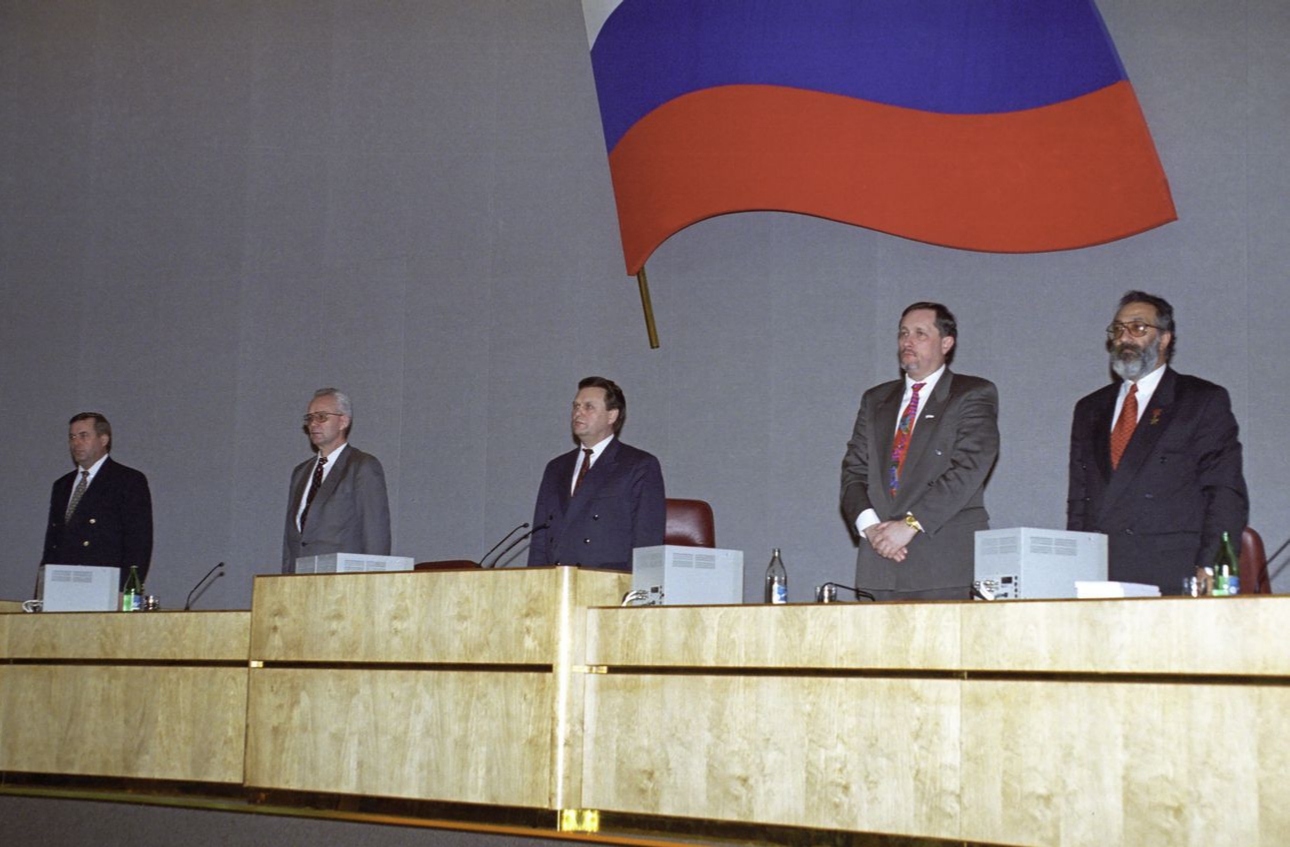
On 28 November 1995 the Russian State Duma did hold parliamentary hearings on a ‘Concept of Public Security of Russia’, and Petrov was among the speakers. Surviving materials and archival references document the event. Recommendations included familiarising institutions and the public with the proposed concept and discussing it openly.
That matters because the hearing is sometimes dismissed as invented. But the opposite exaggeration is also wrong: a parliamentary hearing is not the same as adoption of KOB as official state doctrine or scientific verification of its claims. The hearing demonstrates institutional consideration, not truth of the whole system.
Petrov attempted to move the ideas into formal politics through the Conceptual Party ‘Unity’. In the 2003 State Duma election it received about 1.17 percent of the party-list vote and won no seats. That is a real constituency, but it does not support the claim that KOB won a mass political mandate.
The Supreme Court liquidated the party in 2007 on statutory membership and regional-branch requirements. This is an important correction: the liquidation decision itself was not a judicial finding that the theory was false or ideologically prohibited; it concerned compliance with the political-party rules then in force.
Russia’s Ministry of Justice currently lists the 2004 edition of Dead Water and Petrov’s Secrets of Governing Humanity or Secrets of Globalisation as extremist materials pursuant to court decisions. That legal status is verifiable and the article does not conceal it.
At the same time a court designation cannot substitute for analysis of every separate proposition. Legal status tells us how a particular edition is treated in Russia; by itself it does not settle whether agenda setting, structural power or information asymmetry exist. Those claims need their own evidence.
Evidence matrix and conclusion: what remains of the system
| Claim | Status | Boundary |
|---|---|---|
| Petrov was a major general with a real military-space career. | CONFIRMED | Veterans’ biography and parliamentary materials. |
| KOB placed conceptual power above ordinary branches of power. | CONFIRMED AS DOCTRINE | Movement texts establish the doctrine, not a natural law. |
| The six priorities are genuinely part of KOB. | CONFIRMED AS DOCTRINE | Their universal ranking is not independently empirically established. |
| Knowledge, agenda, finance and asymmetric information can create power without direct force. | STRONGLY SUPPORTED | Akerlof, McCombs/Shaw, Foucault, Strange and modern regulation support component mechanisms. |
| Every mass trend is the product of structureless management. | UNCONFIRMED | Similar patterns can arise spontaneously or from multiple unrelated causes. |
| Alcohol and tobacco cause large public-health harms. | CONFIRMED | WHO; harm alone does not establish genocidal intent. |
| A unified global predictor coordinately directs the world historical process. | OPEN / UNCONFIRMED HYPOTHESIS | Would require a direct organisational and causal evidence chain. |
| The Duma officially adopted KOB in 1995. | NOT ESTABLISHED | The hearing and recommendations for discussion are documented; formal state adoption is not. |
| KPE was liquidated in 2007 because its ideology was banned. | NO | The Supreme Court decision rested on membership/regional-branch requirements. |
| Specific KOB/Petrov editions are on Russia’s extremist-materials list. | CONFIRMED | Official Ministry of Justice list. |
The most useful part of Petrov’s framework is not a demand to accept the entire ‘Dead Water’ corpus. It is the question: who defines the concept, who holds the knowledge, and who sets the framework within which others decide? That question remains legitimate without a global predictor. Established social science confirms that power can reside in agendas, institutions, information, finance and standards, not only police power or ballots.
But this is also where discipline matters most. If every overlap of interests becomes proof of one centre, a theory becomes unfalsifiable and therefore analytically weaker. The article preserves both sides: Petrov’s warning that high-level power may sit in knowledge and concepts, and the requirement that every claim about a concrete hidden governor be supported by a concrete trail.
Sources and further reading
- Moscow City Organization of Strategic Missile Forces Veterans. Konstantin Pavlovich Petrov: military biography, rank, Baikonur and Energia-Buran service.
- State Duma parliamentary-hearing materials, 28 November 1995, ‘Concept of Public Security of Russia’: transcript and participant list including Major General Konstantin Petrov.
- Russian Public Initiative archive. Summary of the 28 November 1995 parliamentary-hearing recommendations: public familiarisation and discussion of the proposed concept.
- Supreme Court of the Russian Federation, Decision No. GKPI07-298, 15 May 2007: liquidation of Conceptual Party ‘Unity’ for failure to meet statutory membership/branch thresholds.
- Russian State Library catalogue. ‘Zakon vremeni’: periodical materials of the Concept of Public Security ‘Dead Water’, documenting the movement’s publishing history from 1997.
- Ministry of Justice of the Russian Federation, Federal List of Extremist Materials, item 2520: 2004 two-part edition of ‘Dead Water’ declared extremist by Moscow’s Lefortovo District Court in 2013, appeal upheld 2014.
- Ministry of Justice of the Russian Federation, Federal List of Extremist Materials, item 1463: Petrov’s ‘Secrets of Governing Humanity or Secrets of Globalisation’, vols. 1–2, listed pursuant to a 2012 court decision.
- Internal Predictor USSR, ‘Conceptual Power as a Social Phenomenon’ (2007): primary movement text defining conceptual power in two senses — people who formulate/implement a concept and the power of the concept itself over society.
- KOB encyclopaedia, ‘Generalised Means of Governing Society’: movement-side presentation of the six priorities — worldview/methodology, chronology, factual/ideological information, economics, ‘genocidal’ means, and military force.
- KOB-oriented overview of the six priorities, including the claim that upper priorities produce slower but more durable effects while lower priorities act faster.
- Concept of Public Security supporters’ archive, parliamentary-hearing provenance and GARF references for the 1995 hearing materials.
- SOVA Center, ‘Citizens without the USSR’ (2023): contextual history of KOB/KPE, later organisations and the legal status of several texts in Russia.
- SOVA Center reference work (2009): historical profile of Conceptual Party ‘Unity’ and Konstantin Petrov, including its 2003 election participation and later transformation.
- 2003 Russian State Duma election table: Conceptual Party ‘Unity’ received about 1.17% of the party-list vote and no seats.
- Stanford Encyclopedia of Philosophy, ‘Michel Foucault’: power/knowledge, observation, documentation, normalisation and governmentality as established theoretical approaches to dispersed power.
- McCombs, Maxwell E., and Donald L. Shaw (1972). ‘The Agenda-Setting Function of Mass Media.’ Public Opinion Quarterly 36(2):176–187.
- Akerlof, George A. Nobel Prize facts and explanatory materials on asymmetric information: one side’s informational advantage can systematically alter outcomes without requiring a conspiracy.
- Akerlof, George A. (2003). Personal account of ‘The Market for Lemons’ and the broader logic of asymmetric information.
- Strange, Susan. States and Markets: structural power as the capacity to shape the frameworks within which other actors operate, including security, production, finance and knowledge.
- Cambridge Review of International Studies (2025). Reassessment of Susan Strange’s structural power across security, production, finance and knowledge.
- OECD (2021). Lobbying in the 21st Century: legitimate expert input and documented risks of opaque or disproportionate influence in public decision-making.
- U.S. Federal Trade Commission (2014). Data Brokers: A Call for Transparency and Accountability — aggregation, inference and commercial use of information about individuals.
- European Commission. Digital Services Act transparency framework: recommender-system transparency, systemic-risk duties and researcher access.
- World Health Organization. Alcohol fact sheet: alcohol caused about 2.6 million deaths worldwide in 2019; used to separate demonstrated public-health harm from claims of coordinated genocidal intent.
- World Health Organization. Tobacco and nicotine fact sheet: tobacco causes millions of deaths annually; used to separate harm from an unproven claim of centrally planned population destruction.
- World Health Organization. Human genome editing: documents real safety, ethical and governance issues without treating genome editing as inherently a weapon.
- World Health Organization. Genetically modified foods Q&A: currently marketed GM foods have undergone safety assessment; risks must be assessed case by case.
- McCombs & Shaw article record at JSTOR: bibliographic cross-check and abstract on media issue salience.
- LSE History (2025). Susan Strange on structural power and authority shifting across states, markets and telecommunications.
- Russian Ministry of Justice searchable Federal List of Extremist Materials: legal context for listed KOB/Petrov texts; the listing is a legal fact, not a scientific adjudication of every analytical proposition.