When Wellness Becomes a Ceremony
Cacao ceremonies and sound rituals are marketed through heritage, experience and training. The article asks what is historically documented, who can grant permission and who benefits from the sales.
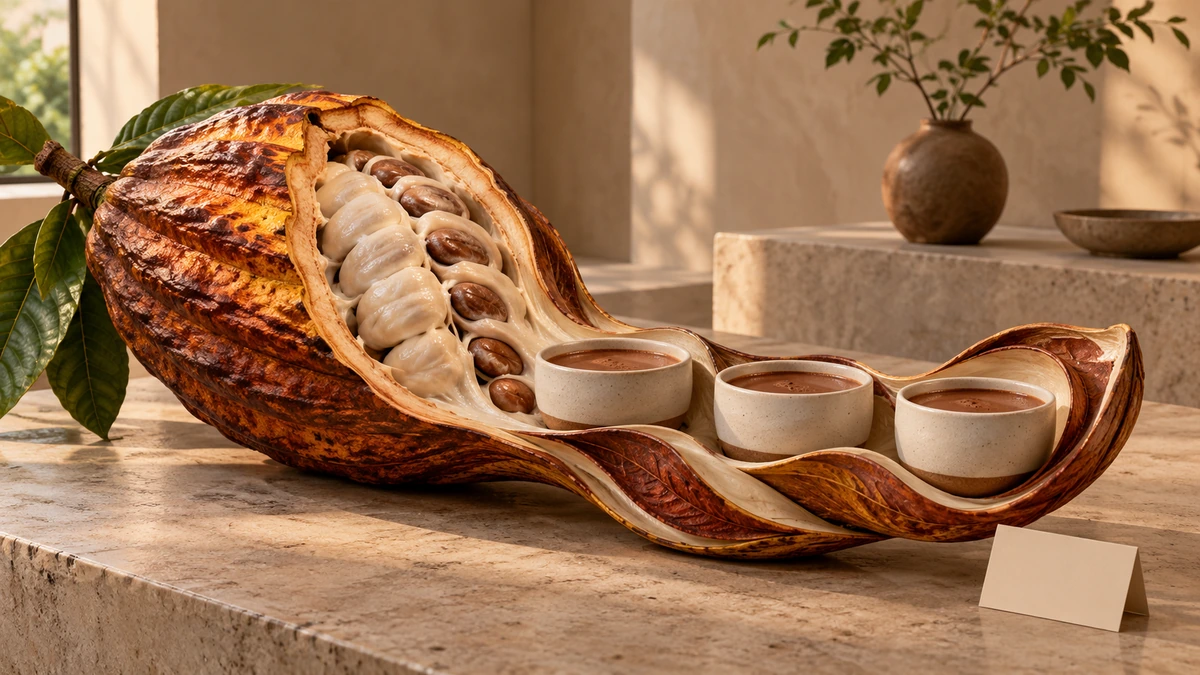
Evidence note: The price and training details come from a public offer reviewed on 15 October 2026 and may change. Participants' experiences do not establish medical efficacy. Companies' statements about origin, payments, and social impact are not independent audits.
A Ceremony with a Schedule, Registration, and a Price
A British wellness centre in Leeds publicly advertises a price of £200 for a six-hour day of practical training. What participants are offered is more than a practical introduction to preparing cacao: the British wellness centre We Are Wellness markets training in facilitating cacao ceremonies. A four-to-six-week assessment period follows the day of practical instruction; according to the provider, participants receive a qualification described as CMA-accredited only after successfully completing the required assignments. The programme covers the plant's history, methods of preparing the drink, safety considerations, group facilitation, setting intentions, and designing one's own ceremony. That was the publicly advertised offer when it was reviewed on 15 October 2026. [1]
At first glance, this is an entirely understandable service. Someone prepares a space, gathers knowledge, teaches, takes responsibility for organizing an event, and charges for the work. None of this, in itself, establishes deception or cultural appropriation. What is more interesting is something else: how did an activity that can be taught through a relatively short training programme become a “ceremony”—and where is its authority supposed to come from? Payment is not the only thing being sold. So are a way of leading a group, a sense of special meaning, and a vocabulary that distinguishes the event from an ordinary group workshop.
The provider's description is revealing in this respect. A contemporary cacao ceremony may include meditation, breathing exercises, sound, movement, journaling, intention-setting, and conversation in a circle. Its structure can be adapted to the facilitator and participants. The provider even states explicitly that it does not prescribe a single mandatory script for its trainees and that facilitating a ceremony does not require affiliation with a particular spiritual tradition. [1] This is an important distinction: it describes a flexible contemporary method, not necessarily the transmission of one precisely identifiable historical rite.
This is where the change lies. A circle of people, a warm drink, sounds, and shared reflection may be deeply meaningful to someone. But the experience of depth does not, by itself, answer the question of who owns the story of the practice's origins. There is a difference between saying “a ceremony we have created today” and “an ancient Mayan ceremony you can perform after taking our course.” The difference is not merely stylistic. The latter description borrows authority from history and may suggest an unbroken, verifiable chain through which knowledge was passed down.
There is no need to single out one culprit. Nor can we automatically attribute to this British centre a claim that it grants traditional Mayan authority: its public description concerns a private qualification, ethical questions, and the creation of one's own format. But the existence of such a course shows what happens when ceremonial language becomes part of a standard wellness-market offering. Where one might once have asked who conducts a rite and what relationship they have with a community, the prospective buyer can now begin by asking when the next session takes place, what the training costs, and which certificate they will receive.
These are not equivalent questions. Learning how to organize a gathering safely can be worthwhile. Receiving a community's consent or authorization to represent a particular tradition is another matter. To understand why, we must separate the age of the plant from the age of the event being sold today.
How Old Is Cacao—and How Old Is Today's Ceremony?
Cacao was not invented by the modern wellness industry. A study by Sonia Zarrillo and colleagues, published in Nature Ecology & Evolution in 2018, identified traces of cacao use dating back approximately 5,300 years at the Santa Ana–La Florida archaeological site in southeastern Ecuador. The researchers combined three kinds of archaeological evidence: starch grains, residues of theobromine, and ancient DNA. This is an important finding about the early use of Theobroma cacao in the upper Amazon basin. [2]

We should not quietly transfer that finding to other places and centuries. An archaeological trace in present-day Ecuador is not evidence that a group ritual involving meditation, written intentions, and contemporary musical accompaniment existed in the same form 5,300 years ago. Still less does it show that such a ritual was a shared, unchanged practice among all Maya peoples. The history of the plant, the history of particular ways of using it, and the history of a modern workshop are three distinct research questions. Evidence for the first does not automatically answer the other two.
In different Mesoamerican societies, cacao acquired nutritional, economic, social, and ceremonial meanings. That is precisely why it is unfounded to compress this entire history into one universal “cacao rite.” Words such as “ancestral,” “traditional,” and “ceremonial” can mean very different things. One may refer to a historical relationship with a plant; another to a specific practice within a particular community; and a third may now function as a mark of quality or a marketing description. When all three are fused into a single advertising sentence, their differences disappear from the customer's view.
The contemporary format is interesting precisely because it can be assembled from different elements. Meditation, personal journaling, sound baths, and group conversation can all be brought into one gathering, each with a history of its own. Combining them is not necessarily culturally wrong: people everywhere create new rituals, including in cities without a single, firmly shared religious affiliation. The problem begins when a new combination is certified as ancient simply because it incorporates an old plant or object. The age of cacao is not evidence for the age of a programme someone sells under its name today.
This does not mean that every modern ceremony is an empty performance. It may create closeness, attentiveness, and a sense of community. But the meaning people experience today must be distinguished from the historical claim about who did the same thing in the past. By the same logic, we would not call a modern urban wedding an unchanged ancient rite merely because marriage ceremonies have existed for a very long time. A newly created ritual can be entirely real in the experience of those taking part without having remained historically unchanged.
A 2026 research paper by Caitlyn Charles and Alison Ormsby helps establish another boundary. The authors reviewed the literature and surveyed eleven cacao-ceremony facilitators; they also described field observations, which were not a controlled experiment. Their work primarily explores possible interpersonal aspects of such gatherings and emphasizes the need for further research. Such a small sample of facilitators cannot prove that cacao treats trauma, depression, or other illnesses; nor is it representative of all ceremonies. [3] The question of measurable health effects is separate from the question of cultural origins and deserves examination in its own right.
But who has the right to describe today's format as “Mayan” in the first place? Here historical findings are no longer enough. What matters is what specific people who live with these traditions have to say.
Who Gets to Call It “Mayan”?
In 2024, Solveig Barrios, co-founder of the Mayan Wisdom Project, described her discomfort at finding online offerings of “Mayan cacao ceremonies.” She grew up with her father, Carlos Barrios, and, as she writes, attended various ceremonial gatherings and learned from teachers in Guatemala, yet she did not recognize the format circulating in wellness offerings. She therefore asked teachers among the Kaqchikel, K'iche', and Q'eqchi' communities. According to her account, those she spoke with distinguished between historical uses of cacao and the generalized modern model of a “cacao ceremony.” She also mentions Kotzij', a fire ceremony in which cacao may serve as an offering rather than necessarily as a drink shared by a group. [4]
This is important, directly attributed testimony—not the position of all Maya peoples. Barrios speaks about her own experiences and the people with whom she has spoken. The Mayan Wisdom Project is not outside the market either: it sells cacao and related educational offerings. [4] That is no reason to discard her account, but it does matter what kind of source we are reading. Her statement supports criticism of the generalized label “Mayan cacao ceremony.” It does not establish that no community has ever held a ceremony involving cacao, or that any one person can pronounce on the only authentic form.
In the same material, Barrios also attributes various biochemical and psychological effects to cacao. We cannot simply accept those statements as clinically established facts, even if we agree with her warning against commercial simplifications of culture. This shows why cultural sources should be read respectfully but precisely: someone may have authority to describe their own experiences while also making a health claim that requires separate scientific verification.
There is another part of the story that a convenient critique of Western appropriation often overlooks. Members of Maya communities are not merely people about whom others tell stories. They can be entrepreneurs, growers, organizers, and negotiating partners who decide for themselves how to present cacao to buyers. On its website, Maya Moon Cacao states that sisters Maura and Lisa founded the company in 2019 in San Marcos La Laguna and that their work is rooted in a Kaqchikel context. It describes women working in its workshop and ties with Q'eqchi' supplier families in Alta Verapaz. This is the company's own account, not an independent examination of its wages or contracts. [5]
A November 2022 report by the Food and Agriculture Organization of the United Nations (FAO) offers a somewhat different, more independent perspective: it describes four cooperation agreements between cacao-grower organizations in Alta Verapaz and smaller chocolate businesses, including MayaMoon Artisan Cacao. The report sets out agreed quantities, an indicative price, and delivery terms. This confirms the existence of agreed commercial relationships, not that every delivery was completed, what individual women growers earn today, or how profits have been distributed. [6]
These distinctions are essential. It is unfair to cast one group of people as untouched guardians of tradition while assigning everyone else the role of traders. Tradition is not a museum exhibit that its bearers may only preserve, never use to earn a living. But it is equally wrong for an outside organizer to buy a few packets of cacao, photograph a smiling grower, and present that as proof of permission to speak for an entire culture. Purchasing a raw ingredient, collaborating with a particular business, and obtaining consent to use a cultural name are three different things.
The question, then, is not whether Maya people or other bearers of traditions may participate in today's market. Of course they may. The question is who, specifically, is involved, what decisions they are able to share in, and what others tell audiences about that involvement. If a visitor pays for a “Mayan ceremony,” it is reasonable to ask which community, which teacher, or which agreement justifies that designation. If there is no clear answer, “a contemporary group cacao ceremony inspired by different practices” would be a more honest description.
What Does the Source Establish—and What Does It Not?
| Claim / example | What is documented | What it does NOT establish | Article source |
|---|---|---|---|
| Historical cacao use | Archaeological evidence of Theobroma cacao use from approximately 5,300 years ago at Santa Ana-La Florida, Ecuador. | That a present-day wellness cacao ceremony is the same historical ritual or follows an uninterrupted transmission from one culture. | [2] Zarrillo et al. (2018) |
| Contemporary training | On 15 October 2026, We Are Wellness advertised a six-hour practical course for GBP 200, with subsequent assessment and a claim of CMA accreditation. | That a commercial qualification confers traditional Maya authority, or that this article independently verifies the provider's accreditation claim. | [1] We Are Wellness, provider listing |
| “Maya ceremony” label | Solveig Barrios / the Mayan Wisdom Project challenges unfounded descriptions of modern events as ancient Maya ceremonies. | That this is the view of every Maya community, or that every modern ceremony constitutes appropriation. | [4] Specifically attributed testimony |
| Support for cacao producers | Maya Moon describes its own sourcing practices; FAO reports commercial agreements involving women cacao producers in Alta Verapaz. | That company statements have been audited, that all agreements resulted in completed payments, or that commercial agreements amount to cultural authorization. | [5] Maya Moon; [6] FAO |
| Commercial white sage | Statements by named Indigenous contributors and locally bounded ecological-ethnographic research on Salvia apiana have been documented. | That every retail bundle was illegally collected or that the study establishes the status of all populations of the species. | [8] CNPS; [9] Garibay-Toussaint et al. |
Editorial boundary: the table compares different types of evidence; it is not a statistical analysis. Prices are time-sensitive.
From the Circle to the Certificate
Once a group experience becomes a method, it can be repeated. Once it is repeatable, it can be taught. And once it can be taught, a certificate can be attached to it. There is nothing inherently objectionable about this sequence: working with people also requires organizational skills, an understanding of the limits of one's competence, and responsibility towards participants. But a certificate answers only the questions it was issued to answer. A course-completion certificate is not a historical certificate of a ritual's origins.
The We Are Wellness programme illustrates this distinction fairly clearly. It advertises six hours of practical instruction, a defined period of subsequent assessment, and a qualification bearing a CMA accreditation claim. The page also advertises coverage of contraindications, communication with participants, professional boundaries, and responsible sourcing of cacao. These are useful topics. At the same time, the provider encourages participants to develop ceremonies of their own and incorporate them into existing yoga, counselling, sound, or other wellness services. [1]
The commercial transition is therefore quite concrete. Someone may enroll in training out of personal interest; afterwards, they may offer the same format to their own clients. The new ceremonies are then marketed not only by the original organizer but by a dispersed network of facilitators, each of whom can add their own elements. Ceremonial language associated with a particular place can thus become a broad category of services without any single cultural point of origin. If the word “Mayan” is used without a clear explanation, it may convey more historical assurance to the buyer than the training actually provides.
We need to distinguish at least three levels: whether a person knows how to prepare cacao safely and facilitate a group gathering; whether they hold a certificate that its issuer and any relevant accrediting body actually recognize for a specified course; and whether a particular community has authorized that person to represent its tradition. The first two can be connected to a training syllabus. The third requires a different kind of relationship and evidence. Neither the word “accredited” nor an impressive facilitator biography removes that distinction.
A £200 course fee tells us nothing by itself about the centre's profit. It does not reveal the costs of premises, teaching, insurance, preparing materials, taxes, or staff labour. Nor does it tell us what share of that payment, if any, reaches cacao growers or people whose knowledge is mentioned in the teaching materials. It would be unfounded to claim that anyone must have grown rich at the expense of a tradition because of this price. But it would be equally unfounded to infer from a reference to ethical cacao sourcing that the entire supply chain has already been independently verified as fair.
The most sensitive component of the commercial product may be the authority it promises. Buyers may feel they are acquiring knowledge about a tradition; what they may chiefly have acquired is a contemporary skill in designing a group event. That skill has value. It is simply not the same as a right to the history from which its prestige is borrowed. When a seller distinguishes the two honestly, there is less room for a misleading impression. When the two are merged, the tradition's age becomes part of the value attached to the seller's certificate.
What Happens When Sound Becomes Heritage?
Cacao is not the only element in contemporary ceremonial offerings. At a sound bath, participants generally remain still or lie down while a facilitator creates a sound environment using gongs, metal or crystal bowls, chimes, the voice, and other instruments. People may experience such an event as relaxing or personally meaningful. But the use of historically familiar instruments—or the fact that music accompanies many older rituals—does not establish that today's wellness format was directly inherited from a single culture.
In a 2026 article, ethnomusicologist Meghan Hynson examined precisely how the modern sound bath has been assembled. She describes the interplay of new spiritual movements, the wellness market, different musical objects, and participants' expectations. Among other things, she critically examines the attribution of one uniform, unchanged ancient Tibetan history to contemporary sound baths and their associated instruments. In her analysis, today's group format developed through newer cultural and commercial connections; this does not deny the long histories of sound in religious and social practices. [7]
The mechanism resembles that of cacao ceremonies. An object may be old, and a technique may draw inspiration from different traditions, while an event assembled around them for a contemporary audience may be new. If providers make clear that they are offering their own modern sound gathering, participants have a chance to understand what they are buying. But if an advertisement implies an exclusive, unchanged ancient lineage, the provider should be able to explain which tradition is involved, who taught it, and what supports the claim of continuity.
Hynson is not concerned solely with debunking inaccurate historical claims. She suggests that researchers also look for the meaning of these gatherings in the relationships between sound, space, expectation, the group, and the interpretation of experience. [7] This is an important counterargument to dismissive criticism. We do not need a fictitious ancient pedigree to accept that a contemporary ritual can hold genuine meaning for someone taking part. At the same time, subjective meaning does not automatically establish a health benefit or give the seller a special claim over the cultural origins of the practice.
The modern sound bath is therefore an example of how a market offering can create something new while presenting it through a borrowed past. The critical question is not why someone listens to a gong. It is why, in advertising, a gong sometimes has to carry a certificate of antiquity that historical sources do not support. This is a product in which the sonic experience and the origin story can serve two different purposes: one shapes the event; the other helps sell its supposed distinctiveness.
When a Ritual Consumes a Plant
With white sage, the difference between a symbol and the material world becomes especially clear. The plant Salvia apiana grows in parts of southern California and northern Baja California. For particular Indigenous communities, it is connected to ceremonial, practical, and place-based relationships that cannot be reduced to a bundle of dried leaves for indiscriminate “energy cleansing.” White sage is a specific species; it should not be confused with every type of sage sold as a culinary herb or incense.
In 2022, the California Native Plant Society, together with Indigenous advocate Rose Ramirez and researcher Deborah Small, presented the documentary project Saging the World. It highlighted cultural appropriation and illegal harvesting of white sage. The film's introduction also quoted Tongva community member Craig Torres, who cautioned against treating plants merely as commodities or abstract “cultural resources,” rather than as part of relationships and responsibilities. [8] His position should be heard as the voice of a particular contributor, not as the opinion of all Indigenous peoples in North America.
A 2026 study by Isabel Garibay-Toussaint and colleagues gives that warning an ecological context. Drawing on six months of participatory ethnographic work in the Kumeyaay community of San José de la Zorra in Mexico, together with spatial analysis, it describes the significance of white sage for local knowledge and the pressures associated with land loss, excessive commercial harvesting, urbanization, and climate change. It also discusses traditional approaches to management and harvesting that take the plant's reproductive cycle into account. [9]
This study is not a survey of all white sage populations and does not justify declaring the species equally threatened everywhere in the world. Nor does it prove that every bundle sold was harvested illegally. It does reveal something often concealed by the consumer label “space cleansing”: the plant must be gathered somewhere, people know and care for that place, and harvesting can have real consequences for habitats and the transmission of knowledge. A ceremonial commodity is not just a symbol. It has an ecological origin and a material cost.
It matters whether an event organizer uses plants from verifiable cultivation, knows their origin, and respects the wishes and restrictions of the communities whose traditions are being invoked. The marketing term smudging can present diverse Indigenous practices as a single universal technique performed without historical or geographical context. The difference between a local ceremonial relationship and an object that someone lights as decoration for a programme can thereby disappear. Establishing specific harm, however, still requires investigation of the supply chain, plant species, and circumstances of use.
The story of sage, then, is not a simple moral lesson that no one outside a community may ever engage with its traditions. It is a question of who bears the costs of the market. An organizer may be paid to run an event, a buyer may feel cleansed, and a supplier may earn income from selling the plant. But who decides how harvesting takes place, who cares for the plants, and who keeps the knowledge alive if the local habitat is shrinking? A modern ceremony can promise a connection with nature while concealing the place from which it took its most important ingredient.
What Would a Fair Exchange Look Like?
None of these examples means that all contemporary ceremonies should be prohibited or that it would be fair to preserve a tradition only on the condition that its bearers explain it to outsiders free of charge. People have a right to create new group practices. Communities have a right to develop businesses, sell crops, teach, and enter partnerships that benefit them. Skillful group facilitation, appropriate safety procedures, and fair pay for work also have value. The problem is not that something is new or paid for. It arises when the authority of others is sold as part of a new, paid service without making clear where that authority comes from.
UNESCO's Ethical Principles for Safeguarding Intangible Cultural Heritage emphasize the central role of communities in safeguarding their heritage, the need for transparent cooperation and consent, and their part in identifying risks—including decontextualization, commodification, and misrepresentation. [10] Article 31 of the United Nations Declaration on the Rights of Indigenous Peoples explicitly recognizes their right to maintain, control, protect, and develop their cultural heritage, traditional knowledge, and cultural expressions. [11] These are important standards for evaluation, not a blanket global permission or prohibition governing every individual event. Establishing legal responsibility in a particular case requires knowledge of the applicable law and the facts.
For an organizer, fair exchange would begin with an honest description. If a ceremony is a new combination of cacao, meditation, sound, and personal reflection, it can be named as such. If an organizer claims to transmit a specific tradition, they should explain where the knowledge comes from, who taught it, what relationship they have with the community, and which elements are not intended for public imitation. If they refer to cooperation with growers, they should distinguish a supply contract from cultural authorization. If they use the word “certificate,” they should explain what it actually verifies—and what it does not.
Transparency about who benefits matters too. Does a community help design the event, or does it appear only as a photograph on the website? Does a woman supplier determine the terms of sale, or is her name used as a free badge of authenticity? Can those involved refuse the use of their symbols, names, and stories? Can claims about plant sourcing and payments be checked? Companies' public marketing statements generally cannot resolve these questions on their own. Nor does the absence of publicly available contracts prove wrongdoing; it means that a claim of fair benefit-sharing has not yet been independently confirmed.
Responsibility also includes safety. A facilitator organizing gatherings involving food, drinks, or physical practices must understand the limits of their knowledge and take appropriate care to keep participants informed. That does not, however, entitle them to promise cures. In its guidance on advertising health products, the United States Federal Trade Commission requires adequate substantiation for objective health claims; traditional use alone is no substitute for evidence of efficacy. This is a US framework, not a direct account of Slovenian law. [12] For present purposes, the crucial point is that a right to cultural expression must not be confused with proof of a health claim.
Some research limitations remain unresolved. We do not have a comprehensive overview of all contemporary cacao ceremonies, direct statements from every community, or independently audited payment data for the businesses mentioned. Nor can the same historical claim be attributed to every sound bath, or the same sourcing method to every product containing white sage. These gaps limit judgments about individual providers. They do not remove the possibility of asking every provider for historical accuracy, clarity about authorization, and transparency about material relationships.
A contemporary ceremony may emerge from present-day needs, bring people together, and constitute a completely legitimate service. It does not need to claim thousands of years of someone else's history to do so. It is enough to say openly what is new, what has been borrowed, and who participated in making it. The greatest change a market brings to a ritual often happens not in the circle of participants itself. It happens when the origin story becomes a selling point—and when the right to name a ritual begins to count for more than the right of its bearers to set the terms on which their knowledge is used.
---
Sources and further reading
- We Are Wellness, “Cacao Ceremony Facilitator Training”; public programme and price, reviewed 15 October 2026. source Source
- Zarrillo, S., et al. (2018), “The use and domestication of Theobroma cacao during the mid-Holocene in the upper Amazon,” Nature Ecology & Evolution. source Source
- Charles, C., and Ormsby, A. (2026), “Potential Interpersonal Applications of Cacao: A Review and Call for Further Research,” Ethnobiology Letters, 17(1). source Source
- Solveig Barrios / Mayan Wisdom Project (2024), “The Truth About Cacao Ceremonies”; directly attributed account and the organization's own description. source Source
- Maya Moon Cacao (2026), “Inside Maya Moon: Where Ceremonial Grade Cacao Is Made”; the company's own account, without an independent audit of financial claims. source Source
- FAO Guatemala (2022), “Productoras de cacao de Alta Verapaz consolidan acuerdos comerciales con empresas chocolateras.” source Source
- Hynson, M. (2026), “Beyond the Crystal Bowl: Ethnomusicology, Spiritual Transformation, and the Modern Sound Bath,” Religions, 17(7), 809. source Source
- California Native Plant Society (2022), “California Native Plant Week Focuses on the Plant-People Connection,” section on Saging the World. source Source
- Garibay-Toussaint, I., et al. (2026), “Vanishing Cultural Landscapes: White Sage, Indigenous Knowledge, and Conservation Across Borders,” Journal of Ethnobiology. source Source
- UNESCO (2015), “Ethical Principles for Safeguarding Intangible Cultural Heritage.” source Source
- United Nations General Assembly (2007), “United Nations Declaration on the Rights of Indigenous Peoples,” resolution A/RES/61/295, Article 31 (original declaration). source Source
- U.S. Federal Trade Commission (2022), “Health Products Compliance Guidance.” source Source