Longevity: The Medicine of Aging Between Promise and Hype
Aging biology has become a serious research field, but human evidence for life extension remains far weaker than the marketing. What do we actually know about geroscience, rapamycin, senolytics and biological clocks?
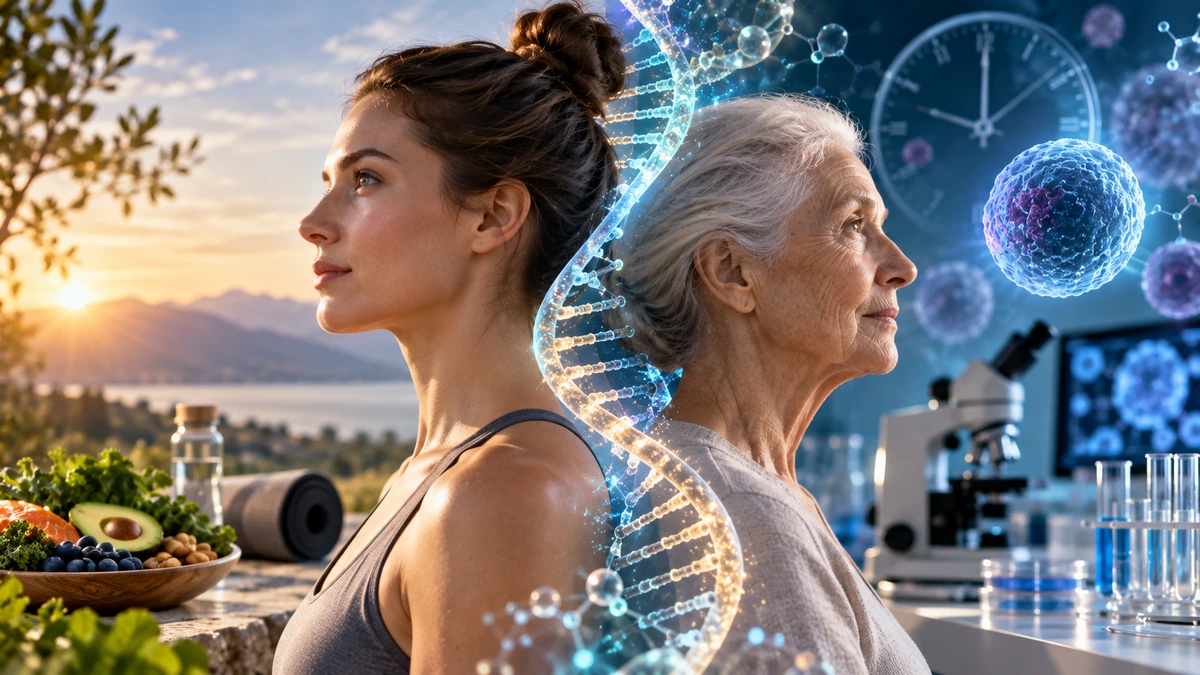
Extending life is one of humanity's oldest ambitions, but modern biology has turned the question into a measurable research program for the first time. Researchers now study not only individual diseases of old age but also processes that raise the probability of many diseases at once: genomic damage, loss of protein quality control, metabolic changes, cellular senescence, chronic inflammation, and other connected mechanisms. This gave rise to geroscience — the attempt to ask whether modifying aging biology can delay multiple diseases and functional decline together.
Yet the phrase "aging medicine" easily slides from research into marketing. A result in yeast, worms, or mice can become a promise for humans; a change in a biomarker can be presented as "rejuvenation"; and a drug approved for another disease can be sold rhetorically as an almost proven longevity treatment. That is why this field demands a strict separation among biological mechanism, clinical signal, and actual evidence that healthy human life has been extended.
The crucial distinction is between lifespan and healthspan. Living longer is not automatically a success if the added years contain more disease, dependency, and loss of function. Geroscience therefore aims not merely to add years but to extend the period in which people remain functional and relatively free of major chronic disease. That is a harder target because it cannot be captured by one number or one laboratory test.
this article therefore does not search for the "best anti-aging treatment" and does not offer medical advice. It examines what is actually known about aging biology, metabolic pathways, senolytics, rapamycin, energy restriction, biological clocks, and partial cellular reprogramming — and, above all, where a promising mechanism ends and a claim begins that human clinical evidence does not yet support.
Aging is not one clock but a network of interacting processes
Modern aging biology has no single accepted "master cause." The updated Hallmarks of Aging framework published in 2023 describes twelve interacting features: genomic instability, telomere attrition, epigenetic alterations, loss of proteostasis, disabled macroautophagy, deregulated nutrient sensing, mitochondrial dysfunction, cellular senescence, stem cell exhaustion, altered intercellular communication, chronic inflammation, and dysbiosis. The framework is a map of research mechanisms, not a diagnostic checklist for an individual.
These processes also overlap. Mitochondrial dysfunction can alter inflammatory signaling; nutrient-sensing pathways influence autophagy; senescent cells can reshape the tissue environment. An intervention in one pathway therefore often produces effects elsewhere, sometimes useful and sometimes harmful. Aging biology is a systems problem, not a single broken component waiting to be replaced.
This also explains why animal results are both essential and insufficient. In laboratory models researchers can control genetics, diet, and environment and directly measure lifespan. Human lives are long, populations are heterogeneous, diseases are multiple, and ethical constraints are much greater. Translation across species is therefore a research step, not an automatic conclusion.
Healthspan is a more meaningful target than counting years alone
The National Institute on Aging frames geroscience around delaying multiple chronic diseases and functional decline by targeting shared mechanisms of aging. In this framework healthspan is the portion of life spent in relatively good health and function, while lifespan is simply the length of life. They are related but not identical.
This distinction blocks one of the most common errors in longevity discussions. A drug can improve one laboratory marker without reducing disease burden. It can delay one disease while increasing another risk. It can improve function for several months without changing lifespan. A clinically meaningful result must therefore ask whether people remain functional longer, develop fewer diseases, or die later — and at what cost in adverse effects.
For the same reason, the broad label "anti-aging" is often less useful than more precise language. An intervention may affect a particular aging mechanism or age-related disease without "stopping aging" as a whole. The broader the claim, the stronger the evidence it requires.
Metabolic pathways: why mTOR, AMPK and nutrient sensing matter
Some of the strongest experimental clues come from pathways that tell cells whether energy and nutrients are sufficient for growth, repair, or conservation. mTOR promotes growth and synthesis, while AMPK and related processes participate in responses to low energy availability. Insulin/IGF-1 signaling, autophagy, and other metabolic regulators are also important. Across multiple organisms, altering these pathways can strongly affect lifespan.
That does not mean one pathway is simply "bad" and another "good." Growth, protein synthesis, immune activity, and tissue repair are necessary. Too much inhibition of a pathway that is useful in one context can be harmful in another. A living organism needs regulation, not permanent maximum conservation.
This is why metabolic targets are both attractive and difficult for pharmacology. A drug can hit a mechanism associated with longevity in mice, but in humans it still must establish an appropriate dose, duration, population, safety profile, and clinically meaningful benefit. Mechanistic plausibility is the beginning of evidence, not its end.
Calorie restriction: the strongest human signal is still not proof of longer life
Energy restriction without malnutrition extends lifespan in several model organisms, but human data do not justify the same conclusion. CALERIE was a two-year randomized trial in 220 healthy adults without obesity in which the intervention group was assigned to reduce energy intake by about 25 percent. The intervention changed several metabolic measures and, in a later analysis, modestly slowed DunedinPACE, a DNA-methylation measure of pace of aging.
The size and meaning of the effect matter. The DunedinPACE change was small, while other epigenetic clocks used in the study, including PhenoAge and GrimAge, did not show significant changes in estimated biological age. The authors themselves emphasized that a decisive test of the geroscience hypothesis will require long-term follow-up of real outcomes such as chronic disease and mortality.
CALERIE is therefore a good example of how to read longevity findings correctly: randomized human data show that some aging-associated biomarkers can be moved. They do not show that the intervention extends human lifespan. Those are different claims.
Rapamycin: extraordinary animal evidence, an open question in healthy people
Rapamycin inhibits mTOR and is one of the most reproducible pharmacological lifespan-extending interventions in mice. That has made it a central geroscience candidate. In medicine, however, it is not an experimental mystery: sirolimus and related drugs are already used in transplantation and some diseases. Their clinical profile therefore also includes known adverse effects that depend on dose and context.
A 2024 systematic review of human studies found improvements in some physiological parameters, particularly in immune, cardiovascular, and integumentary systems, but no general benefit across all organ systems and no demonstration of longer lifespan in healthy humans. A 2025 review reached the same basic boundary: human evidence still does not establish rapamycin as a proven therapy for slowing aging in healthy adults.
This does not mean the research direction is wrong. It means that very strong preclinical biology must be distinguished from much thinner clinical evidence. The statement "rapamycin extends lifespan in mice" is well supported; the statement "rapamycin extends lifespan in healthy people" is not currently established.
Senolytics: removing old cells sounds simple, but the biology is not
Senescent cells are cells that have permanently exited the cell cycle and often change the molecules they secrete. They can accumulate with age and contribute to inflammation and altered tissue environments. In mouse models, selectively removing them has improved function in some conditions and extended healthy life. This inspired senolytics — drugs intended to preferentially eliminate senescent cells.
Early human trials have shown biological signals, but the clinical evidence remains early and heterogeneous. A 2024 review describes mixed results for classical senolytic strategies, while a 2025 Nature Aging commentary notes that initial studies still do not provide clear evidence of efficacy in humans. Senescence is also functionally diverse: it can participate in wound healing, suppression of damaged-cell proliferation, and other useful processes.
The goal is therefore not simply to "remove all old cells." It requires the right target, timing, tissue, and evidence that benefit exceeds risk. The NIA has repeatedly cautioned that senolytics are not yet established as a clinical anti-aging intervention outside research settings.
Biological clocks measure patterns, not the number of years you have left
Epigenetic clocks use DNA-methylation patterns and statistical models to estimate chronological age, health risk, or the pace of some age-related changes. They have become extremely useful in population research because they allow researchers to track biological differences far sooner than waiting decades for disease or death.
But a clock is not a direct sensor of "how much aging" is present. Different clocks are trained for different targets, use different tissues, and have different sensitivities. Reviews from 2025 and 2026 highlight challenges involving generalization, uncertainty, technical variation, and interpretation. A model that predicts risk well across a population is not automatically accurate enough for decisions about one person.
The key methodological issue is surrogacy. If an intervention moves an epigenetic clock by two years, researchers must still show that the change predicts fewer diseases, better function, or longer life. A biomarker can accelerate research; it cannot substitute for a clinical endpoint until it has been validated for that purpose.
Partial cellular reprogramming: the most radical promise carries major unresolved risks
Partial reprogramming temporarily activates factors associated with induced pluripotency in an attempt to produce some more youthful molecular features without erasing cell identity. In cell culture and animal models, researchers have reported changes in epigenetic patterns, improved regeneration, and some functional benefits. That has made the field one of the most visible frontiers of longevity research.
The same biology that gives reprogramming its power also creates risk. Excessive or poorly controlled activation can produce loss of cellular identity, abnormal growth, or tumorigenesis. Reviews published from 2024 through 2026 therefore emphasize delivery, tissue specificity, timing, dose control, and long-term safety.
The claim that partial reprogramming can change some aging-associated features in cells or animals is well grounded. The claim that we have a proven method for safe systemic rejuvenation in humans is not. A large translational gap still separates those statements.
Why mice move faster than medicine
Aging research almost inevitably produces dramatic results first in short-lived organisms. A mouse experiment can measure an entire lifespan within a few years; the equivalent human endpoint would take decades. Researchers therefore rely on intermediate outcomes: physical function, multimorbidity, frailty, immune responses, metabolism, and biomarkers.
Faster endpoints also create more room for error. An intervention may improve a marker that is not causal; a result may depend on sex, genetics, or laboratory environment; an effect in a model without multiple diseases and medications may change in an older human with multimorbidity. And an intervention that extends animal lifespan may still be unacceptable if it causes frequent infection, metabolic complications, or worse quality of life in people.
Good translational medicine therefore moves more slowly than the longevity market would like. It requires replication, phased clinical trials, adequate follow-up, appropriate control groups, and transparent reporting of adverse events. That is not bureaucratic obstruction; it is how promise is separated from therapy.
What would count as a real breakthrough in aging medicine?
A real breakthrough would not be only a lower biological-clock score or a longer-lived mouse. In well-designed human studies it would need to show that an intervention safely reduces the incidence of several age-related diseases, preserves physical or cognitive function, reduces frailty, or ultimately extends life without an unacceptable burden of adverse effects.
It would also need a clear answer to the question of who benefits. The biology of an eighty-year-old is not simply an older version of the biology of a forty-year-old; sex, genetics, disease, medications, immune status, and living environment can change the balance of benefit and risk. A universal "anti-aging pill" is therefore a much stronger claim than a targeted treatment for a particular aging mechanism in a defined population.
The most defensible conclusion is both optimistic and restrained. Aging is biologically plastic: it can be modified in animals, and in humans researchers can already measure changes in some processes and biomarkers. That is real scientific progress. But we have not yet established that a currently available geroscience intervention reliably extends the lives of healthy people. Aging medicine is therefore a legitimate research field — not yet a fulfilled promise of longevity.
Sources and further reading
- THY-REALITY — Transhumanizem: od zdravljenja do preoblikovanja človeka / Transhumanism: From Healing to Transforming the Human Being (LOCKED): distinction between therapy, enhancement and claims about human transformation.
- THY-REALITY — CRISPR in urejanje genoma: zdravljenje, dedovanje in meja posega / CRISPR and Genome Editing (LOCKED): translational boundary between mechanism, therapy and inherited intervention.
- National Institute on Aging — Trans-NIH Geroscience Interest Group: geroscience, aging physiology, multimorbidity and healthspan.
- López-Otín, C.; Blasco, M. A.; Partridge, L.; Serrano, M.; Kroemer, G. — Hallmarks of aging: An expanding universe. Cell 186 (2023): 243–278.
- National Institute on Aging — Live Long in Good Health: Could Calorie Restriction Mimetics Hold the Key? Human lifespan evidence and anti-aging hype boundary.
- Waziry, R. et al. — Effect of long-term caloric restriction on DNA methylation measures of biological aging in healthy adults from the CALERIE trial. Nature Aging 3 (2023): 248–257.
- Lee, D. J. W.; Hodzic Kuerec, A.; Maier, A. B. — Targeting ageing with rapamycin and its derivatives in humans: a systematic review. Lancet Healthy Longevity 5 (2024): e152–e162.
- Hands, J. M. et al. — What is the clinical evidence to support off-label rapamycin therapy in healthy adults? Aging 17 (2025): 2079–2088.
- Lelarge, V. et al. — Senolytics: from pharmacological inhibitors to immunotherapies, a promising future for patients’ treatment. npj Aging 10 (2024): 12.
- Khosla, S.; Monroe, D. G.; Farr, J. N. — Towards a personalized approach in senolytic trials. Nature Aging 5 (2025): 1926–1929.
- National Institute on Aging — Does cellular senescence hold secrets for healthier aging? Human-safety and translation caution for senolytics.
- Teschendorff, A. E.; Horvath, S. — Epigenetic ageing clocks: statistical methods and emerging computational challenges. Nature Reviews Genetics 26 (2025): 350–368.
- From population science to the clinic? Limits of epigenetic clocks as personal biomarkers. 2025: individual-level clinical utility and interpretation limits.
- Do we actually need aging clocks? npj Aging (2025): uncertainty estimation and limits of applicability.
- Rose, M.; Adashi, E. Y. — Targeted partial reprogramming as a novel therapeutic strategy for age-related decline. Ageing Research Reviews 108 (2025): 102731.
- Avelar, R. A. et al. — Conserved biological processes in partial cellular reprogramming: relevance to aging and rejuvenation. Ageing Research Reviews 108 (2025): 102737.
- The long and winding road of reprogramming-induced rejuvenation. Nature Communications (2024): safety, dedifferentiation and translation limits.
- National Institute on Aging — Are You Developing Drugs That Target Aging Mechanisms? NIA Wants to Hear from You. March 2026: translational barriers for drugs targeting aging-related conditions.
- National Institute on Aging — The epigenetics of aging: What the body’s hands of time tell us. Research promise and caution against unsupported anti-aging claims.