How Many Deaths Lie Behind U.S. Presidents’ Orders?
When a president authorizes a military operation, the decision can sometimes be summed up in a single sentence.
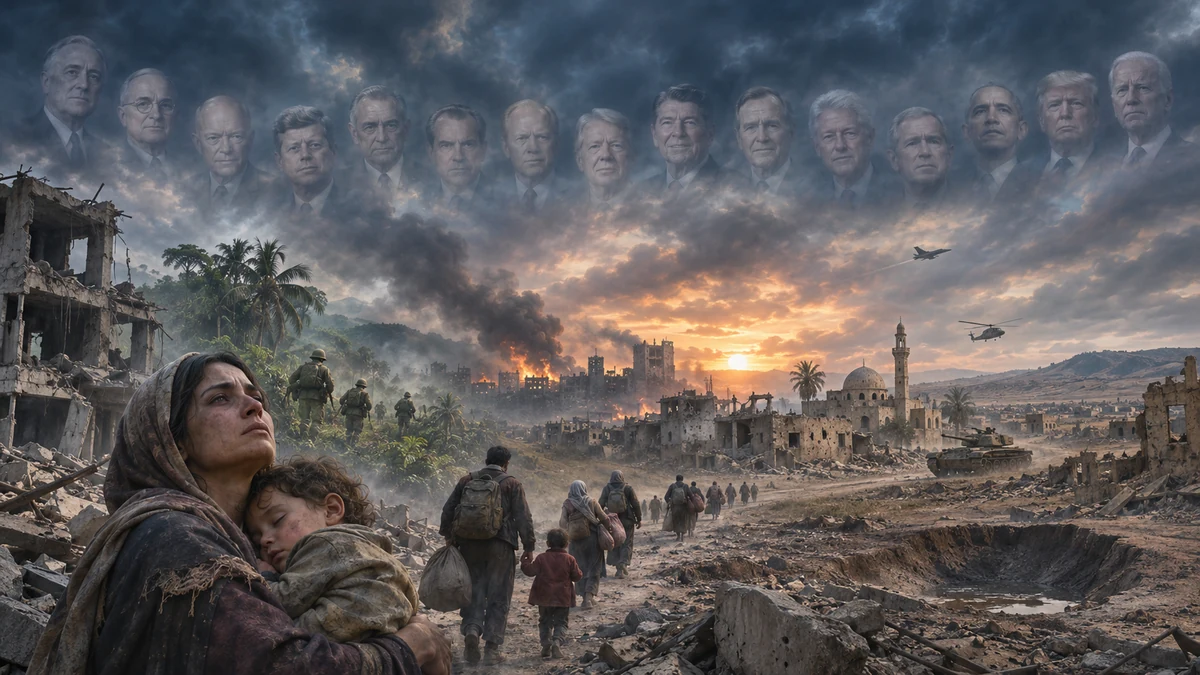
Editorial illustration.
From Firestorms and Atomic Bombs to Invasions, Secret Wars, and Drones
When a president authorizes a military operation, the decision can sometimes be summed up in a single sentence. Its consequences cannot. Between a decision made in the White House and a person dying in a destroyed home, a hospital, on a road, or on a battlefield, there may be a long chain of orders, commands, and decisions. American forces, allies, local armed groups, and adversaries all play a part in that chain. Sometimes a war outlasts a president’s term in office; sometimes its consequences outlast the war itself.
The question in the title is therefore both necessary and dangerously simple. Necessary, because those who wield the power to use lethal force must be held accountable for their decisions. Dangerously simple, because it would be easy to attribute every death in a particular country to one person without knowing which deaths resulted from that person’s orders, which were caused by other actors, and which arose from the conflict’s long-term consequences.
This series does not rank presidents by the number of people killed. It asks what can demonstrably be linked to a presidential decision, what force was used, and what we actually know about its human consequences. When the historical record does not permit an honest total, the right answer is unknown, not a figure that merely creates an illusion of precision.
A Decision Is Not the Same as Every Individual Strike
The president of the United States holds extraordinary political and command authority, but that does not mean personally choosing every target. A president may authorize the start of a war, a change in strategy, a covert program, a military action, or the use of a particular form of force. Military commanders may then decide when, where, and how each individual strike is carried out. In other cases, documents show that a president became directly involved in a specific operation.
To distinguish these situations, we use three levels:
- P1 — direct presidential decision or authorization. A sufficiently specific document, statement, record of a conversation, or other piece of evidence shows that the president authorized a particular operation, the beginning of a campaign, or a significant escalation. Even P1 does not automatically mean that the president personally selected every subsequent target.
- P2 — a presidentially approved policy or campaign framework. The president determines the direction and continuation of policy, while many concrete operational decisions are delegated to military commanders. Presidential responsibility must therefore be established at the level of policy and the campaign, rather than assumed to involve a personal order for every individual death.
- P3 — operational or tactical execution. The evidence concerns an individual strike, target selection, an intelligence assessment, or action on the ground. P3 may occur within a policy established at P1 or P2, but it does not, by itself, prove either level.
This distinction is not an excuse for political decision-makers. Anyone who initiates or sustains a campaign bears responsibility for its direction, oversight, foreseeable dangers, and response to warnings. But political responsibility for a campaign and evidence of a personal order for a specific strike are not the same claim. If we lose that distinction, we also lose the ability to describe precisely what each person actually did.
Our research therefore gives priority to documents produced at the time: presidential statements, operational orders, disclosed diplomatic records, investigative reports, and other verifiable evidence. Later memoirs and political explanations matter, but we do not automatically treat them as the final word. For example, the documentary trail leading to the decision to use atomic weapons in 1945 is more complex than the simplified image of a single president’s signature. Both Truman’s role and the actual sequence of military instructions matter. [1][2]
The Scale of Force Tells Us Much — but Not How Many People Died
Historical records measure bombing in tons of bombs dropped, aerial campaigns in combat sorties, missile strikes in missiles launched, ground operations by the number of units involved, and the course of a war by the extent of territory controlled at different points in time. These are important measures. They tell us how much military force was employed, for how long, and under whose command.
None of these measures, however, directly measures deaths. A ton of bombs from the Second World War is not comparable to a single modern guided missile. A sortie count does not tell us whether an aircraft attacked a target; a target count does not tell us whether civilians were present. The same quantity of weapons can have vastly different consequences depending on population density, warnings, target selection, civilian protection, and access to medical care.
For that reason, throughout this series we do not add up tons, sorties, missiles, and strikes to produce an artificial single measure of destruction. We present figures for the force used separately from figures for deaths. Where sources permit comparisons, we also explain when each estimate was made and precisely what it covers.
One War, Several Different Categories of Death
The greatest methodological mistake would be to label everyone who died in a conflict a victim of the U.S. military — or, without further evidence, to attribute everyone killed by an American strike to a direct presidential order. To help readers navigate the series, we use the following distinctions:
| Label | What it means | What we must not infer |
|---|---|---|
| DIRECT-US | A death is demonstrably linked to the direct actions of U.S. forces. | That the president personally selected the target or authorized the individual strike. |
| US-LED/COALITION | A death is linked to an operation by a U.S.-led coalition, where the force that directly carried out the relevant action cannot always be reliably identified. | That a U.S. unit necessarily caused the death. |
| NATO/COALITION | A death is linked to a wider multinational operation; the actual command arrangements also matter. | That all consequences are exclusively American. |
| INDIRECT/MULTICAUSAL | Indirect consequences, such as the breakdown of healthcare, supplies, or other systems essential to life, arise through multiple causal pathways. | That all such deaths can be attributed to one order or one country without further analysis. |
| LEGACY | Consequences that persist after an attack or the end of a war, such as unexploded ordnance. | That these deaths can be added to previously counted fatalities without checking for overlap. |
| OTHER-ACTOR | Deaths caused by other forces: adversaries, local partners, or other armed groups. | That they become deaths directly caused by U.S. forces simply because they occurred in the same war. |
These categories are not legal verdicts on culpability. They are a way of avoiding confusion between who caused the harm, the political framework, and the wider historical context. We also distinguish military from civilian deaths where possible, and the dead from the wounded. If a report combines deaths and injuries, we must not present that figure as a death toll.
There is another danger: double counting. An individual incident may already be included in a regional estimate, which in turn forms part of a total for an entire war. We cannot then add the incident again as a separate set of deaths. The same applies when different organizations investigate the same strike: two reports do not necessarily represent two different groups of people killed. When estimates form a range, we must not arbitrarily select the highest figure simply because it is the most shocking, or the lowest because it is more politically convenient.
When the available evidence cannot be tied to a particular operation, it is more honest to retain the broader category. When an estimate is contested, we explain who produced it, on what basis, and why it differs from another estimate. When data are poor or incomplete, the most important information may be the limits of what we know.
Examples That Show Why the Distinctions Matter
Hiroshima and Nagasaki in 1945 show why political decisions, military execution, and different timeframes for deaths must be kept separate. For Hiroshima, the city authorities estimate that approximately 140,000 people had died by the end of 1945; that is not the number who died at the moment of the explosion, nor is it a count of civilians alone. Such a figure has its own location, timeframe, and methodology. The presidential decision to use atomic weapons can be investigated separately from the question of how many people died and when. [1][3]
Cambodia in the late 1960s and the 1970s illustrates a different relationship. Documents concerning the bombing and secret decision-making permit a much more specific assessment of certain authorizations by Nixon. But it does not follow that every death in the subsequent Cambodian civil war or under the Khmer Rouge was a direct victim of American bombs. The question of American responsibility is serious precisely because it must not be confused with the overall death toll from crimes committed by other actors and from other causes. [4]
The invasion of Iraq in 2003 offers a clear public presidential statement that the war began on George W. Bush’s orders. This is strong evidence of a decision to use force. It does not, on its own, tell us how many individual deaths can be attributed to a particular strike, a coalition partner, later armed groups, or the indirect consequences of the state’s collapse. Such claims require additional evidence, not merely the president’s statement. [5][6]
The battles for Mosul and Raqqa remind us to distinguish U.S. leadership of a coalition, the forces that actually carried out specific strikes, and civilian deaths caused by other armed actors. Independent investigations of civilian harm may uncover incidents omitted from official assessments. Their scope, criteria for confirming incidents, and period of investigation must also be examined. [7][8]
The strike in Kabul on August 29, 2021 reveals another important distinction: the U.S. Department of Defense later acknowledged that a strike based on a mistaken assessment killed ten civilians. The evidence identifying the U.S. as the actor responsible is different from evidence that President Biden personally selected the vehicle or authorized that exact target. The tragic outcome is documented; the degree of presidential involvement must be established separately. [9]
These examples are not exhaustive analyses. Each has its place in the articles of the series, where the broader historical context, documents, disputed estimates, and counterarguments are examined.
Inherited Wars, Coalitions, and the Responsibility of Successors
Presidential terms have clear dates. Wars often do not. Roosevelt died in 1945 in the midst of a war that Truman then led. Eisenhower inherited the Korean War from Truman. Over the decades, the Vietnam War passed through several administrations. One president may decide to begin a conflict, while a successor decides whether to continue it, escalate it, change its objectives, or withdraw.
If we attribute every death in a multiyear war solely to the president who began it, we may obscure the decisions of that president’s successors. If we divide the deaths simply by the calendar dates of presidential terms, we may hide the fact that a president inherited an operation already underway. The political decision to begin a war, its continuation, changes in strategy, and tactical execution are distinct subjects of assessment.
Even within a coalition, the leading state does not necessarily have direct control over every action undertaken by its partners. And when the U.S. government arms, funds, or supplies intelligence to local forces, we must investigate the documented extent of its influence. Such support may raise serious questions of political and moral responsibility, but it is not automatic proof that the U.S. president ordered every act committed by those receiving the assistance. The reverse is equally true: the fact that a partner directly carries out an operation does not, by itself, remove responsibility from those who planned or directed it.
How We Read Sources and Conflicting Estimates
A presidential statement may confirm that an operation was authorized, but it cannot by itself establish all its effects. A military report may describe the weapons used and intended targets in detail, yet apply different criteria for civilian casualties than an independent organization. Witnesses may describe events on the ground without knowing the full chain of command. A historian may explain a broader pattern, but cannot replace a missing primary document.
For that reason, we distinguish documented decisions, official claims, independent estimates, and open questions when assessing key assertions. We read American archives and military records critically, rather than rejecting them automatically. We apply the same scrutiny to evidence from nongovernmental organizations, affected countries, local authorities, and political opponents. What matters is not an institution’s reputation but the quality of the specific evidence it provides. [7][8][10]
Reports on wars are frequently revised. Deaths documented later, a change in how an incident is classified, or a newly released document can alter an estimate. The difference between a minimum confirmed number and a broader statistical estimate also matters. The same caution applies to alleged causal links: the fact that an event followed a decision does not in itself establish that the decision was its sole cause.
The research cutoff for this edition is September 25, 2026. This matters especially for the most recent article, on Donald Trump’s second term: its descriptions of operations reflect the documented information available through that date, not predictions of how their consequences, investigations, or casualty estimates will develop. Later findings belong in a clearly identified update, not in a silent rewrite of the original research record.
Ten Articles, Four Historical Periods
Readers can begin here or go directly to an individual period. Each article stands on its own; together, they show how weapons, legal arguments, decision-making processes, and the distance between a presidential decision and the battlefield have changed over the decades.
I. Total War and the Cold War
US-01 — From Total War to Korea — Roosevelt, Truman and Eisenhower. From the mass aerial bombing of the Second World War and the atomic bombs to the Korean War: presidential decisions, military strategy, and the consequences for civilians.
US-02 — Vietnam, Laos and Cambodia — Kennedy, Johnson and Nixon. The escalation of war, covert operations, the president’s role in bombing campaigns, and the problem of assessing deaths that cannot simply be attributed to a single campaign.
US-03 — After Vietnam — Ford, Carter and Reagan. The Mayaguez operation, covert forms of intervention, Lebanon, Grenada, and Libya, as well as the differences between direct strikes and support for other forces.
II. The New World Order and U.S. Interventions
US-04 — George H. W. Bush — Panama and the Gulf War. Large-scale military operations, U.S.-led coalitions, the destruction of infrastructure, and both immediate and later consequences.
US-05 — Bill Clinton — War Without a Major Ground Invasion. Missile strikes, bombing campaigns, Iraq, and Kosovo: what changes when the use of force relies primarily on air and missile campaigns.
III. The War on Terror and Remote Warfare
US-06 — George W. Bush — Afghanistan, Iraq and the War on Terror. Two major wars, the arguments used to justify them, their long-term consequences, and the exceptionally difficult task of distinguishing deaths caused by direct attacks from those arising through other causes.
US-07 — Barack Obama — The Surge, Drones, Libya, and Remote Warfare. The expanded use of targeted strikes, coalition operations, and the question of how much control over an individual strike can be attributed to the president.
IV. Contemporary U.S. Wars and Presidential Responsibility
US-08 — Donald Trump — From MOAB to Soleimani. Inherited wars, strikes in Syria and other countries, targeted operations, and the distinction between presidential orders and wider violence.
US-09 — Joe Biden — Withdrawal from Afghanistan and a New War from Afar. The decision to withdraw, the catastrophe and civilian harm in Kabul, subsequent counterterrorism strikes, and responses to regional escalations.
US-10 — Donald Trump II — The Use of Force, 2025–2026. An overview of documented decisions and unresolved estimates through September 25, 2026, where the proximity of events calls for particular caution.
Responsibility Is Not Just an Accounting of Deaths
Investigating death tolls is essential, but it does not answer every question. Even a strike with few documented fatalities may be politically or legally contested. Conversely, a defensive war may claim many lives without it being fair to attribute every death automatically to the decision-maker who entered the conflict after an attack by another party. The legality of resorting to force, the rules governing warfare, political judgment, and moral responsibility overlap, but they are not interchangeable.
The moral premise of this series is simple: a human life is not worth less because the person died on the “other side,” far from cameras, or in a war that an official document describes as a successful operation. The same standard applies to victims of American forces, their allies, and their adversaries. But respect for victims also demands accuracy. A death attributed to the wrong actor does not redress a historical injustice; it can obscure who was actually responsible.
That brings us back to three questions: Who made the decision? What force was used? What do we truly know about the deaths? Sometimes the answer is clear and documented. Sometimes there is only a range of estimates or one of several interpretations. Sometimes the most honest conclusion is that there is not enough evidence. This is not an abandonment of accountability; it is a prerequisite for establishing it at all.
Sources and further reading
- Harry S. Truman Presidential Library & Museum, The Decision to Drop the Atomic Bomb Source
- National Security Archive, The Atomic Bomb and the End of World War II (document collection) Source
- City of Hiroshima, official historical information and estimates of casualties from the atomic bombing Source
- Office of the Historian, Foreign Relations of the United States, document concerning authorizations for Operation Menu in March 1969 Source
- George W. Bush White House Archives, presidential statement at the beginning of the Iraq War, March 19, 2003 Source
- Human Rights Watch, Off Target: The Conduct of the War and Civilian Casualties in Iraq, 2003 Source
- Airwars, research records on coalition strikes in Iraq and Syria Source
- Amnesty International, reporting on the joint investigation with Airwars into civilian deaths in Raqqa, 2019 Source
- U.S. Department of Defense, official acknowledgment of ten civilian deaths in the Kabul strike of August 29, 2021 Source
- United Nations Assistance Mission in Afghanistan (UNAMA), Afghanistan: Protection of Civilians in Armed Conflict — Annual Report 2019 Source