Mosquitoes as Antigen Delivery Systems: Research, Technology, and the Boundary of Consent
The “flying vaccinator” concept has already been demonstrated in the laboratory, and humans have been immunized by mosquito bites in controlled research. What is actually proven, what is already implemented with modified mosquitoes, and where does the open question of future or covert use begin?
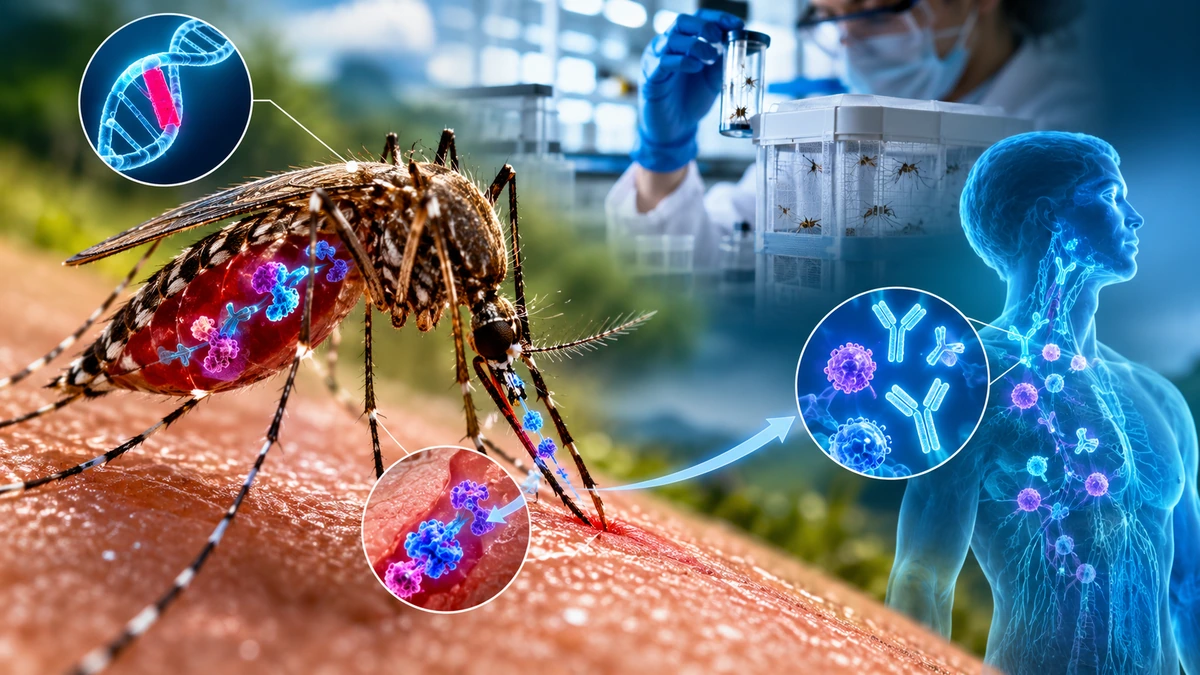
The idea that a mosquito could become a carrier of an immunologically active substance is not merely an online speculation. In 2010, a peer-reviewed study described genetically modified mosquitoes whose salivary glands expressed a Leishmania vaccine-candidate antigen; repeated bites induced an antibody response in mice. The authors themselves called the concept a “flying vaccinator.”
This does not mean that a public programme currently exists in which released mosquitoes mass-vaccinate people. It means something more precise: the basic biological principle has been experimentally demonstrated, while separate technical components have continued to develop in other research programmes.
Humans have also been immunized through mosquito bites in controlled clinical research, although by a different mechanism: mosquitoes delivered genetically attenuated malaria parasites. That is not the same as engineering the mosquito itself to secrete a chosen antigen in saliva, but it directly demonstrates that mosquito bite can function as a delivery route for immunizing material in a medical experiment.
The article therefore will not close the subject with the label “myth.” It will separate three questions: what has already been done in laboratories and clinical trials, what has already been implemented in mass releases of modified mosquitoes for other purposes, and what evidence would be required before a covert or future antigen-delivery programme in humans could be claimed. The central ethical boundary is consent: technological possibility and legitimate use are not the same thing.
The idea is not an internet fantasy: the 2010 “flying vaccinator”
In 2010, Daigo Yamamoto, Hitoshi Nagumo and Shigeto Yoshida described a transgenic Anopheles stephensi mosquito whose salivary glands expressed SP15, a candidate protective antigen derived from the saliva of the sand fly Phlebotomus papatasi. The protein was engineered for secretion into saliva during blood feeding.
Mice repeatedly bitten by these mosquitoes developed antibodies against SP15. The authors therefore presented the work as a proof of principle for the “flying vaccinator” concept. The evidentiary boundary is clear: the study did not demonstrate effective human vaccination or a field programme, but it did show that mosquito salivary glands can be genetically programmed to secrete a foreign antigen that induces an immune response after biting.
The same paper explicitly raised the problems that prevented the authors from recommending the technology as a public-health delivery method: dose control, medical safety, public acceptance, and informed consent. The controversy was therefore already present in the original scientific literature; it was not invented later by social media.
What was demonstrated—and what the experiment did not demonstrate
A proof of principle is narrower than an operational public-health system. The researchers showed antigen expression and secretion and a serological response in mice. They did not show standardized dose per bite, controlled exposure in an open environment, long-term human safety, clinical protection, or the ability to recall exposure once mosquitoes had been released.
This distinction allows two statements to be true at the same time: the technology is real and the technology is not thereby ready or acceptable for population use. Denying the first ignores published evidence; skipping the second turns a laboratory result into a claim about an existing programme.

Not every antigen works: a second experiment exposed a technical limit
In a related study, researchers generated Anopheles stephensi expressing the malaria circumsporozoite protein (CSP) in their salivary glands. Expression was confirmed, but mice did not develop the expected antibodies after repeated bites. The researchers concluded that the CSP had not been properly secreted into saliva.
That failure is an important counterweight to sensational interpretations. Genetic insertion does not automatically create an effective delivery system. Promoter choice, secretion, protein stability, quantity, immune presentation and reproducibility all matter. Future applicability is therefore a research problem rather than an automatic consequence of genetic engineering.
Humans have already been immunized by mosquito bites—but in a different system
Malaria research uses another route: the mosquito is not engineered to manufacture an arbitrary antigen, but carries genetically attenuated *Plasmodium falciparum* parasites. In controlled clinical trials, volunteers have received dozens or even roughly two hundred bites from infected laboratory mosquitoes per immunization.
In the PfGAP3KO study, participants received three or five immunizations involving roughly 200 bites per session; half of vaccinated participants remained free of blood-stage malaria after later controlled challenge. Later GA2 studies used 50 bites per immunization, and a study published in 2025 reported protection in nine of ten participants after a single immunization with 50 infected mosquitoes in a small trial.
These studies took place under strict clinical control and written informed consent. Their relevance is specific: the statement that mosquitoes have never been used as a route of human immunization is false. They do not, however, demonstrate open-field vaccination of a population.
This is not the same as a mosquito that manufactures a vaccine in its saliva
At least three technologies must be separated. The first is a transgenic mosquito that secretes a foreign antigen in saliva—the Yamamoto proof of principle. The second is a mosquito acting as the natural carrier of a laboratory-attenuated parasite, as in controlled malaria trials. The third consists of genetically modified or Wolbachia-carrying mosquitoes used to suppress vector populations or reduce disease transmission.
Online discussion often collapses these systems into one. The release of millions or billions of modified mosquitoes for population control does not mean those mosquitoes were delivering vaccines. Conversely, the population-control purpose of field programmes does not erase the separate laboratory proof that mosquitoes can be engineered to secrete an antigen in saliva.
Mass releases of modified mosquitoes are already real
The operational capacity to breed and release modified mosquitoes at scale is not hypothetical. In 2024, the CDC described successful use of genetically modified Aedes aegypti in Brazil, the Cayman Islands, Panama and India and stated that more than one billion mosquitoes had been released since 2019. In the United States, EPA authorized experimental Oxitec OX5034 releases in Florida; that permit later expired, and in May 2026 EPA stated that no new releases were then authorized in the United States.
The declared purpose of these programmes was mosquito population suppression, not human vaccination. From an infrastructure perspective, however, they demonstrate that industrial production, genetic marking, distribution logistics, monitoring and regulatory approval of large field releases are practical realities.
The future question is therefore no longer whether mosquitoes can be mass-produced and distributed over a defined area. The documented question is which engineered traits would be safe, lawful and ethically acceptable in such populations.
Why regulators care about what appears in the saliva of an engineered female mosquito
In 2025, the U.S. EPA released material for expert review on genetically engineered mosquitoes that included analytical approaches for demonstrating the absence of novel proteins in the saliva of engineered female mosquitoes. This is not evidence of a vaccination programme; it is a safety-assessment issue for organisms that might express new proteins.
The point is still significant. The biological route underlying the “flying vaccinator” concept is real enough to be addressed explicitly in regulatory evaluation. If an engineered female expresses a novel protein in saliva, a bite can become an exposure to a biologically active molecule. Independent verification of such traits is therefore relevant even when the declared programme objective is not medical delivery.
The central problem is not only safety but consent and dose
Conventional vaccination identifies the recipient, dose, batch, contraindications and medical record. A free-flying biological vector makes individual exposure much harder to control. The authors of the 2010 proof-of-principle study themselves identified dosage and informed consent as central obstacles to public-health use.
WHO guidance for genetically modified mosquitoes used in vector control emphasizes safety, governance and meaningful community engagement. For area-wide interventions, individual consent from every resident may not be practical, so ethical governance may rely on community-level processes. Deliberately delivering an antigen to alter an individual immune response, however, would be qualitatively closer to a medical intervention than ordinary vector suppression.
This is where the controversy becomes most acute. Even if a future system were effective and medically safe, a separate question would remain: is it acceptable to design a medical exposure in which an individual cannot reliably know when it occurs, how much is received, or whether it can be avoided? Technical feasibility does not answer that ethical question.
Does a covert human-vaccination programme exist today?
The public sources reviewed for this article do not provide verifiable evidence of an open-environment programme intentionally releasing mosquitoes to covertly deliver vaccines or antigens to humans. None of the reviewed regulatory records, clinical trials or scientific papers documents such an operation as an existing public programme.
That statement is not equivalent to “such a programme could not possibly exist.” The absence of a public document cannot prove the nonexistence of every secret activity. The same methodological boundary therefore applies as in other sensitive topics: lack of public admission is not proof of innocence, but a covert programme cannot be presented as fact without traceable evidence.
A serious investigation of such a hypothesis would require different evidence: transgene sequences in captured mosquitoes, proteomic analysis of saliva, unexpected regulatory or procurement records, manufacturing traces, laboratory documentation and independently reproducible field samples. That evidentiary threshold is far higher than a photograph of a mosquito or an isolated patent reference.

Could this become a future reality?
Several building blocks already exist: salivary-gland-specific expression of foreign proteins in transgenic mosquitoes, immune responses in animals after biting, human immunization by infected laboratory mosquitoes, and industrial-scale production and field release of modified mosquitoes. It is therefore reasonable to say that the concept is not biologically unimaginable.
Combining those components into a public antigen-delivery programme would still require solutions for dose, targeting, expression stability, spread of engineered traits, non-target exposure, ecological effects, accountability, reversibility and consent. None of the sources reviewed shows that such an integrated system is currently ready for routine human use.
A related frontier—self-disseminating vaccines—is being explored mainly for wildlife in order to reduce zoonotic reservoirs. The literature itself notes that the inability to obtain individual consent creates a fundamental barrier to considering transmissible vaccines for humans. This confirms that autonomous biological delivery is an active scientific idea, while human application raises a substantially different ethical problem.
Evidence matrix: what is already real and where the open question begins
| Documented stage | What has actually been shown | What does not yet follow |
|---|---|---|
| Yamamoto et al. 2010 — “flying vaccinator” | A transgenic mosquito secretes a foreign antigen in saliva; bites induce antibodies in mice | Does not show safe or effective open-field human vaccination |
| Transgenic CSP mosquito, 2010 | A malaria antigen can be expressed in mosquito salivary glands | Expression alone does not ensure secretion or immunization |
| PfGAP3KO / GA2 clinical trials | Consenting humans have been immunized via mosquito bites carrying attenuated parasites | Mosquitoes were not engineered to secrete an arbitrary vaccine antigen |
| Oxitec and other field releases | Mass production and field release of modified mosquitoes are operationally feasible | The declared purpose is population control, not medical delivery |
| EPA 2025 — novel salivary proteins | Regulators explicitly consider novel proteins in saliva of engineered females | Does not show that such a protein is a vaccine or that an immunization programme exists |
| WHO ethics framework | Area-wide vector interventions require governance, safety and community engagement | Does not automatically resolve the ethics of deliberately changing an individual immune response |
| Self-disseminating vaccines for wildlife | Autonomous spread of immunization is an active research field | Reviewed programmes are not covert human-vaccination programmes |
| Covert-programme hypothesis | Existing technical components make the question scientifically testable | Without biological samples, documents or an operational chain, the programme is not demonstrated |
The central finding is therefore twofold. First: the idea of a mosquito as a biological delivery system for an immunologically active substance has already been experimentally realized, and humans have been immunized through mosquito bites in controlled trials. Second: this does not establish that a public or covert mass programme currently vaccinates humans through released mosquitoes.
The open question is more precise—and more important—than a slogan: once the basic components have been demonstrated and mass releases of modified mosquitoes are operationally possible, what technical, legal and social safeguards are necessary to ensure that the boundary between vector control and non-consensual medical exposure can never be crossed without the knowledge and agreement of affected people?
Sources and further reading
- Yamamoto, Nagumo & Yoshida, Insect Molecular Biology (2010), ‘Flying vaccinator; a transgenic mosquito delivers a Leishmania vaccine via blood feeding’ — primary proof-of-principle study of antigen secretion in mosquito saliva and antibody induction in mice; also explicitly discusses dosage and informed-consent barriers.
- PubMed record for Yamamoto et al. (2010) — indexed abstract and bibliographic confirmation of the ‘flying vaccinator’ experiment.
- Yoshida et al. — Production of a transgenic mosquito expressing circumsporozoite protein in the salivary gland of Anopheles stephensi — proof that expression can be achieved while immunization can still fail if secretion is inadequate.
- Vaughan et al., genetically engineered PfGAP3KO malaria parasite vaccine — controlled human immunization via roughly 200 infected mosquito bites per vaccination and subsequent challenge testing.
- New England Journal of Medicine — Safety and Efficacy of Immunization with a Late-Liver-Stage Attenuated Malaria Parasite — GA2/GA1 controlled human trial using mosquito-bite immunization.
- Roozen et al., Nature Medicine (2025) — single GA2 immunization delivered by 50 infected mosquitoes; 9 of 10 participants protected in a small controlled trial.
- CDC — Genetically Modified Mosquitoes (2024) — official overview of GM Aedes population-control programmes, including large-scale releases and regulatory context.
- U.S. EPA (2022) — extension and expansion of Oxitec OX5034 experimental-use testing for mosquito population suppression.
- U.S. EPA (2026) — fact check stating the prior experimental-use permit expired in 2024 and no GE mosquito releases were then authorized in the United States.
- U.S. EPA (2025) — peer-review material on genetically engineered mosquitoes, including analytical approaches to determine the absence of novel proteins in saliva of GE female mosquitoes.
- WHO (2020), Evaluation of genetically modified mosquitoes for the control of vector-borne diseases — position statement emphasizing staged evaluation, governance, health and ecological assessment.
- WHO (2021), Guidance framework for testing genetically modified mosquitoes, 2nd edition — safety, efficacy, regulatory and social/ethical framework for GMM research and field testing.
- WHO (2020), Ethics and vector-borne diseases — guidance on informed consent, community engagement and ethical issues in vector-control research.
- Resnik, Development World Bioethics (2018), Ethics of community engagement in field trials of genetically modified mosquitoes — discusses why individual consent may be impracticable in area-wide field trials and why community engagement is essential.
- NIH / Lancet phase 1 AGS-v trial (2020) — humans were vaccinated by injection with mosquito-salivary peptides and later exposed to controlled mosquito feeding; relevant to the separate field of vector-saliva immunology.
- AGS-v PLUS phase 1 trial (2022) — further human research targeting mosquito salivary proteins, administered conventionally rather than by mosquito delivery.
- Nuismer & Bull, Nature Ecology & Evolution (2020), Self-disseminating vaccines to suppress zoonoses — research roadmap for autonomously spreading vaccines in wildlife reservoirs.
- Sandbrink et al., Nature Ecology & Evolution (2021), Safety and security concerns regarding transmissible vaccines — highlights evolutionary, biosafety and governance concerns in self-disseminating vaccine research.
- Streicker et al., Science / USGS (2024), Developing transmissible vaccines for animal infectious diseases — current research framework stressing that lack of individual consent prevents consideration of transmissible vaccines for human use.
- WHO/TDR (2003), Ethical, legal and social issues of genetically modified disease vectors in public health — early governance analysis of intentional release of genetically modified vectors.
- WHO/TDR (2010), Progress and prospects for the use of genetically modified mosquitoes to inhibit disease transmission — documents long-running international planning for GM mosquito technologies.
- CDC — Mosquitoes with Wolbachia — official description of a distinct population-control technology, useful for separating vector-control releases from antigen-delivery concepts.